
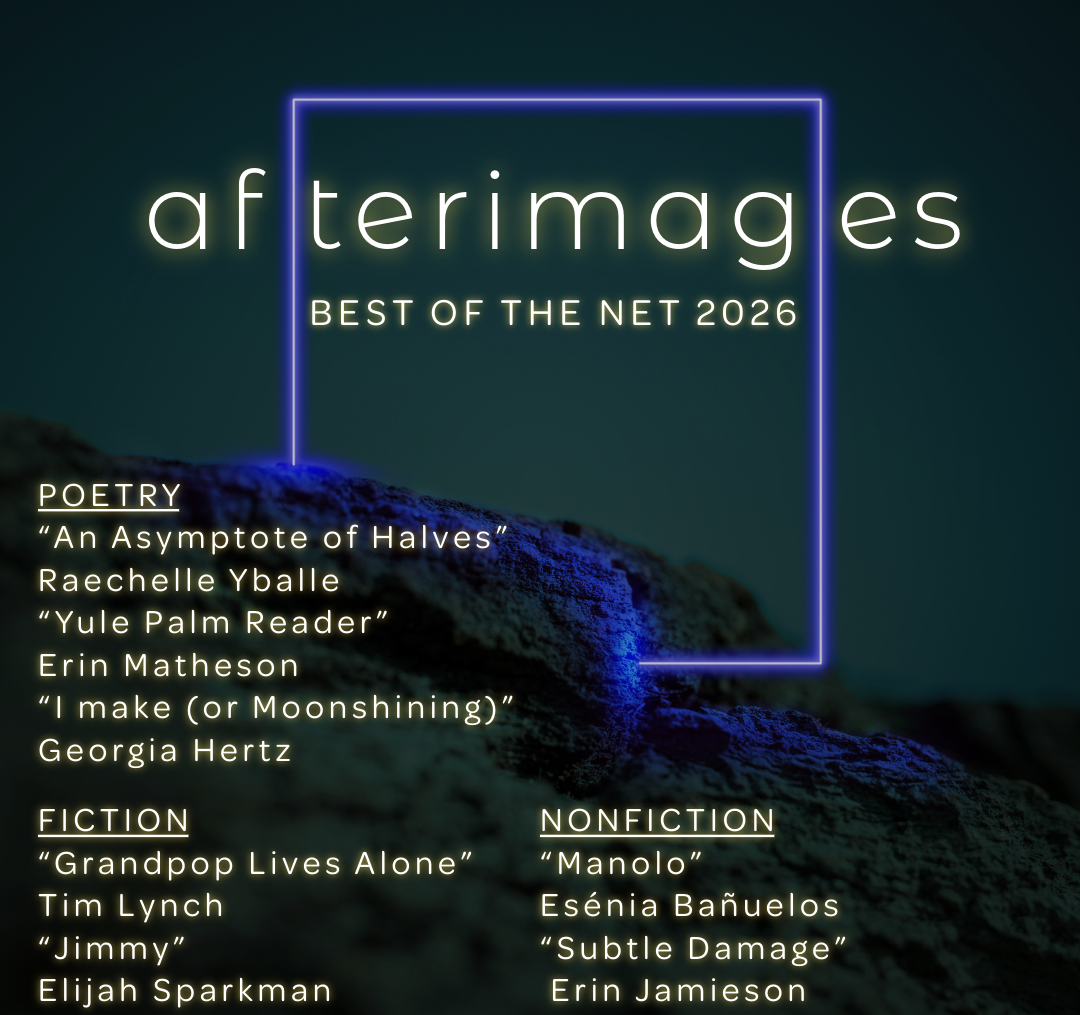
“An Asymptote of Halves”
Raechelle Yballe
Meet me halfway, Mama, beside the Bangka gravid with sardines. Where I drowned in a galaxy of starfish and Daddy’s breath saved me. Love and labor were inscribed at our start. Meet me halfway, along the sandpiper’s chase, where the boy unhooking lace discovered my Miraculous Medal and Scapular. Almost succeeding. Never quite touching. Then, meet me halfway. Halfway once more. Meet me beside the flaming mimosa—the caterpillar’s nursery, the firefly’s tophet. On this strand, among shells of infinite halves. Where there is love. Where there is labor.
“Yule Palm Reader”
Erin Matheson
For you, she pulled the universe—
moonbeams sunny side up,
redwood cathedrals swathed gold,
spring chlorinated smiles—
your light I bask in daily
on full display for the cards.
For me, she drew the four of cups.
I pushed it away before she could
study my palm, trace its stuttering
heartline and pronounce me
closed, deficient, too cold
for your glow.
“I make (or Moonshining)”
Georgia Hertz
moonwater at the full moon and pray it fills me up,
or that it teaches me to glow from within – bioluminescence doesn’t
only belong to the sea, does it? I ask again: does
no one care to trawl along the shoreline for illumination anymore?
Search lights aim for any fellow ghosts we left behind, so
how, then, does the spirit shine in starless darkness?
in the eager void that gulps all down its great hulking maw?
not for its sustenance — worse — erasure? not an excavation but
instead a slow suck, a thieving glimmer of joy once close,
now wrenched away — all ripple, all sway, all sundry — a
glint on fickle tides and me, an anchor in newly wetted sand?
“Grandpop Lives Alone”
Tim Lynch
A maple’s branches bangle in soft, Spring gusts, late sunlight sifted through its budding arms. The sound is like a distant, breaking wave, that fathomless breath. Dormant for a season, this tree lives on, here, on the block of the city, as in every city, where district lines become apparent, where potholes lead to Hell, and infected guts of rowhomes spread their sepsis down the line, nothing to do but set plywood on porch windows like pennies on a body’s eyes.
In the liquor store window, a cardboard Easter egg goes on getting pale.
His body stands on the strip mall sidewalk between the parking lot and the road. Sunlight through the latticed branches dapples his cheeks, and the shadow of the maple’s bole blankets him below the neck. Nothing-eyed, his lids hover asymmetrically open, the wider hardly open at all. Cars shush loudly, sharply by. Then, the ballet begins.
First, the bending at the waist, slowly. Slower. Slower even than that. A robin in the maple sings entire operas in staccato chirps of two, its cacophonous flock chirping back, while the torso, impossibly counterweighted by each foot, creaks toward the ground, arms slack, legs stiff in crooked balance, until the fingertips hang finally still and kiss the sidewalk grit.
And then, an old story. A white man in his forties leaves the liquor store and lets the door fall shut, even after noticing an older black man reaching for the handle. He isn’t quick enough and can only keep pace, fingers trailing just behind. Who tells the story is what matters now.
Slowly, the body on the sidewalk unfurls upright. A woman clops straight-on, talking down to her phone, saying, “—which is fine but—,” then stutters, glancing up, and steps around, continues, “—but she’ll be weird about it, she’ll be, she’ll be like…,” fading down the block.
His body wavers in place, a ghastly shape glimmering in the unfit shade of a gold-lit tree.
“Jimmy”
Elijah Sparkman
Jimmy died in the truck, but I kept thinking about the little bugs in my bathroom sink. I didn’t think they could be bed bugs because I thought bed bugs were invisible. I thought they might be fruit flies, but where was the fruit? Jimmy died in the truck while I was cutting Mrs. Sampson’s house. Old woman always had her gardening gloves tucked into her khakis. A visor on her head, gray hair eking out the side like an octogenarian octopus. The last thing Jimmy said to me was: “I don’t feel so good.” I left him in the truck with the AC on and said we’d figure something out if he still felt that way when I was done. You have to give me a break. Jimmy said he didn’t feel good every day. And there was usually a Big Mac or a bad memory to blame for that. Now I’m signing his death certificate, as a witness. Everyone has one, or gets one eventually. It proves you're dead to the future. Now he’s going to the morgue. To keep cool. While they figure out who the people are who are supposed to be figuring out what to do with him next. Tucked between his legs was a fountain pop from 7-Eleven. By the time the cops got there it was beaded with sweat. Jimmy’s neck was cold and pulseless. Only people have death certificates. It makes me rethink the mornings when I squish those little bugs into the side of my sink. Their remains graffitied on the porcelain canvas where I clean myself. I lied: Jimmy’s last words were: “You always say that.” He said it like he believed it.
“Manolo”
Esénia Bañuelos
It was the first night Papá had ever allowed me in his space.
The pine gateway struggled emptily beneath my childish weight; what seemed like decades of merciless receipts crinkled a passage towards the nightstand. What was José Manuel’s terreno had melted into a play desk for his son to fold the legs of his glasses and the fingers of his soul into a taut bind the size of what then seemed like cousin Lichi Lichi’s mansion in St. John’s—which is to say, it was quite the sight for a little worker’s elf to see my Father basking in an inherited Gooseneck from his nephew and scowling out towards the banalities of a capitalism writhing and crawling endlessly towards him. In many ways, Abuelito’s odd construction burdened him and simultaneously supported my Father as he leaned his hardy disposition on his face. Many men before him, like him, had sworn their bodies to the oak—what was merely a nightstand with not an inch to give for his legs became a place of sincere glory.
Papá was never one to speak. I was meaninglessly six years old and mute. What he and I did not know, we shared in some non-linguistic tongue—that of endless creation, one that was not so limited to this sanctuary of desire. Like his workspace or oficína St. José, as he earnestly urged Mamá and I to call it, the mustard yellow Ford Expedition was not so much a landscaping mobile and was instead more of a banana buggy—a horse-drawn carriage fashioned in the Perrault shape of only the finest golden vegetable. It collared breathlessly into the Hoover parking lot and squealed into a blustering and belabored halt. Bañuelos Lawn Service. Without a word towards the day, Papá was the conductor towards a beautiful palace sheerly bordering the lip of the Calumet River and 173rd—Lansing, where thousandaire Mark (Már) throned an impossibly gorgeous and derelict playground. A reward for all the good I had probably done that week, like get my card flicked to an admonishing yellow, or climb the stout railings to the stairs, pitchpole onto my stomach, and nosedive into the oblivion of a five-stair flight and straight into a heavily pregnant Mrs. Jordan. Whatever it was, he hoisted me up from my armpits and nervously placed me at the mouth of the slide, and that was as much conversation as he and I had before the stirrings of guïras singed my nose and married my ears with the low hum of cicadas.
It seemed that wherever he and I made a space, it was from the remains of another. The workspace was no different in that sense. An ocean of inheritance swarmed my heels and often licked feverishly at my ankles like a mutt Mamá would die before ever letting me explore the porch. Papá did not seem deterred by my interruption of his little workspace and had continued his endless tinkering at the desk, wrangling the plump black vein of some unearthly device beyond my comprehension and making the waters of Lethe flush aglow with light. I knew nothing of what I was watching when I flanked him to see the magician, the craftsman in perfect peace. I only noticed, for the first time, that when he spent that anthemic grin, he sported a little void between the canines. He squinted, rolled his jaw into the burrow of his throat, and beamed a whistling cardinal when he smiled. I had never noticed he was missing something.
Papá was never one for farmer’s decorations. The walls were still aching and painted a tortured beige, a little tribute to Calumet City from the last family to flee towards the gorgeously haggard bungalows of Hegewisch. What could have been the arena for a couple of portraits of starlings and quotes from Matthew—a bursting cinematic of the Final Supper blessing the grounds on which we feasted pearl haricots and carbonized guajillos—a gingham tapestry, anything that would make heaven a little less industrial—was instead ripe with wonder. It seemed more like he wore his California cholo beginnings paged over his head in an uneven, amateur fade than anywhere where he could nestle in at night and become a child again. He unfolded his beloved Dell Inspiron from Tío Hector and gestured ferociously at the cable extending from the paunch monitor he managed to wrestle from a garage sale out on the South Side some years before. What I was about to witness inverted the state of technology as we knew it. Papá was a Da Vinci fashioned from the whit of Guadalajara.
In a split second, there was a versant and severe twinge of light that blinded both my Papá and I in a gruesome inception—all I could translate then with my childish capability towards discernment was that I was seeing. I was effectively seeing two portals squealing—demanding—explicating and inundating me with the same proverbial light. Papá hitched a gasp and crowed, slapped the boundaries of his hands against the fatigued desktop, and proudly stood up amidst the sea of decadent wrappers. My God, I could read his congested pupils below the burden of his brows, I had done it. I found out what happens when you plug an HDMI cable from a laptop into a monitor. Him and I swirled the confines of the oficina, kicking against the burdens of receipts, demands, labors, pain, inheritance, genetic disease, insurance, mortgage, and pain, and pain, and pain. Amid the paper chaos, there were no manuals—no set of instructions—no means of knowing, at least not one available in our language (or lack thereof). Just pure ingenuity.
The greatest engineer—the designer of man. Father, bright in the flesh.
Papá. The son.
José Manuel.
—
Manolo!
I am standing in front of a vacuous abyss at the edge of where Heaven once remanded the loan. Where the Calumet River stood, a couple of pebbles shouldered nothing but the dryest air—some weeds, unattended and forlorn for a trim, whimpered among them. What lifted me from O’Hare this morning was not a banana buggy, but a simple burgundy, faceless landau from the Facebook Marketplace. The return is obligatorily silent, as is typical in the avenues of death and destruction. St. José is no more, and his funeral mass is imminent. A little piece of childhood seems to fill in the driveway cracks. Papá—Manolo—a child joins me at the ledge and pulls a red filament where the desktop once stood. The columnar tree whines, weakly mithers, and ultimately straightens his spine.
It seems the harsh Chicago summers have made for stubborn, humid children. “I never noticed him before,” A little breath stifles and struggles through my teeth. The thing was impossibly tall and disruptive—so unashamed, yet so skinny and fragile. His leaves hadn’t even survived the mild September weeks, and he was undeniably exhausted. An easy Chicago wind would send him over to the Lansing plains—after that, everything else is just another way to say hell.
“He started growing a little bit when you left,” He wrestled the ends of his lips from flying away, sheepish of his pride. “I watered him a little bit sometimes, but often, I forget about him. He’s strong,” His brittle palms are simultaneously caressing and choking the thing, “but he needs me to feed him a little more. What do you know about trees?”
I act the fool.
“Subtle Damage”
Erin Jamieson
A week after I was born, you had seizures.
You’d never had anything like that, nor had you displayed any abnormalities after you were born. Mom didn’t know what to do, she had a newborn baby and for some reason, Nana and Papa must have been away or somehow unable to help. She was terrified, I think, that she was going to lose you. I wonder if that week, that fear of losing you, and not knowing what to do with me, stayed with her more than she or any of us will ever fully know.
So she took me to her best friend’s house, who herself had had a son only about a month before. And she took you to see if anyone could stop the seizures.
But the thing is, they stopped on their own.
It was a miracle or a nightmare, depending on how you look at it. A miracle that they stopped, bad luck that they started in the first place. I of course cannot remember any of this and maybe that is a good thing. I would not have wanted to be there to witness Mom getting so upset. I wouldn't have wanted to be there to see your tiny scared face as seizures rocked your body. If you were able to be scared at all that is. I doubt you fully understood what was happening at all.
I imagine how things went. I imagine Mom came home with you in her arms, I imagine she did not ever want to let go. I imagine that was one of the most frightening times of her life, and I can tell in part by how often she tells it.
But eventually, time passed and you had no more seizures. Eventually, even Mom let you start to resume your normal toddler activities.
You went on play dates with her friend's older children as I stayed wrapped up in a blanket stroller. As you got older, the two of you went to garage sales where you selected action figures, or “men” as you called them. You lived as any toddler would, with the exception of having at times an overprotective mother.
She did ask, many times, if there would be any lasting damage. Suppose the seizures had done anything to harm you long-term. I imagine this as a stressful time, although I have no way of knowing if she poured over articles the way she looks up symptoms and cures on the internet for various aches and pains to this day. I know she did everything to find her own answers herself. She never did believe in trusting physicians completely just at their word, and while sometimes she was wrong or paranoid, later, as we both know, her insistence would prove her right and quite possibly even though I don't want to admit it, in part saving my life.
But then it was a toss-up, the way things always are. It was a toss-up whether back then she had a reason to doubt the doctors or something about her was terrified, even then to lose you. Even though the doctors insisted there would be no damage, she did everything she could to make sure you would be safe, and I suspect that trickled down to me by default.
This is all speculation. Of course, I have never had a child, and you have not when I last checked.
But when the doctors said there would be no lasting damage, they did truly believe that. And there is no sign that they were wrong, from a medical perspective. There is no evidence, for example, that the exhaustion seizures you would suffer from shy of two decades later were related in any way, though Mom always insists that they were.
The problem is this: when we talk about damage, we all sound like we are having the same conversation but we really mean many things at once. There are too many ways someone can be damaged to put a firm label on it, to quantify or qualify it.
There is no way of estimating emotional damage, invisible scars we wear every day as we put a good face on others.
Those seizures may not have changed you in any way the first time, but they changed Mom. They showed her just how vulnerable a happy life was. They showed her that the most terrible and unexpected can happen no matter what you do.
Because sometimes damage isn’t obvious, and sometimes damage comes in forms and ways we can do little to control.