
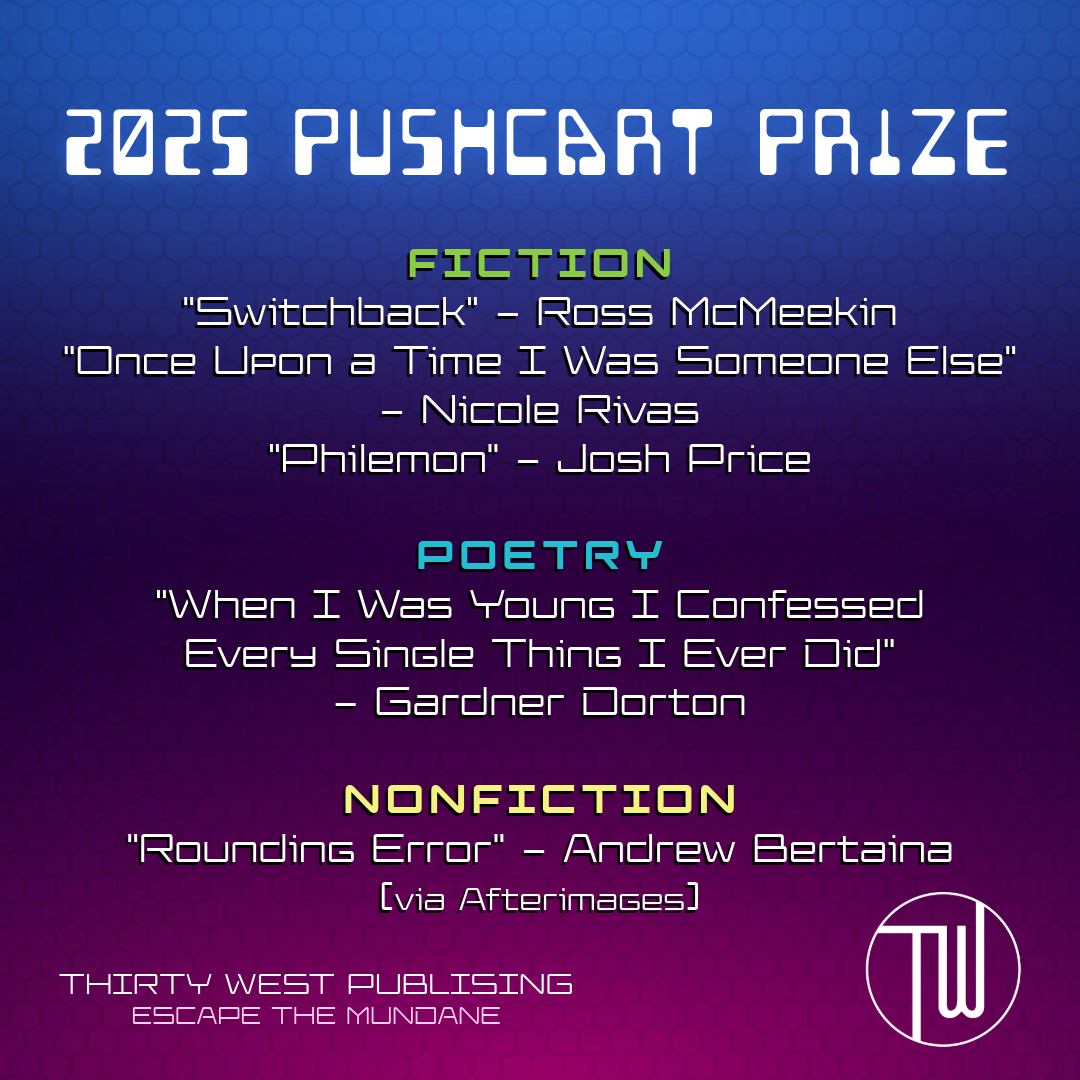
“Switchback” from Below the Falls
Ross McMeekin
DOWN THE DRY PATH THROUGH THE FIRS and moss and vines and bustles of mountain blueberries the innocent ran. He knew he wasn’t fast enough to escape, but he believed in miracles, so he continued on, if only to allow more time for God to work. The sound of the men from the camp chasing him had grown louder over the last quarter mile. All that mattered was that the tiny cloth sleeve he’d stolen lay safely inside the pocket of his thin, woolen trousers—a sleeve filled with small, kernel-like seeds, so few, so small, by appearance little more than sand, seeds that would heal the world, the prophet had said. The theft was the only physical sin he had knowingly committed, though violence often played in his young mind. For this reason, he feared the men; he’d not only heard stories of them, but he’d imagined in great detail what they might do if they caught up to him. He crossed himself.
At a switchback near a small alpine pond, his endurance failed. He heard the barks of dogs—they would likely be the first to catch him. Winded, he stopped, leaning over, coughing, praying. Morning sun shone across the path: canary, butter, butterscotch. He removed the seed sleeve from his trouser pocket. He considered dumping them out and hoping they’d grow, but he didn’t have time to bury them, and the ground was a leaf, warped brittle by the changing of seasons. Thinking of nowhere to hide them, he poured the seeds into his dry mouth, conjuring enough spit to make a paste to store under his tongue. He threw the empty sleeve into the bramble on the side of the path just before the dogs and the men rounded the switchback. They stopped, and some began mocking him, perhaps in delight at what would soon follow. They looked haggard, all of them, even while they were triumphant. Did he have the seeds? Would he tell where they’d gone? No.
These are my people, he thought, as a chestnut-bearded man gripped his arm tightly enough to make him wince. These men, he thought, they know not what they do. He exhaled a last, brief breath of fear, and his heart settled. He no longer cared what they did to him. He cared only about the seeds in his mouth, resting against his gums. His time wasn’t yet spent. As the prophet once said, “The logic of miracles is the wisdom of fools.”
Jeering at him, leering, they walked together to a sun-torched meadow, tan as the gut side of an uncured belt. The stout, bearded man struck him. As he fell, he could hear the rest of the men cheer. Then, at the orders of the bearded man, two of the others tied his hands and ankles and carried him toward the soft, damp soil near the creek feeding the pond.
The two who carried him began digging a grave. Head sideways on the ground, he watched and was met with the sort of inspiration that only the arrival of death can bring. It occurred to him he’d been caught up in a miracle. They would bury him, but in his mouth were the seeds. Next to the creek, the seeds would grow, wrapping their roots through his tongue and throat and face and body, nourished by the damp soil surrounding him. He was lowered into the grave, ankles and wrists raw, and he blessed the men, each of them, as they laughed over his words. Laughed. Laughed as if their souls weren’t in peril for the very miracle they were helping to perform.
“Once Upon a Time I Was Someone Else” from Tender Hoof: Stories
Nicole Rivas
THE BOY SAYS THAT IN A PAST LIFE, he was a grandfather. He claims he had three grandchildren and that he died of lung cancer, in bed, surrounded by his family. Everyone sitting on folding chairs in the library has read the boy’s book and heard this part of the story. The memoir is called, Once Upon a Time I Was Someone Else, and on the book’s cover the boy is pictured wearing a tweed blazer with a pipe jutting out of his thin smirk.
Today, the boy is sitting on an armchair in front of us wearing a button-up shirt and slacks. His eyes are a stony gray, and his hair is so blonde it’s almost white. It’s incredibly fine, his hair. It flutters and flaps in the breeze of the library’s overhead fans, like the feathers of a baby bird.
His parents sit on his left, a little too wrinkled and shrunken for the parents of a ten-year-old. They look like they could be siblings.
On the boy’s right sits Amanda, my coworker, who told me she believes in everything the boy says. She’s read Once Upon a Time I Was Someone Else twice and cried both times.
As Amanda and I were setting up the snack table, she told me that and more. Amanda arranged the paper napkins into a crescent moon. She said that she believes in reincarnation, in the power of the stars, in soulmates, and in the prophetic properties of dreams. In response, I opened the tin of store brand butter cookies with a loud pop, gathered up the crinkly plastic seal, and crushed it into a small ball before throwing it into the trash can.
Everyone is quiet while listening to the boy read from his book, even the children who were dragged here by their parents. The boy closes his eyes and begins. He explains that in his past life, his hair was jet black until his 50s. He says he used to smoke a corn cob pipe and that his name was Henry Owens. Everyone already knows this, but they still lean forward to listen, slack-jawed in the face of reincarnation.
During the reading, I sit in the back of the room, legs crossed, occasionally looking at my watch. The audience members hug the boy’s book to their chests. They cling on to his every word. Amanda holds her copy on her lap. She switches her gaze between the boy and his parents, and at one point I see an almost imperceptible exchange of smiles between her and the boy’s father. He, up to this point, has been inanimate.
“It was the Great Depression,” the boy says. “The soup my wife made was mostly just watered down chicken stock. Little Sue was our daughter, and she was always crying from hunger. One time, things got so bad we had to eat our pet dog.”
“What was the dog’s name?” a young child blurts out. The child’s mother shushes them and apologizes to the room with a meek smile and the flutter of a hand.
“That’s okay,” the boy says. “Her name was Tootsie Roll.”
I can’t help but arch an eyebrow. I enjoy some degree of fantasy, but even this is too hard to believe. I look at my watch again, then at my text messages. A dick pic and a question mark from Jake, who I had saddening sex with once two weeks ago. I save the picture to my phone, delete the text, and check my email. Junk, junk. A forwarded house listing from my mother, who is convinced I’ll one day move to the suburbs of Orlando where she lives with her boyfriend and their toy poodle, Cherise. “You need friends,” she tells me.
Delete.
“What do your parents think of your past life?” a lone woman asks during Q&A. She has large, brown eyes like a doe. She is wearing a shirt that says BELIEVER in pink and silver sequins.
The boy looks at his parents. I feel myself shiver.
“We are so thankful for our son and his God-given gift,” the boy’s mother says. The boy’s father nods and takes a sip of water. Amanda hurries over to refill his glass.
After the reading and Q&A, there is a brief intermission before the boy is scheduled to sign copies. On my way to the staff restroom, I wonder if the boy even has a signature. It took me so long to develop mine, laboring over lines and lines of my cursive name in my spiral bound notebook.
Lost in thought, I’m surprised when I open the restroom door to find a fully clothed mass heaving, gyrating against the floor’s ugly pink tile. The mass turns around and dissipates into two. A sharp little scream emits from the smaller mass, a sound like stepping on a mouse’s tail.
Amanda and the boy’s father scuttle apart, only there’s nowhere for them to scuttle. I stand in the doorway, gazing at this performance. Amanda crawls into the restroom stall and slams the door.
The boy’s father turns his back to me, crouching toward the restroom’s paper towel dispenser as if he is on time-out. I hesitated for a moment. I hear him fumble with his zipper. I see his chest heaving, his bald spot perspiring, and his brown jeans sagging on his nonexistent ass.
As I close the door to leave, I find that for the first time this evening I am almost gleeful. This, I think, is the realest thing that’s happened all night.
The book signing goes off without a hitch and the family prepares to depart. The boy leaves his parents’ side and walks over to thank Amanda and I for making the event possible. Amanda’s mascara is smudged, and I can’t tell if it’s from sweat, from tears, or both.
I have a tissue in my pocket that I hand to her. She nods and takes it, wipes the corners of her eyelids.
“Thank you for letting me share my truth in your library,” the boy says, staring at me. He puts his hand out and I don’t immediately take it.
Amanda smiles at the boy and takes his hand for me, gushing over his words and mannerisms. Despite her smile, she avoids eye contact with his parents, especially his father. To the boy, I offer a tight-lipped nod and bow slightly so as to avoid shaking hands. But I’m unable to avoid touch entirely. Without warning, the boy reaches out and grips me on the shoulder. I can feel each of his fingers against my bone like the talons of a vulture. My jaw clenches. He says, “You look just like my wife from my past life. Her name was Delilah.”
I instinctively smack the boy’s hand away. It’s unintentional, but it’s fierce and honest, this violence. Amanda gasps. The boy’s parents, who are watching us across the room, shift imperceptibly, but say nothing. The boy puts his hand in his pocket and smirks just like on his book cover.
“Delilah,” I say. “How did she die?”
“I don’t know,” the boy says. “I beat her to it, the dying part.”
Weeks later, Amanda forwards me a news article about the boy, his parents, and Once Upon a Time I Was Someone Else. The email’s title is “So Sad!!” I’m on my lunch break and eating leftover lasagna. I’m used to Amanda forwarding me junk, and I almost delete the email without reading it.
It turns out that what’s in the email is, indeed, sad. The article says that the boy and his parents were recently continuing their literary tour to the Midwest. During an overnight stay in Kansas, a man described as a “stalker” entered the motel room of the family and shot them all, point-blank, dead.
After rereading the scant article, a couple more times, I put down my phone and scrape what’s left of the lasagna out of the Tupperware. I find it hard to believe that the boy had a stalker. Who, I wonder, could care that much about another person, let alone a child who made an early fortune from deceit?
I think of Amanda engaged in an impromptu bathroom tryst. A man who is now dead by a shot to the head. What did she see in him? I try to think of his face, but I can’t picture it. Only him hunched in the corner of the restroom, kneeling, almost praying to become invisible. The sweat beads on his bald spot gleamed like the scales of a fish.
I also think of the boy with his smirk, his fine-tuned story, his blonde hair matted into a pool of blood. I consider the possibility that he thought he was telling the truth. What then? I snap the lid shut on the Tupperware and close my eyes, imagining what it would be like to believe in something like Amanda and the others. To believe in dying and coming back as someone new, or to believe the others are telling the truth. I think of myself as I am now, faults on faults. I wonder, if reincarnation were real, who I would become next if I could become anyone at all.
“Philemon” from Trailer Park Ocean
Josh Price
I’D BEEN OUT FOR TWELEVE HOURS and came awake to gunshots with my heart in my throat. I don’t know if being sober would have made things different.
I saw what the rifle bullet did to his face from so close; I remember it like something behind a veil.
He was face down with no jaw in a red puddle, looking off into the distance, Bible beside him, concrete stained with his offering to God, all evidence of human fragility screaming in the moment. Surrounded by police, my friend wasn’t praying now.
I went to his memorial. Thought about the word I’d learned when I was in church, Philemon: to love, but with peculiar affection, like Jesus was said to have loved his disciples.
If this man I knew was not accepted in heaven there is no such place.
I wished for a place like heaven to go to when I died. Everybody does.
Sometimes, he prayed with me. I would have been embarrassed to pray with my other friends around. I was always looking into the heart of what was the matter but never recognized what I was seeing.
Other times, he came home beat to shit from his logging job, to find me sitting outside his apartment wanting to borrow money or use his phone. Those times, he wouldn’t say anything.
He invited me to a Bible study at his place, and I went. Kind people were there. The neighbors stood outside looking in his window, seeing a thing no one wanted to figure out: scared people standing around a tiny apartment, clutching bibles and praying in tongues.
Once I surprised him by telling stories I'd learned from the Bible, ones he hadn't heard. He thought he was teaching me—that someone like me couldn’t know as much about the Bible as he knew, but I did. I heard him through the thin walls the night before it happened, praying in his apartment, alone and afraid.
My girlfriend—not the woman I’d marry—said she didn’t like what he was doing, the way he was talking.
We stood outside smoking her cloves.
“What’s he doing?”
“He’s praying.”
“What’s he saying?”
“I don’t know, but he sounds really scared. He’s praying against something, I guess, something bad he feels around him.”
“I wish he wouldn’t make noises like that.”
“Why?”
“I don’t know. I want to go back inside.”
We turned on the television loud, but I still heard him across the hall. My friend kept praying and I fell asleep.
“When I Was Young I Confessed Every Single Thing I Ever Did” from If I Were God I Would Also Start With Light
Gardner Dorton
TWICE OVER, MAYBE THREE. When I was younger I swallowed a quarter because I was learning about Hades. I can promise you one thing, they’re coming to collect. Listen, once I left a candle burning and the dog home alone. Once I eyeballed my prescriptions too long and was fed by my roommate for a week. Once I looked when a friend was changing. Once I was drunk in church. I forgot that to be meek doesn’t mean small. Once I swallowed something entirely unlike a coin but the taste was similar. Once I blocked someone, double-locked every door for a month. Once I came back home and the juniper trees erected the end of my 20’s. Once I let the wrong twin win custody of my mind. Once I told one of my classmates that another student was gay after I slept with him. The same thing happened to me. Once I danced to Fleetwood Mac with the windows bared open to the street after they wheeled off the body of my neighbor, drunk on tiredness, freshly diagnosed. Once I messaged a guy from my street under a blanket during a party. Once a church boy kissed me in the name of fellowship. Once I came to on a bridge and drove home. Once I violated my cracked, huge heart. I don’t think I meant harm. Twice I tried to pray again this year. Once I learn how to keep my mouth shut it’s over for you fuckers.
“Rounding Error” as featured on Afterimages
Andrew Bertaina
HE KNEW HE SHOULDN’T EVER READ his Goodreads reviews. This was common knowledge among authors far more famous and beloved than he was. Once, there had been a dispute because a writer had been incensed that their book had been rated as 4.5 out of 5 stars. It was embarrassing for the author who’d made such a big deal out of it, but the author had doubled down, had defended their right to trash someone for giving their book 4.5 out of 5 stars. In fact, the author pointed out that the rating system didn’t allow for half stars, which meant that even though the reader had mentioned that they felt the book deserved 4.5 stars, they’d awarded 4/5 on the site, which the author said was abominable, that it was the sort of thing that drove them crazy, having their life’s work receive only 4/5 stars. Intuitively, he knew where the famous author was coming from. It was hard to have your work judged. During workshops in graduate school, his cheeks had always burned when his story was being discussed, it almost pained him. And he’d never gotten back into the habit of sharing his work after leaving school because he just couldn’t bear to hear it talked of as though he wasn’t there. He couldn’t bear the thought of someone awarding his life’s work, God forbid, 3/5 stars. So, he’d stopped receiving feedback and though he knew it meant his stories were a little rougher around the edges, it was really the only way for him to continue writing, to imagine his audience didn’t exist at all. It barely did.
So why then, he asked himself, had he read reviews of his book, especially when he’d seen that someone had finally rated it below five stars? His overall average on Goodreads, a site every author he knew detested, was now 4.76. Instead of feeling a hot flash of indignation, he found himself scrolling down to read the review of the person who’d given his book 3 stars, well below the 4 to 4.5 stars that the famous author had melted down about. And as he scrolled down, his attention, which was shoddy and often why he barely wrote anything, narrowed.
He found himself reading the words hungrily. For here was a non-ideal reader, someone who didn’t like his stories, his lyricism, his homage stories to Borges, Calvino, July. In fact, as the reviewer went on, he said the very thing the writer knew in his heart to be true. The reviewer said he wasn’t surprised the book only had five-star reviews, and that it was common for a smaller press book to only be reviewed and starred by people who knew and liked the writer.
And he knew the reviewer was speaking the truth, that all the five-star reviews were people who knew the writer, in person or online, who were predisposed to like his stories, to leave a positive review. Now he was finally breaking through that veil. Someone was reading his book for the very first time, a stranger. Someone who had no intentions toward him at all, good or ill. He was just a reader, and isn’t that what every writer really wanted? Not a mother or a good friend to like their book, but a stranger, someone they didn’t know at all, who briefly picked up their book and encountered their mind.
He read the three-star review again, committing the words to his memory. It was the happiest he’d been since his book was published.