Image 1 of 2
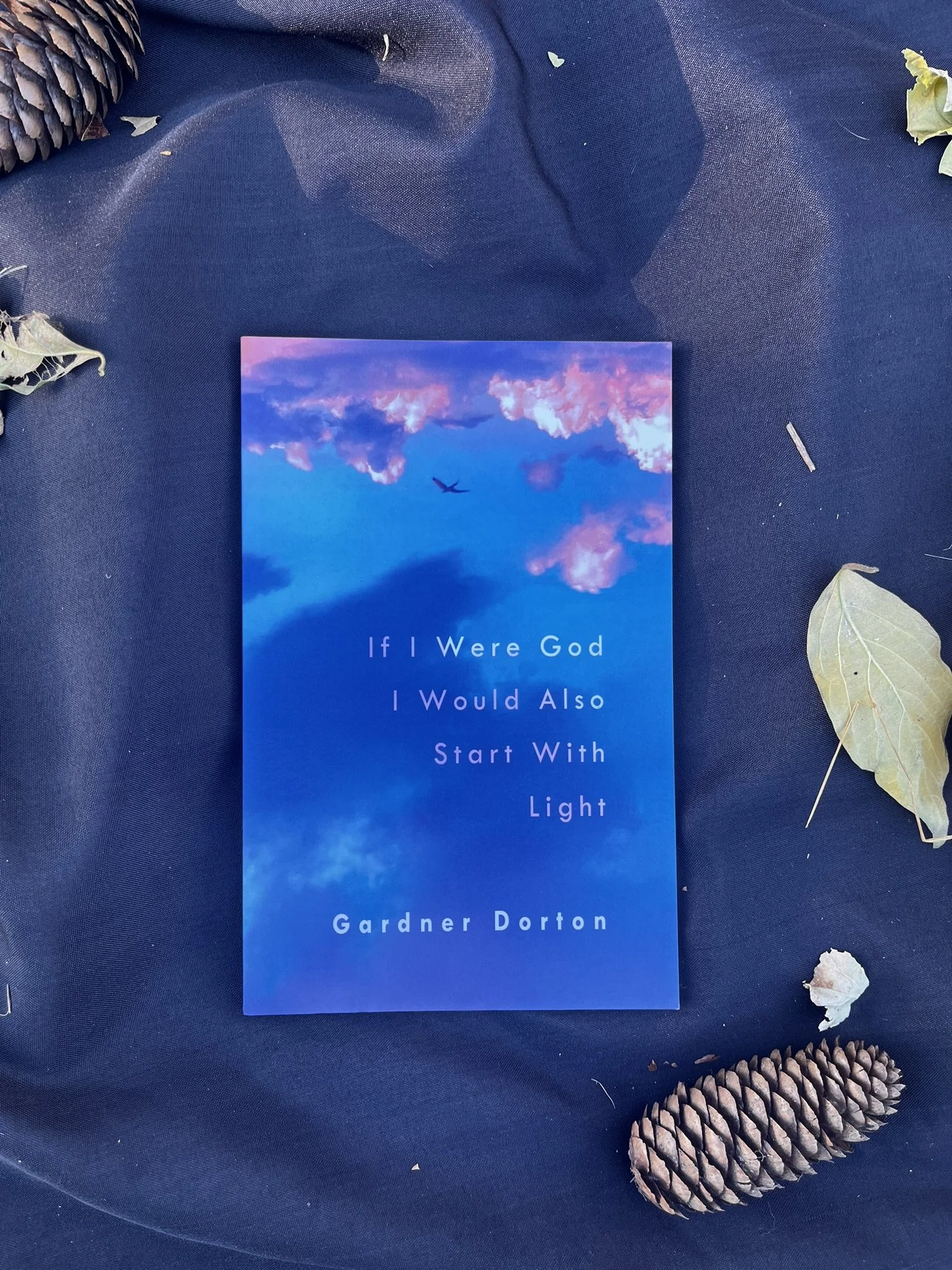 Image 2 of 2
About the Author
Gardner Dorton is a poet writing at the foothills of the Smoky Mountains in Knoxville, TN. His poems have appeared in journals and anthologies like Narrative, The Florida Review, Rattle, and The Greensboro Review. His chapbook, Stone Fruit, was published by Glass Poetry Press in 2021. Gardner writes about queerness, bipolar disorder, and the South. Visit his website and say hello at www.gardnerdorton.com
Reviews
"Gardner Dorton’s If I Were a God I Would Also Start With Light actually springs forth from darkness; the gloom of being queer within a hostile family and community. We see how familial and religious trauma disrupt queer desire and limit later opportunities for love, acceptance, and joy. The speaker of these poems undertakes the sizable quest of finding alternative role models in order to reconstruct the desire that has been long denied. Dorton turns our heads towards art, drops us into the eye of the storm as his speaker navigates mental illness, and suspends us in moments equally jarring and intimate to illustrate that the journey to “sheer, queer joy” requires resilience, a different kind of faith than the one we are taught."
—Taylor Byas, author of I Done Clicked My Heels Three Times
"In If I Were God I Would Also Start With Light, Dorton redefines divinity. With radiant language and unabashed queerness, this powerful new collection navigates religion, identity, and longing with an intimate and heart-wrenching beauty, brimming with poems that are “eager and crowded with life.” Dorton has gifted us with a new kind of holy book and I, for one, am all in."
—Adam Gianforcaro, author of Every Living Day
"Dorton’s poetry is courageous as much as it is emotional. In this collection, a gentle soul fights for survival, and along the way has picked up a remarkable gift of poetry to protect himself. His writing braves the fearful darkness of life, and hands life back over to us, still raw, yet somehow undeniably beautiful, a miracle in language."
—Nicholas Goodly, author of Black Swim
"Gardner Dorton’s collection of poems If I Were God I Would Also Start With Light is a first baptism where we are reminded that there is “phlegm and violence in every prayer.” Dorton is grabbing our hand and guiding us through the church, through the field, through the “hollow landscapes,” through all the places queerness lives in danger. There is so much space in between each poem, room for us to walk around and grow, to turn away from the trauma of both God and family in order to learn how to love. This collection teaches us how to sing through our sadness; that there might always be something worth praying to, often it is not God but love itself."
—jason b crawford, author of YEET! and Year of the Unicorn Kidz
"If I Were God I Would Also Start With Light is a debut collection that knows what it means to stay tender—despite God’s wrath, despite God-wind, despite God-fearing men (with their heavy hands and their picket signs). Twining religion with natural wonder and Southern topography, Gardner Dorton speaks clearly: “I apologize for adding more mysticism to this / world, but I’ve realized that this is how it all came to be.” Here, you’ll find poems steadfast in their joy and meticulous in cataloging the contents of their hearts—from outside the Ark to Virginia fields, from eating over the trashcan to your local Target—here are poems: “a prairie, eager and crowded with life.” If I Were God I Would Also Start With Light is a gift, and much like light itself, dazzling in its brilliance."
—Ashley Cline, author of to eat the sleeping sky, whole
"In Gardner Dorton's sublime, Appalachian debut, a modern oracle speaks from the desert of grief, boyhood, and violence. In sharp, precise language drawing from scripture and from place, Dorton asserts the importance of a single question, of small miracles. The importance of seeing then waiting. Like Jericho marching around the city walls in defiance or Job abiding in his dejection from God, Dorton speaks to the power of transfiguration through the erotic, through self determination, and through queer self actualization. Here, one finds wings among the carnage and emerges with a new, vibrant, whole-life, a "second / chance" of grace and redemption. This is a haunting collection from a memorable new voice.
—Halle Hill, author of Good Women: Stories
"At the border of death and resurrection, If I Were God I Would Also Start With Light is a collection of poems from exile. Dorton’s words sound with the force of a prophet preaching in the wilderness. Urgent, hungry—his message is ultimately one of queer self-determination. Crows, flies, bruises, and ash populate this landscape, but so do pearls, light, fruit, and dogwood blossoms. Dorton writes, “There still is / grief in the garden.” Like a drunken voicemail left for God, these poems are unsparingly honest. They take inventory of suffering alongside joy and are not afraid to confront or invent. In response to a Baptist church questionnaire and a triage intake form, Dorton asks questions. What does it mean to be a body? What does it mean to hold what you’ve been given, whether or not you wanted it? What does it mean to keep living? “If this is the end, / or close to it, it was an honor to eat / everything this world had to offer.” For all the places this book takes us, it leaves me with hope. This book is a gift."
— Joshua Garcia, author of Pentimento