
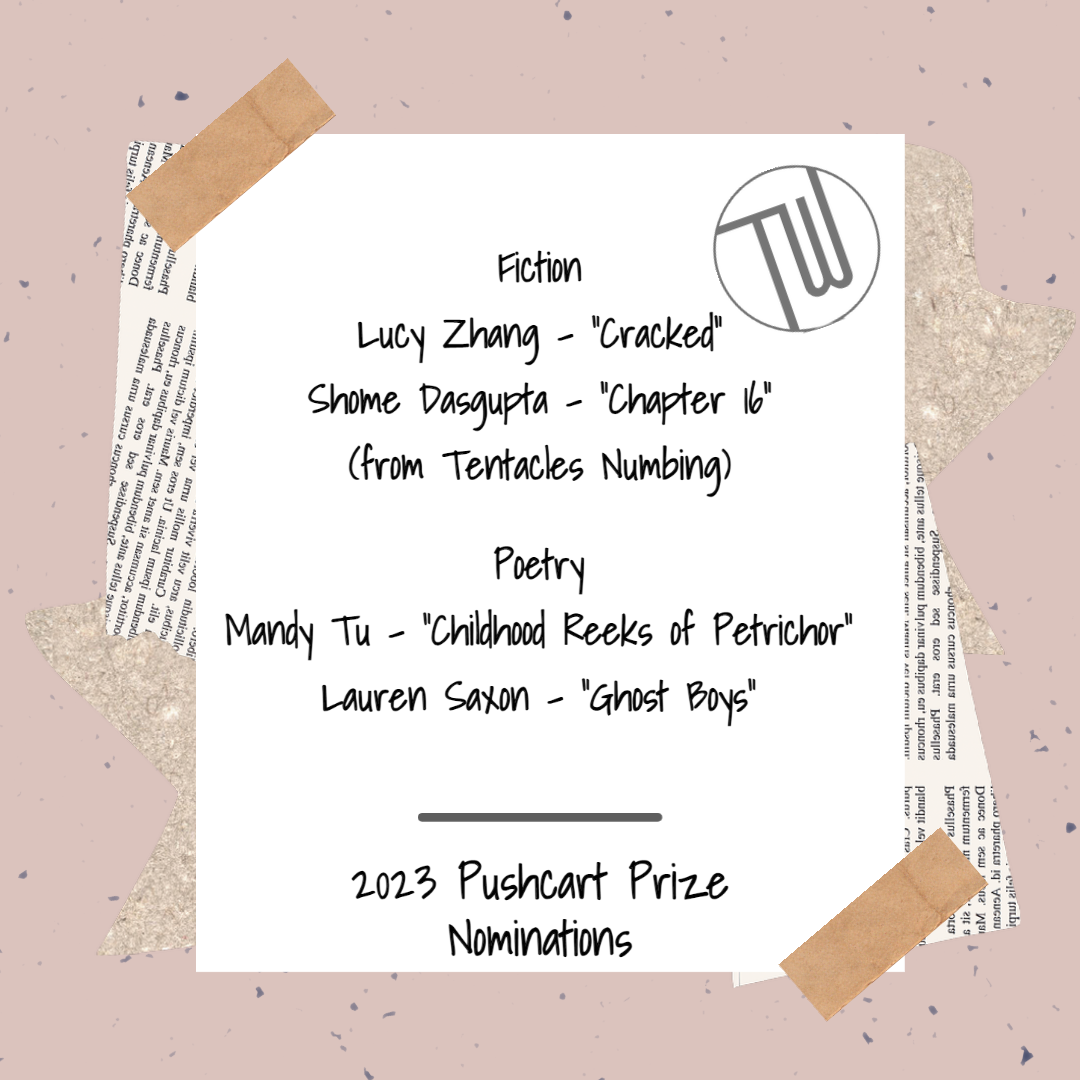
“Cracked” from Hollowed
Lucy Zhang
Everything I touch ends up dead. The succulent dried up on the windowsill. The dog I had for two whole months contracted rabies from a squirrel. The data pipelining project I recently joined was deemed unnecessary and canceled. This is why I tell my friends I can’t have pets, why I tell my parents that planting a vegetable garden won’t engage me with the Zen. I tell them there is not enough room in the apartment. Where a TV is supposed to go are two work desks and the tangle of wires and overloaded power strips. All in a room doubling as the kitchen—my husband and I eat our meals at our desks, too: typing, slurping, hunching our necks forward, there is no room for a pot of soil or litter box.
I wonder if I’ll end up killing the embryo still cushioned in an amniotic sac, like stabbing a fork into an egg yolk, sunny side up, still runny, not quite denatured into chalk-like protein. Is killing an embryo as easy as killing a plant? Out of neglect, although I suppose I just wanted a reason to throw the plant out and make space on the floor for a portable laptop desk?
My parents send me dried bird’s nests, produced from a swallow’s solidified saliva. I am supposed to cook it in water until the white gelatinous strands soften and drink it as soup. They say it will help the baby’s appetite and digestion. It will keep my skin and the baby’s skin clear—like the smooth white bathtub I scrubbed down with bleach after it got stained by blood from my uterus lining. My parents tell me to eat more fruit, especially peaches and strawberries. I should be able to get farm-fresh here in California. I tell them just because the fruit grows here doesn’t make it less expensive. They advocate for watermelon, too. My mom claims that’s what she ate to ensure I had good skin. Good skin is important, I realize, and if my child has bad skin, it is my fault.
Provided we both stay alive, of course. My husband, Li
Jun, or John, his English name that I use because I stopped learning Chinese in eighth grade and butcher his native name, flinches whenever I hold the tip of the knife on the cutting board and pump the knife handle up and down too quickly. From his position where he sits on a squeaky office chair, it looks like I’m cutting my fingers off. It has gotten worse now that I am pregnant. I can see his Adam’s apple bob as he swallows. I also see it when I snip bok choy or crack through a salmon steak’s bones with the butcher’s knife.
I think he’s afraid I’ll run out of blood.
When we go out, John insists on carrying everything—the gym bag of water bottles, the half-empty tube of sunscreen, my hat when I need both hands to tie my hair up—even though I can outlast him in squats and lunges and burpees and planks. He prefers to watch the stock market tickers. I decide not to dispute his logic and instead operate on his directives and doubts. Less work for me to think. I sever my brain from my actions, leave my mental energy to contemplate things like: can I still be held responsible if the baby dies? If I die?
I am always thinking about death these days. On our weekly trip to Costco, I pick up a three-pound container of cherries. I walk up and down the poultry aisle, between organic and conventional frozen chicken tenderloins, wondering if eating the happier chicken would make its death more meaningful. John picks up a gallon of milk because he thinks it’s easier for me to drink my protein, even though we are both lactose intolerant, even though I hate the taste of milk, of freeloading off another mother to nourish a life I can’t one-hundred percent guarantee. As we drive back, I watch a BMW hit a bicyclist as it makes a right turn. The bicyclist falls onto his side and the car stops and the driver rushes out and the bicyclist just sits there. His right leg stuck under the bike, on the too hot pavement, like he’s waiting for someone to tell him it’s OK to act alive again.
We park the car and load the groceries into our reusable shopping bags and cardboard boxes. The watermelon takes up one entire bag. I insist on carrying it. It’s just one thing, I tell John. And there are straps I can hook over my shoulder so it’s not like I need much arm strength. I waddle with the twenty-some pound watermelon pulling down on my right shoulder, my feet shuffling diagonally before I straighten up my direction again. I walk with a sawtooth trajectory. We pass by a group of kids playing badminton before climbing the single flight of stairs to our apartment floor. John reaches the door first and holds it open. I smell the goji berries and sesame oil from the unwashed dishes in the kitchen. Maybe it’s the scent that throws me off balance, or the sunlight blinding my eyes for the split second I lift one foot to take another step. Instead of moving forward, my body tilts back and the bag with the watermelon follows. A cataclysmic shifting of my center of balance until we fall together.
I let go of the watermelon and catch myself with my hands. The watermelon tumbles out and thunks on the stairs, splattering on the bottom floor. Its juices leak onto the expansion strip connecting asphalt. There’s a continuous, jagged split through the hard green exterior. Chunks of red fruit break off and stain the ground—I can’t help but wonder if this is how a human head would crack open. I imagine ants will visit soon. The scrapes on my hands and knees begin to bleed, but I’ve avoided hitting the stair edges. John, who seemed paralyzed before, ushers me into the apartment to treat my wounds, to make an appointment with our obstetrician-gynecologist to check on the baby, to WeChat his parents for traditional Chinese medical advice.
I tell him alcohol and gauze are fine. My hands sting as I hold a disinfectant wipe to the cuts. Red continues to surface. I know the blood will eventually clot. I ask John if he’ll clean up the broken watermelon and if he’ll buy a new one. You know, for the baby’s skin.
He says sure, and I think: the watermelon was already dead. As soon as it was plucked from its vines before its seeds could darken. Still white specks and soft. Nearly translucent, infertile. It couldn’t have died twice when it rolled down the stairs and revealed its insides to the world.
Chapter 16 from Tentacles Numbing
Shome Dasgupta
The night before their parents’ murder, Father caught Vavi smoking in the driveway. Ravi was there, watching his brother inhaling and exhaling, watching the smoke coming out his nostrils and mouth, wondering how it all worked. He let Ravi take a drag, and Ravi almost choked, coughing and gasping for oxygen. Ravi said that he would never smoke again and that he couldn’t see why Vavi smoked.
Father was up around two in the morning to get a glass of water when he saw the glowing orange of the cigarette through the window. Vavi didn’t throw away the cigarette when Father walked out—at least not immediately—not until Father told him to throw it out. The brothers both went inside and received such a loud scolding that Mother rushed to the living room with large eyes and loud breathing. This was the maddest Ravi had ever seen his father, shouting how disgusted he was with them, calling them idiots, saying how ashamed he was with them. Ravi was relieved that Vavi was able to hide his drunkenness, or else they would have had to hear it for at least another hour. Vavi remained silent the whole time, staring at the ground with his hands in his lap, while Ravi tried to interject now and then, though he knew that Father wouldn’t give them a chance to speak. Mother remained silent, as well, but it wasn’t the silence Ravi was used to—this silence was filled with disappointment, not sympathy. After Father finished scolding them, he walked back to his bedroom, followed by Mother. The brothers went back to their own rooms, but Ravi couldn’t sleep, so he went to see if Vavi was still awake. He was in bed, reading a book on Eastern philosophy while sipping Vodka.
“I’ve never seen Father so angry,” Ravi said.
“Well, he should be,” Vavi replied.
He spoke in a quiet voice—not a whisper, but with a calm tone. He didn’t seem shaken up at all from the lecture they had just received.
“What do you mean?”
“I mean, he did what he was supposed to do,” Vavi said. “He’s a good father. He loves us.”
He took another sip and told Ravi to go to bed because he wanted to get up early and play outside the next day. This made Ravi happy. It made him think that everything would be okay and that Father would soon forgive them.
The next morning, Father went to Ravi’s bedroom. He was still sleeping or just waking up from sleeping, still in dream mode. Father ran his hand through Ravi’s hair, and Ravi was glad that he did this, but Ravi turned his back to him. Father knew Ravi was awake, and he told Ravi that he loved him. Ravi never responded. He didn’t say anything. For no reason, Ravi was mad at him and gave him the silent treatment. Father kissed him on the cheek and walked out of the room. Mother came in soon after, and Ravi acted the same way, no matter how badly he wanted to cry and tell her how sorry he felt.
“Childhood Reeks of Petrichor” from Monsoon Daughter
Mandy Moe Pwint Tu
I am angling for a dream that will not come.
The ginkgoes have shed; like them, laden with air,
I come up empty. Fistfuls of gold, crumbling.
Wide-eyed and winsome, dandelion grass
tethered in smoke. The house, its fond eyes,
are yellow like its doors. I pull them
from my memory. A cup: browning, shrunk
with age. The heaping of the years is transference—
a girl is older who never grew up. Her hands
stick with poems. Ghosts of tadpoles, frog eggs
like netted seafoam, gossamer, clinging to devil’s ivy.
Hold for the worlds; live only a little.
Rain crashes on cold pebbles.
The frogs, dissonant with desire. The scent
of rainwater indistinguishable from sweat.
My father’s corpse on a wicker chair,
poised as if he were still sleeping. The cat
by his feet, curled up on amber tile.
Horus, I call, until my voice becomes
a whisper. I think the house holds
his ghost in its cupped, yellow hands.
I think it held mine—haunted my father
to death. I know he haunted me, his ghost
my yearning: absence that spills and spills.
My father’s last breath—a teetering raindrop,
splattered on ash. His wife says they cut down
the bamboo shoots of my childhood.
The only percussion now is the rattling
railway, the boisterous frogs, begging,
come back, come back, come home.
“Ghost Boys” from You’re My Favorite
Lauren Saxon
there’s a room outside heaven where Black boys go to
cry they enter single file
lowering hoods & hands at the door
there is standing room only
there are wide eyes only
slowly, they introduce themselves with first day of school
jitters they compliment each other’s Nikes & mixtapes
every laugh and
nah bro, i’m just trynna get like you
gets absorbed by the
walls one boy asks
about the bullet holes in everyone’s
back they realize it all at once
the police. Hashtags.
Injustices. they are missing their own
funerals
a ghost boy cries the word
unfair in his sister’s voice, while another
collapses under the weight of his father’s
sigh each time the phrase too young strikes the
ceiling
two spirits merge—
they exhaust themselves.