
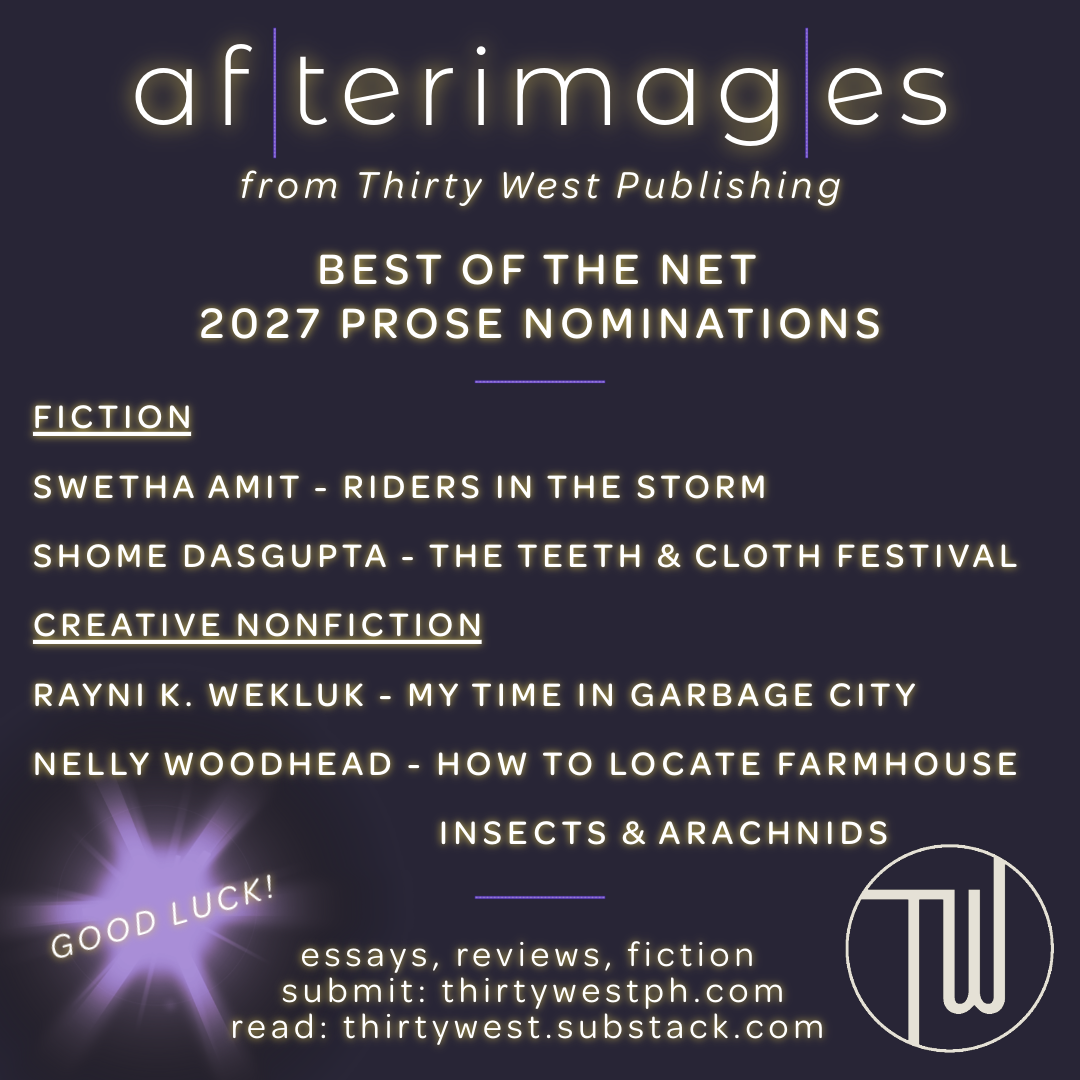
“How To Locate Farmhouse Insects and Arachnids”
Nelly Woodhead
· Recall that many types of exoskeletal creatures offer clues to their recent presence. For example, cockroaches leave behind the shells of their hatched eggs to show you where they nest. These eggshells can be found stuck to the labels of out-of-date canned goods.
· Fully-grown cockroaches are usually lounging under an armchair, and will scuttle away if the chair is moved in an effort to clean the floor. Their dead companions will remain in a supine position, legs akimbo, and can be swept into the plastic standing dustpan that was found outside after a half-hour’s search.
· June bugs typically prefer to expire on window sills, whereas silverfish enjoy wriggling among the pages of books, especially monographs on gardening methods or country-style décor.
· A yellowjacket will occasionally tread water in a cooling cup of coffee, like the one that the farmhouse owner placed on a level surface for several minutes while he repaired a leak under the bathroom sink. This winged swimmer will typically forgo a friendly greeting in favor of stinging the coffee drinker’s mouth when he sips the now-lukewarm caffeinated liquid.
· Find spiders and their webs at face level, across a door frame.
· Let’s not forget that scorpions are arachnids, too, and they consider your toes to be tasty prey. View resident scorpions from a distance by turning your shoes upside down and shaking vigorously. In addition, carefully de-scorpion packaged angel food cake before consuming.
· In the bedroom that also functions as a hobby room and a storage area, look for dead flies and gnats between the window pane and some plastic sheeting, where the tiny winged beings have congregated in a failed effort to exit the premises.
· Farm guests may prefer to identify insects by their bite. This strategy is most useful with ants, chiggers, mosquitoes, and hornets.
· If you are a teenager, and you are avoiding kitchen cleanup by taking a long shower directly after a meal, note that the bathroom can be a prime insect-viewing location. However, keep in mind that you may want to cut short your showering time if you happen to see a maggot in the shower while you are washing.
· Remember that the maggot sighting could later be called into question when a millipede is found in the living room, and your parent or aunt wonders if maybe it was actually a millipede that you saw in the shower instead of a maggot.
· Further, your confidence that it was indeed a maggot might be bolstered when your teenage cousin claims that she, too, saw a maggot when she was showering.
· If you are a parent of a teenager, keep alert for insects while showering, but also move the tension rod holding up the shower curtain over about six inches. This will prevent the shower curtain liner from clinging to your skin while you are washing, and at the same time, will allow you to remain vigilant in finding insects, such as maggots.
“My Time in Garbage City”
Rayni K. Wekluk
First love is torsional. It acts as a fish does when met with air, foreign. Timeless. A very old god. Suppose there’s the rare case that it’s everlasting, as we convince ourselves it is, the parties involved are either very lucky or rather unlucky. Who am I to say for sure? I feel fortunate to be absolved of my first love, though if the embers were stoked, I’m sure “the subtle electric fire” playing within me, as Whitman writes, would return in an unstoppable swell of flame. Romance bears emotion we’re taught to desire early on in life–and that initial inkling? The happy writhing of our body, heart, and mind, which, for the first time in our realities, is dependent solely upon another? Maybe nothing is more sensational.
Someone I know got shot in the leg. He was put in a truck bed, and the bed was filled with blood on the way to the hospital. Beautifully, humans have the capacity to hold so much within our bodies. A bullet to the leg? That’s our physical capacity, but there’s also our emotional and psychological capacities, which, unlike our bodies, are vast, wiry, and unending in cases such as love. It’s not always a great thing–I mean, who wants a bullet in their leg? Some lovers have all that metal. Some lovers have hooks. It’s the hooks we spend so much time trying to understand. For me, no solace was ever born from those attempts. Only poems. Only the resolve to look at poetry as an entity–something much bigger than any of us or, in this case, my first love, with all of its impropriety and languor. It came for me at an age where everything I knew was changing, and respite was in asking not what poetry could do for me, but what I could do for it while navigating a period of immense pain; there’s so much to harness there. To pull from the well of ache has always been a poet’s greatest strength, and though I don’t endorse all poets being trad-sad and full of constant woe, I admit to the merits of what such a mental state can produce if done for the right reasons, which is to say, in the name of poetry itself.
I was never writing to him or even for him, that first love of mine. I couldn’t write. When the question of how I was doing would come up, my response was a spin on “down in the dumps.”
“I’m in Garbage City, man.” I would say. Everyone knew why.
Perhaps, since the day we met, I loved him. To his credit, he told me he had a girlfriend. It was likely the third sentence he spoke to me that day. As crushes do, one formed against my will and, as is typical when one crushes on a member of a committed relationship, I imagined my crush harmless. But what was apparent to me in an ineffable way was that my feelings were reciprocated, thus resulting in the beginnings of a tormenting emotional affair. And the physicality was out of a Jane Austen novel. Never anything more than is respectable. A handhold. Removing the hair above my eyes. Gestures of affection like drawing hearts in the dust caking my windowpanes or getting down on one knee and presenting me with a leaf. Such courtship, so elementary. Not of this time or any time. Iridescent in my memory, yet haggard with my recollection of everything wrong with our secret love for one another–that really was no secret at all, just unspoken: was I putting it into words to make it so?
I think that’s fair to say.
And, what I truly documented was our unravelling. I found a typewriter at an antique store for $80. It was a 1967 Adler. I spent all day working on computers, and I wanted something more tactile and urgent. I was obsessed with finding my creative process, and after switching directly from T.S. Elliot’s how-to-write essays to Stephen King’s On Writing, it felt possible for me to call myself a writer for the simple act of writing. I asked the internet what the first step to publishing poetry was, as this was before I entered The Writer’s Workshop at my alma mater, The University of Nebraska Omaha. I knew what I wanted and was learning how to make it happen.
Around this time, I began to suffer from insomnia. It was suggested to me that I read the dictionary before bed to put me to sleep, but it had the opposite effect. Garbage City was becoming more than a saying for me. It was my state of mind. A mental cavity, I believed, there was no escape from. Everything was for the writing; regard for my well-being was very little.
I listened to hours of live readings done by my favorite poets and began memorizing the lines, and even what they said between them. Drafts came at all hours of the day and night. This was likely the most manic and productive period of my life thus far. I’d take a pen to the freshly typed pages before hanging them on the walls for days, and transferring them to a digital space to send out for publication. My manuscript was prepared prior to my learning the word “chapbook.” I’ll never forget the feeling of “Oh, that’s what I’ve been making.” It was like a diagnosis. I had all the symptoms–and I was completely obsessed.
I called the chapbook Garbage City Poems in honor of my time spent in Garbage City. “The dumps,” a euphemism for depression and utter loss of control. My youth and my femininity were two things I had to come to terms with if I wanted to move on from the pain represented in each poem. What a large ask of myself. I hadn’t learned patience. I was hungry for purpose. I have no regrets, rather a strange pride in my girl-self. I did what I could do. I, slowly, removed the hooks of my first love. I bled all over the months that followed. I loved again, harder than that time.
I sent my manuscript out in March 2024. Garbage City Poems was a Harbor Editions 2024 “Marginalia Series” Semi-Finalist in September, and by October, Thirty West Publishing House had accepted it for publication. It happened so quickly when I think about it now.
And, it’s as I said–no, I never found what I was looking for in the lines. I still don’t understand. I hold it. The poems hold it too. An un-answer.
What was he thinking?
Didn’t I know it was wrong?
Maybe if I’d been a little older…
These questions will always live inside of me. So, then, will a million others.
I move them aside. Ask: “What’s next, what’s next?” The next love, the next poem, the next death? Anne Sexton said we live again and die again.
At the end of this life, what will I be composed of, body and soul?
So, I ask, not what poetry can do for me but what I can do for it. I wait. The poems come.
Repeat.
“Riders in the Storm”
Swetha Amit
By the time Mark agreed to come to our regular New Year’s Eve horse riding retreat at Santa Margarita Ranch, it already felt like something between us had ended.
When we mounted our horses after arriving, the sky had already turned the color of worn steel. Rain from the past week had soaked the ground completely. We rode in icy silence. The rhythm of hooves shattered the quiet with slow, deliberate beats. The air smelled of pine and decay.
My horse, a magnificent chestnut-colored animal with a white patch on his neck named Copper, kept pausing to graze the grass. Then he would look up, ears pricked, and stare at the gray horizon. Each time he stopped, I gently nudged him with my heels. Whenever Copper moved forward, I could feel his restlessness blending into mine.
Mark was ahead of me, his back straight and almost stiff. I noticed the familiar lines of him—his shoulder slope and the tension in his hands gripping the reins too tightly. He looked tense and maybe a little too controlled.
A year ago, on this same trail, we laughed at everything—at how the cattle seemed to glare at us like unimpressed judges, at how our stretched shadows caused ground squirrels to dash away. and being in awe of the bald eagle circling overhead. Mark would keep turning back, smiling easily, and humming a tune.
Now, he didn’t look back. I couldn’t spot the squirrels, the bald eagle, or the cattle. Perhaps they sensed a storm approaching.
The silence between us stretched as we were in separate rooms after heated discussions about our long, demanding hours at my tech job and his frequent travel in marketing. What used to be small disagreements had escalated into accusations—missed calls and late nights fueled suspicions, widening the gap between us.
Copper stopped again.
Mark finally turned. “He seems restless.” His voice carried a hint of accusation.
“Maybe he feels it,” I said. “The storm.”
Mark’s jaw clenched. “Maybe it’s the rider.”
He urged his horse forward again and trotted ahead. The words hit hard. A sudden gust of cold wind slapped my face. I gasped briefly. My breathing quickened, and my heart pounded. I squeezed my legs and unintentionally loosened the reins to calm myself. Copper immediately lifted his head and then bolted. For a moment, there was no trail, no Mark—just sound and motion. The pounding of hooves, the rush of air, and my raw, animal panic.
I grabbed the reins and pulled them tight. Gradually, Copper slowed down and then stopped at a spot overlooking the valley below.
I heard Mark’s voice behind me.
“Where are you going?” he was panting.
I didn’t reply. My heart was still pounding like a scared bird’s wings. The world around me was foggy.
Two years ago, we ran along Cowell Beach barefoot and breathless, chasing each other. I remembered how he reached for me then, without hesitation, grabbed me around my waist, and swung me around. I laughed and begged Mark to put me down. The gray ocean, soft sand, swarming seagulls, and the pearl white fog around the pier felt like a blur now.
Mark pulled up beside me. For a moment, neither of us spoke.
“Are you okay?” he asked, finally breaking the silence.
“I don’t know,” I said. My hands still shook, and my heart was still pounding. I took a deep breath.
A thunder roll echoed across the sky. The first drops of rain arrived—light at first, then growing steadier—softening the edges of everything they touched.
Mark gazed out over the valley, then turned back to me. His hand lifted slightly, hesitated, and then settled on his reins. I could still feel his warmth through the chilly blast of old air.
“I don’t know either,” he said.
It was the most genuine thing he had said in months.
The rain soaked my hair and our jackets.
He took a deep breath. “We can’t keep riding like this.”
“No,” I agreed.
For a while, we just stood there listening to the rain caress the muddy trails, and our horses perked up their ears.
Then he softly said, “Let’s...try again. Let’s just stay together.”
Together? Did he mean the ride or something else? I wasn’t sure. I looked into his eyes, obscured by the downpour of icy droplets.
“Shall we?” he asked, his hands in control of the reins once again.
I nodded before overthinking it and grabbed my reins.
We left without saying anything else. This time, we rode side by side. The trail squished beneath us. Our horses moved with rhythmic ease, undeterred by puddles of water and splashes of mud and dirt, as we inhaled the scent of wet earth.
The storm seemed to have settled around us. The rain continued—not the kind that destroyed everything, but the kind that brought a respite when heat levels rose. Copper moved smoothly, his earlier tension gone, and his gait more assured. Mark’s horse moved alongside him effortlessly.
The ranch shimmered with fresh green. The cattle and squirrels were still hidden. Even the eagle seemed to have vanished behind the clouds. It was just us walking along the lush trails.
At the stables, we dismounted quietly. My legs felt unsteady as they hit the ground, just like they always do after a long ride. Mark moved closer—not quite touching, but no longer keeping his distance. He gazed into my eyes.
Two years ago, we looked at each other adoringly—when we took our marriage vows—solemn, steadfast, before he wrapped me in his arms and kissed me.
“Are you okay? I asked.
He grabbed my arm as we headed back to the car. On our drive to the hotel, the rain stopped. The swirling gray clouds and mist faded away. The terrain around us was sparkling green. Mark played some music. For the first time, I felt hopeful that the storm wouldn’t return soon.
The Teeth and Cloth Festival
Shome Dasgupta
Bones and dirt and butterflies, and he found a way to marble, cracked and chipped, eroded by air and the bellowing black cloths when once there were hymns of praise, now lamented tongues.
No one knew his name—the town never asked, and he never shared, and there was no need. It was a community of friends and family, all there for each other. Did he live there? Was he born there? He didn’t even know himself, a nomad with no history or account of his origins, but just like that, one day, as the sky darkened—burrowed and burying brow, he arrived wearing nothing but a torn cloth around his waist and holding a peel of an orange.
There he stayed—they invited him, the townsfolk, to stay at their homes, to dine with them. One kind family offered to adopt him, though he was well over age for such an occurrence, but no one knew his age, not even himself. His most remarkable feature, as they would converse daily in recognition, was his teeth. Despite his unkempt nature, the stranger’s teeth shone, some saying the town looks much lighter since his arrival.
10 months he lived there on the streets before dying, living off scraps and sleeping in alleys even though he could’ve resided with a much posher situation, this way and that. He bothered no one, and they didn’t bother him—just a friendly hi, a bit of banter under the sun or drenched in the rain. It didn’t matter; they all enjoyed the stranger’s company.
There was a night, though. A night of the wolves, where they ventured into town in search of flesh and fur and feathers. They haunt in rarity, the last being sixty years ago—some still alive to thread the account for their descendants.
The stranger—he—had just finished dinner, scraping his tongue against the tin plates left behind the bistro after the day’s end, drips from the outdoor faucet sided such a meal, and though the cook incessantly offered him fresh food on clean kitchenry, the stranger refused.
On that night of the wolves, one of them—the largest one went straight for the son of the mayor who was late into retreating to the house. Teething the boy’s arm, the stranger whispered his prayers and sprinted toward the commotion, and before the mayor could make his appearance with his rifle, the stranger tackled the creature with such force; the teeth were released. This was good for the son who was able to run away into the house. This was bad for the stranger as the wolf’s teeth now sunk first into his leg, then his stomach, then up to his neck. This was all before the mayor, once a renown aimer, pushed the bullet forward with the pull of a trigger, causing alarm for the rest of the wolf folk, seeing their leader limp away with whimpered snarls.
All the strangers survived, but the town’s stranger was dead.
The mayor couldn’t gather whether it would’ve been too late if the stranger hadn’t fought the wolf to save the dear son, or if the visitor would’ve paused and he himself could’ve released the wolf with the use of gunpowder, but either way, the community’s guide hailed him as a hero, saving his child and the town.
So, a gathering of sorrow—a celebration to cry and remember, and the town came together to create what became known as the yearly Teeth And Cloth Festival where everyone wore torn rags around their bodies to commemorate this stranger. There was a drummer at the funeral, lightly tapping on skin while the community formed layers of circles around the gravestone. A song—a few words of love, and then they all proceeded to the center of the city for food and dancing.
The townsfolk engraved a name for the stranger on the headstone—a simple one, Stranger And Friend. Once everyone had left to mark the first annual event, there was a new visitor, alone at the stranger’s grave—a wolf, calm, and with a tilted head, whether toward the sky or toward the dirt and bones, there was a butterfly and a tear.
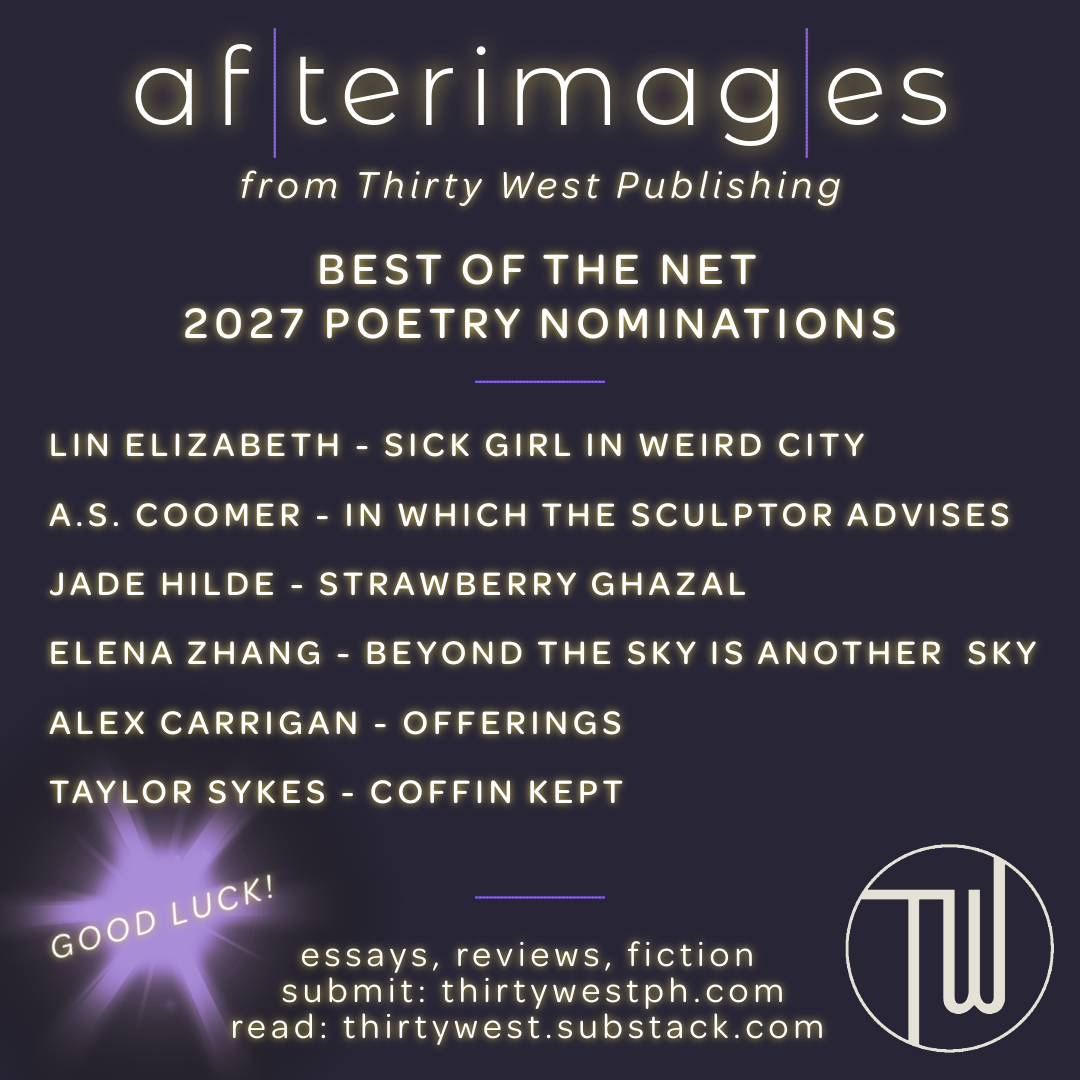
“Sick Girl In Weird City”
Lin Elizabeth
The speaker of this poem is making another hapless attempt at sleep.
The clock on her phone reads 12:01a.m., her partner is sleeping in their shared bed,
It’s been a thing recently.
The speaker of the poem
understands that nothing comes easily.
She is afraid of the four of swords reversed on her ashen table, sage spilled in the air.
She is a dear person,
as in D E E R- target painted neon red on her head.
A light on her prefrontal cortex, where her memories haunt in the middle of her head, as she bows her head to drink from her water.
The speaker of the poem is not the possessor of the laser, of the target, of her being prey. The possessor of the target has forgotten that she, the deer with the laser pointed to her thoughts, eats the meat that they seek too.
They sometimes call it an opportunistic omnivore.
It seeks
Even the cards say so.
“in which the sculptor advises”
A.S. Coomer
i took yer book out into
the tenebrific night knowing the dark
couldn’t cover the neon of yer words
i dripped moon-dipped Poetry
how some books rhyme with our minds
the way watermelon rhymes with summer
old man winter whispers a white sonnet
how we build our homes with ice
this collection of clear rooms
where we all waltz with ourselves in the dark
gives us just enough remove to bare all
even if only in words
it’s a matter of removing what’s not
needed to reveal what’s already there
“Strawberry Ghazal”
Jade Hilde
The beginning of the year, suddenly, is the clapboard stand built to sell spring’s strawberries.
Her face–strong boned and delicately made up–smiles, speaks to the healing of strawberries.
Every year, she calls our children her babies and feeds them, wishes “God bless you, mijas.”
Even though the world killed my belief, I repeat her prayers because survival is strawberries.
This year, she packs palettes of fruit in her car and lets the air conditioning run; the farmworkers
Are gone, fields emptied by fear, and now her papers are tucked between boxes of strawberries.
Today, I drove past her stand, but it was not open yet. She was not there. Sirens scatter birds
From a telephone wire, but they keep formation. I worry her face is, too, fragile like strawberries,
Like my uncle–hard from war but soft-cheeked, if not doughy–in the picture on his “Illegal Alien”
card, features that we didn’t know where they came from, if his father’s fields grew strawberries.
Every new word called out for more questions, just as every wailing siren has me swiveling,
Wondering if she’s okay, where we come from, if our seeds were scattered by birds, berries.
“Beyond the sky is another sky”
Elena Zhang
To go to space you must dance
in fire and catch snowflakes
on your tongue. I went through
a cloud and saw a field of
tulips go out of frame.
When the airplane sang
an aria about houses that are
waterfalls. Do you like to burn
the marshmallow and
taste the dimpled scars?
There is value in collision.
In the kiss of sound.
“Offerings”
Alex Carrigan
A golden shovel after “Hounds of Love” by Kate Bush
I’m ready to give up everything, to take
all that ties me to this place, all that my
life is defined by, and surrender it. No more shoes
for rocky terrain, no more clothes for the cold. I’ll take off
my pendants, rings, and hoops, give them to the depths, and
dance as they sink into the water. Next, I’ll throw
in my hair, my nails, any flecks of skin. All of them
will vanish from sight, as will I, quietly here in
the deep country. Perhaps some part of the
trace will remain, but the rest will sink into the lake.
“Coffin-Kept”
Taylor Sykes
I keep you in the coffin under my bed
My bed itself is a coffin for affection
If coffin were a language
My bed would be coffin for distance
You never got so close to me
Now I keep you under, I keep you close
You used to kick at the boards
A restless death, no quiet going
So different from yourself in life
Beating the boards with splintered palms
The sound that cradled me in sleep
We were both messy sleepers
When I turned, you turned, my mirror man
That was our embrace
There were those nights I almost crawled in there with you
But that coffin was not made for me
Both our bodies could never share such a space
My bed was my coffin and we were death stacked
After months you grew quiet and lay still
You were complacency curled
I kicked the coffin like a dried wasp nest
Just let me die here, you begged, voice spent
But I was not merciful, I was as selfish
As a widow deserves to be
I did what I could to keep you
Though I knew a coffin-kept man had no hope
When I writhed at night, you stayed still
I cried your name and you could not hear
You were barely breathing then
You went the night I slept with another
Loneliness was my excuse, even as I imagined he was you
He did not know your bones were beneath us
By daylight he dissolved and you were gone too
Had you heard? Did you care? Does death envy life?
Alone now, my coffin creaks against yours, back to chest
In the note I ask that they burn us together
In a coffin built for two