

Joseph Sigurdson: 1 Poem
In Meditation
Sometimes I stare at existence as deadpan as an infant who isn't crying. Then I lie in a long field, pick one green strand, and know I am and will forever be the only human to give this particular piece of grass any thought. Then it fades, and I care about little save food and reproduction. Death finds it way in, later. How can I not see blackness even if my eyes are no more? I imagine death will be quite similar to January 8th 1256, which I wasn't present for. And that day wasn't so bad, was it?
Joseph Sigurdson is a poet who likes his orange juice with *some* pulp.
An interview with poet, Rebecca Kokitus

JD: Thanks for taking the time to interview for The Weekly Degree. For starters, tell us a bit about yourself and your poetic endeavors thus far?
RK: Thank you for having me, Josh! Well, I am a poet from the Philadelphia area. I only started publishing work within the past year! I have had almost fifty journal publications thus far and have been participating in readings in the city.
At the end of 2017, I was in a very tough spot—I threw myself back into my schoolwork and into draining, toxic relationships without taking time to acknowledge and work through the grief I was experiencing following my father’s death in May of that year. I started 2018 determined to take care of myself and to change—I put my all into seriously pursuing my passion for writing and it has been so rewarding.
JD: Glad to hear you turned things around! In regards to submitting your work, how does the interaction with presses, journals, etc. encourage and/or inhibit you as a writer?
RK: Most of my interactions with small presses and journals have been very positive and rewarding! Publishing through indie journals is great because it’s definitely very personal, and there’s a lot of mutual support between writer and publisher there. I also volunteer at a couple of online journals—mostly reading submissions and voting on them—and I love it! Reading other people’s work makes me fall in love with the art of poetry again and again.
JD: I may need to call up your reading prowess sometime…What are some common tropes in your work that have defined “you” as a writer?
RK: I once tweeted something that said “How to tell if you’re in a Rebecca Kokitus poem: something is rotting, you’re bleeding from somewhere, slightly sexualized nature imagery, your father is dead or otherwise absent, swamps, sex drugs rock n roll, etc…”I think that sums it up pretty well! In all seriousness, I write a lot about my relationship with my own body, about femininity, about grief, about nature, about sex, about spirituality, and the places where all of these things intersect.
JD: The poems that I’ve published on The Weekly Degree (and also heard you read live) center around your deceased father, which I can empathize with since my mother passed away when I was young. Do you feel the culmination and interpretation of loss is necessary? Are your coping mechanisms more “traditional” or advantageous only to you?
RK: I’m so sorry, Josh. It really is a unique devastation, losing a parent.
I would say that for me, writing through this grief has been one hundred percent necessary. I’m not good with words, except on paper. I’ve always struggled to talk about what hurts. There’s too much temptation to downplay my experiences. Writing is my form of catharsis, and my way of exploring my own emotions in ways I don’t allow off the page.
JD: Totally agree. Poetry, even if abstractly written, can be all it takes to give old memories some fresh air. I’ve also noticed your keen ability of establishing a setting & mood. Do you have any stark influences that have helped you perform these devices well?
RK: I have always been obsessed with atmospheric writing—I’m a sucker for Midwestern Gothic, for dark and rural stories. Finding the darkness in everyday settings is fascinating to me. This is something I strive for in my own writing.
JD: You’ve recently performed some readings with occult themes such as The Witch Market and A Witch’s Craft: Poetry & Panel. How has the community at large received your work?
RK: I truly believe that writing itself is a form of magick. I write poetry by finding magick in the mundane, by attempting to put what is inexplicable into words. There are definitely lots of writers-slash-mystics who are much more in tune with their practice than I am, and they inspire me to explore that part of myself more. I absolutely love being involved with A Witch’s Craft—being part of this sort of niche coven at the intersection of witchcraft and literature is exciting for me.
JD: Cheers to community! Any future projects on the horizon? Chapbook, collection, novel, etc.?
RK: I definitely hope so! Right now I am in the process of trying to publish my debut chapbook. I would love to someday release a full length collection, maybe even explore other genres. For now, I’ve been putting my all into perfecting my chapbook manuscripts and finding the right homes for them.
JD: So, how has your hometown been reflected in your work? How have your studies at West Chester University done the same?
RK: My hometown is often present in my work. I come from a very small town in rural Schuylkill County—real Pennsyltucky country if we’re being honest. But I have a connection with it that I never get tired of writing about—there’s a sort of eerie, Appalachian wildness to the land that I am forever trying to define. All small towns have an ugliness to them though like drug abuse, poverty and the like. I don’t turn a blind eye to that part of my home in my writing. That would be inauthentic.
As for my time at WCU, I applied to the university on a whim after being rejected by another school. I didn’t even see the campus until I moved in as a freshman, but it felt right to me. I still feel like I made the right choice. Through my years as an English major, I have come to understand my craft. I have had one professor in particular, Dr. Kristine Ervin, who has helped me refine my writing over the years. She was one of the first people who encouraged me to submit my work to literary magazines.
JD: Very intriguing. I hung out a lot in West Chester in my youth, so I’ve had plenty of interaction, yet it’s cool to see how you immediately gravitated toward it. Next question, what three adjectives best describe you as a person?
RK: According to the online quiz I just took (haha!), I am “creative”, “adventurous” and “spontaneous”. I’d say that’s somewhat true, although my life is a constant struggle between wanting to be a recluse and wanting to be adventurous (Sun in Taurus, Moon in Aquarius).
Seeing myself as I am is hard for me—I have a lot of issues with self image that go beyond physical. I find that writing about myself, about my thoughts and emotions, about my relationship with my body—is the closest I come to understanding myself.
JD: Apparently, ancestry.com states that only one Kokitus family has been noted in PA and only PA since 1920…how confident are you to think that’s your family?
RK: I would say 100% confident. It’s definitely not a common last name!
JD: …thought so! Lastly, what’s your go-to drink while writing/reading? (Can be alcoholic or non-alcoholic)
RK: I’ve never really thought about it! My inebriated writing leaves a lot to be desired, so probably coffee or tea!
JD: This would explain those late-night writing stints perfectly.

Rebecca Kokitus is a poet residing in the Philadelphia area. She is a student at West Chester University of Pennsylvania, where she studies English with a concentration in Writing. You can find her on Twitter and Instagram at @rxbxcca_anna, and you can read more of her writing on her website: https://rebeccakokitus.wixsite.com/rebeccakokitus.
Josh Dale: Bucks County Book Fair

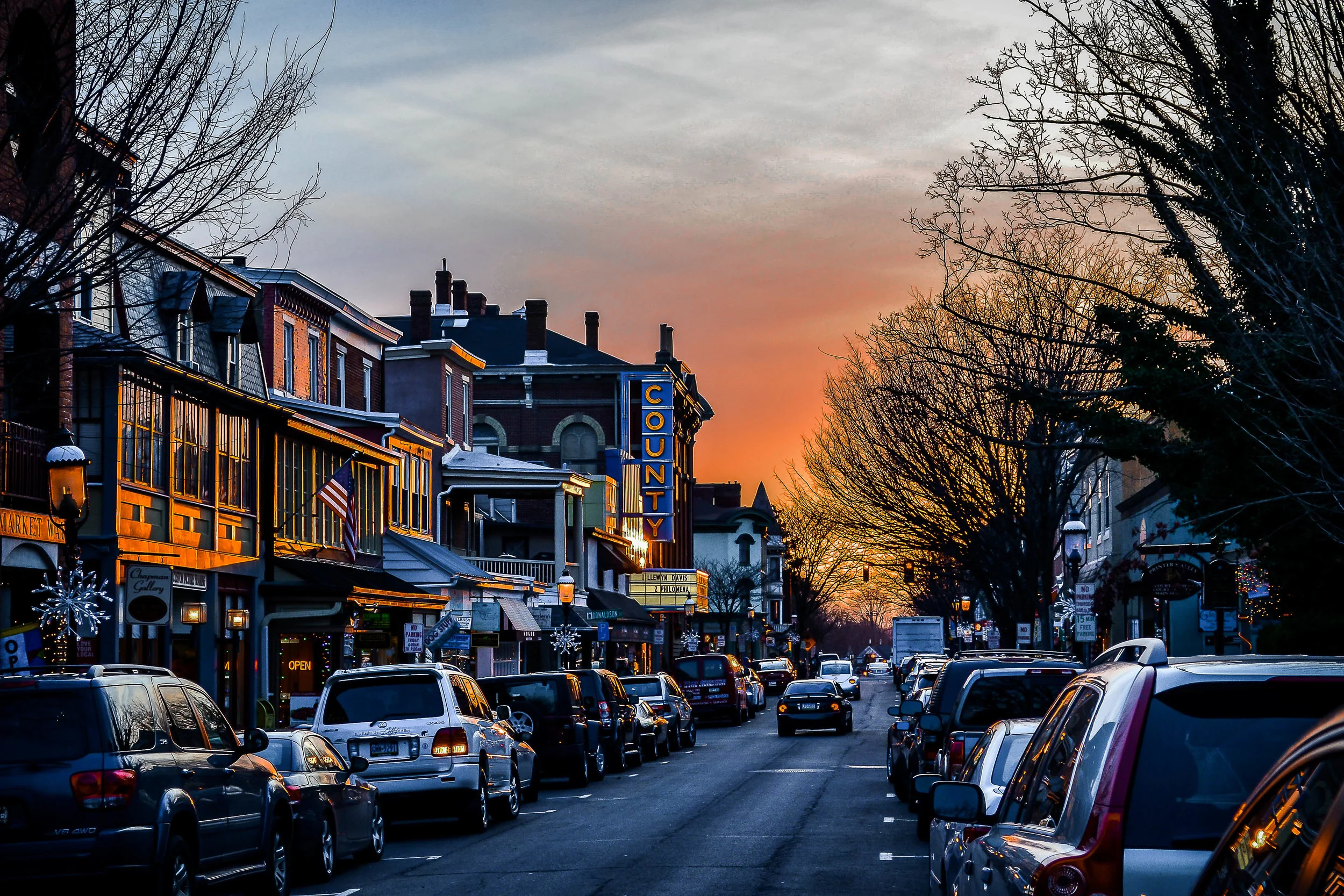
Downtown Doylestown at sunset looking down East State Street, captured by Michael Brooks
Bucks County, which is settled in the suburban north-northeast of Philadelphia, bolsters a growing population of over 620,000 citizens and a rich scene. I’ve never really had the chance to explore due to my geographical locale, but I’ve slowly begun to appreciate what’s to offer there. I’ve driven through the diverse, yet quaint, streets of Lansdale, ridden my bike feverishly down the 202 Parkway trail, read poetry at Farley’s Bookstore in New Hope, seen comedy and lost some money at Parx Casino in Bensalem, and drank multiple pints at the ever-endearing brewery that is Neshaminy Creek. Today, however, was a time where I was to explore the inaugural Bucks Country Book Fest in Doylestown.
Upon parking, I ended up getting lost among the busy center. Small businesses of all types from coffee shops, craft stores, gastropubs, and more pulled me in with a magnetic force that one would acquire when visiting a vivacious community. Splashes of contemporary designs intermingled with the architecture of the past. I stopped by the legendary Doylestown Bookstore to pick up the latest novel from Jac Jemc (a book club favorite as seen with the display they were standing on). I then traversed southbound and made it to the SEPTA train station. Throngs of commuters departed the train which ends its long traverse from Center City to S. Clinton and I hoped, even for a slight moment, that maybe they were all going to the festival. Well, it sure seemed that way once I found it.
I was able to successfully pinpoint the end of the “gauntlet” thanks to local author Nick Gregorio’s keen Instagram story, to only find their spot vacated. Maybe the crowd was concealing them; dozens of intrigued participants head-down into their next favorite read. I decided to meander around, as to not only but hopefully find the wayward author but to peruse the vendors and scenery of the 3rd literary festival I’ve attended this year. The layout was easy to navigate, with a single row of booksellers and authors behind massive white pavilions. Hosted by Philadelphia staple, WHYY, and plentiful amounts of local and statewide support, scores of industry-leading authors, publishers, and illustrators such as Michael Buckley, Floyd Cooper, Jennifer Gilmore, Chris Hedges, and Susie Orman Schnall. There was, of course, a merch pavilion, auxiliary stations for other projects, and a giant banner, teaming with festival-goers’ favorite book.
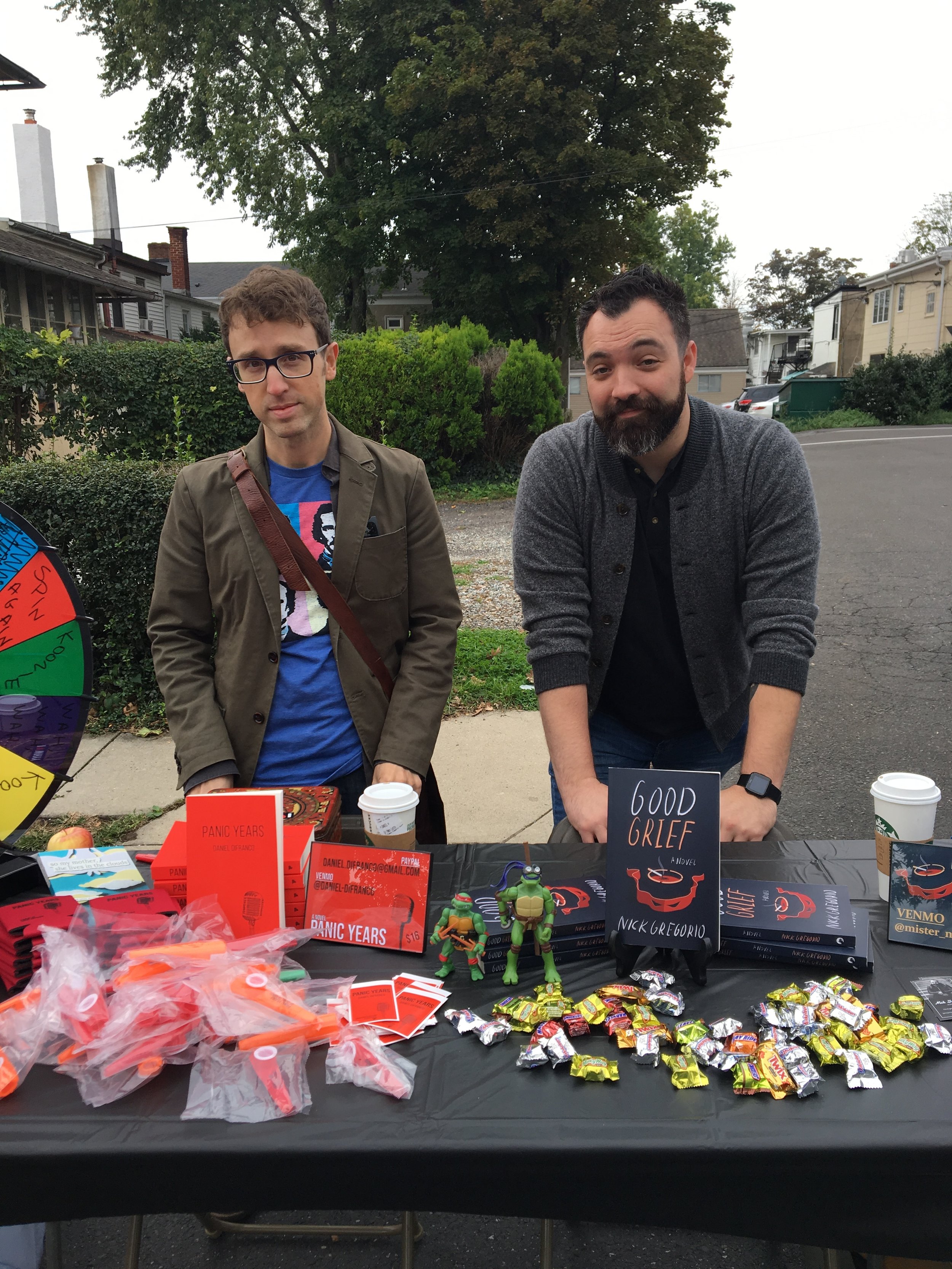
Daniel DiFranco (left) and Nick Gregorio with their displays
I wasn’t keeping track of time, but I ultimately found him, thanks to the unnatural clicks and clacks of a prize wheel. He, along with another local and talented author, Daniel DiFranco, split a table chock-full of their latest novels, bookmarks, pins, candy, and kazoos, to name a few. Passerby’s marveled at their interactive table and perused many pages of Panic Years (Tailwinds Press, 2018) and Good Grief (Maudlin House, 2017) displayed prominently beneath the wheel as the grand prizes of the show. Cutting through all the chatter of the Teenage Mutant Ninja Turtles and the new biopic of Freddy Mercury a la Bohemian Rhapsody, DiFranco sounded of his experiences of a touring musician as a staunch premise for Panic Years, which he recalled jotting down notes riding shotgun between gigs. The “bridging of the two art forms together: writing and music” as DiFranco stated, led way to a more streamlined writing process while completing his MFA at Arcadia University, which he still holds in high regard to this day. I perused a few pages myself, peculiarly the blurbs on the back cover from Bud Smith and Dave Housley reminding myself that my own years of panic are rightfully upon me and eerily close to the narrator.
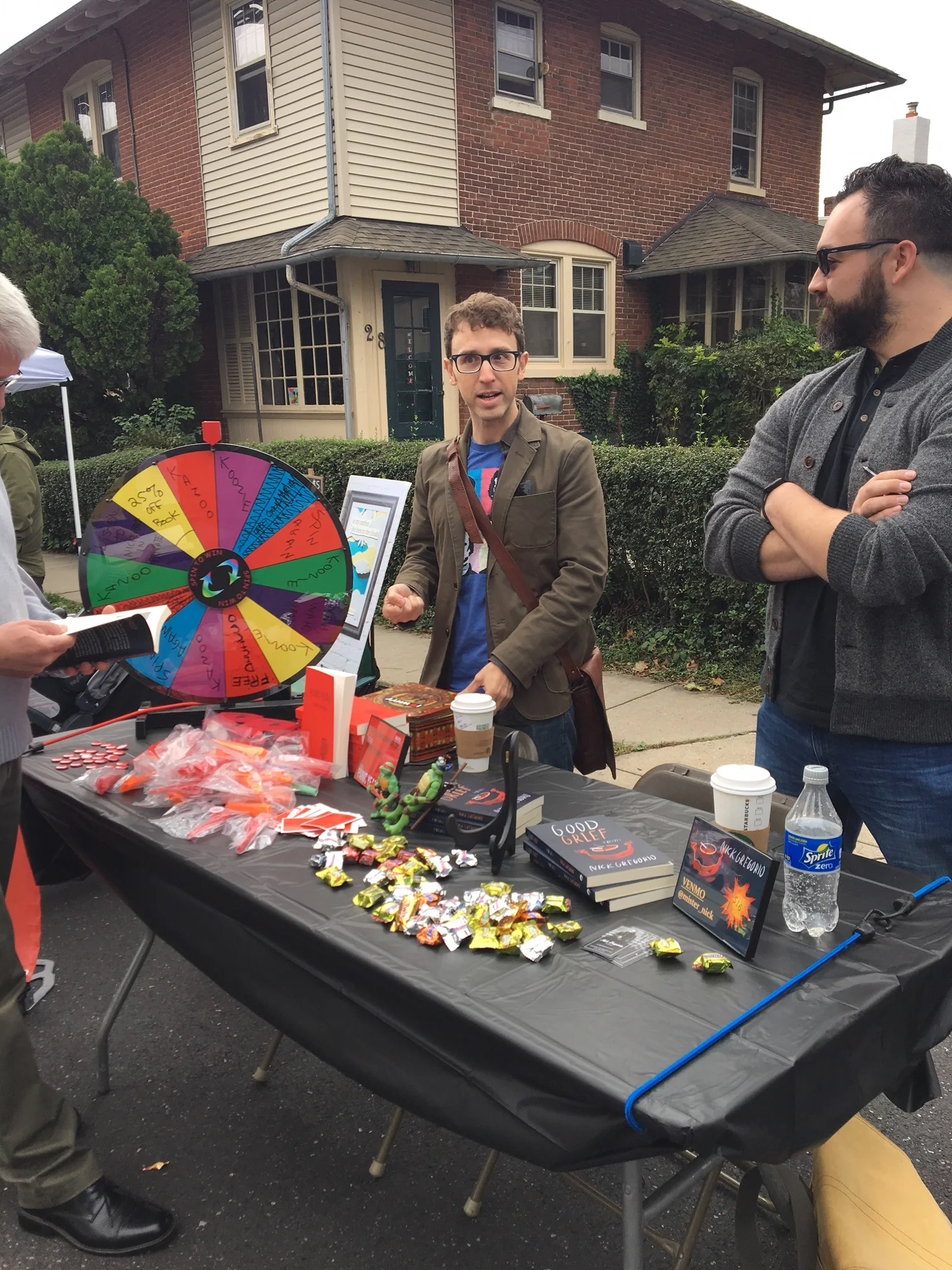
DiFranco describing a scene in his novel, Panic Years.
I then turned to Gregorio and Good Grief, guarded by the classically annotated Ninja Turtles of our collective youth. He, too, is an alum of the Arcadia MFA program, where he and DiFranco met as contemporaries turned friends. Transforming from a prototype of a graphic novel, the premise stemmed from a personal loss in Gregorio’s family and further expounded the idea upon his studies at Arcadia. Gregorio stated that “dealing with the loss of a family member is what carried over to the novel” which is the purest form of an homage, let alone a solace, to the stages of loss. He also noted the influence of the Ninja Turtles that “tethered two different lives together,” which is further explained in the story. For being Maudlin House’s first novel-length publication, I’m sure they were not disappointed; Gregorio has their logo tattooed on his arm for a reason!
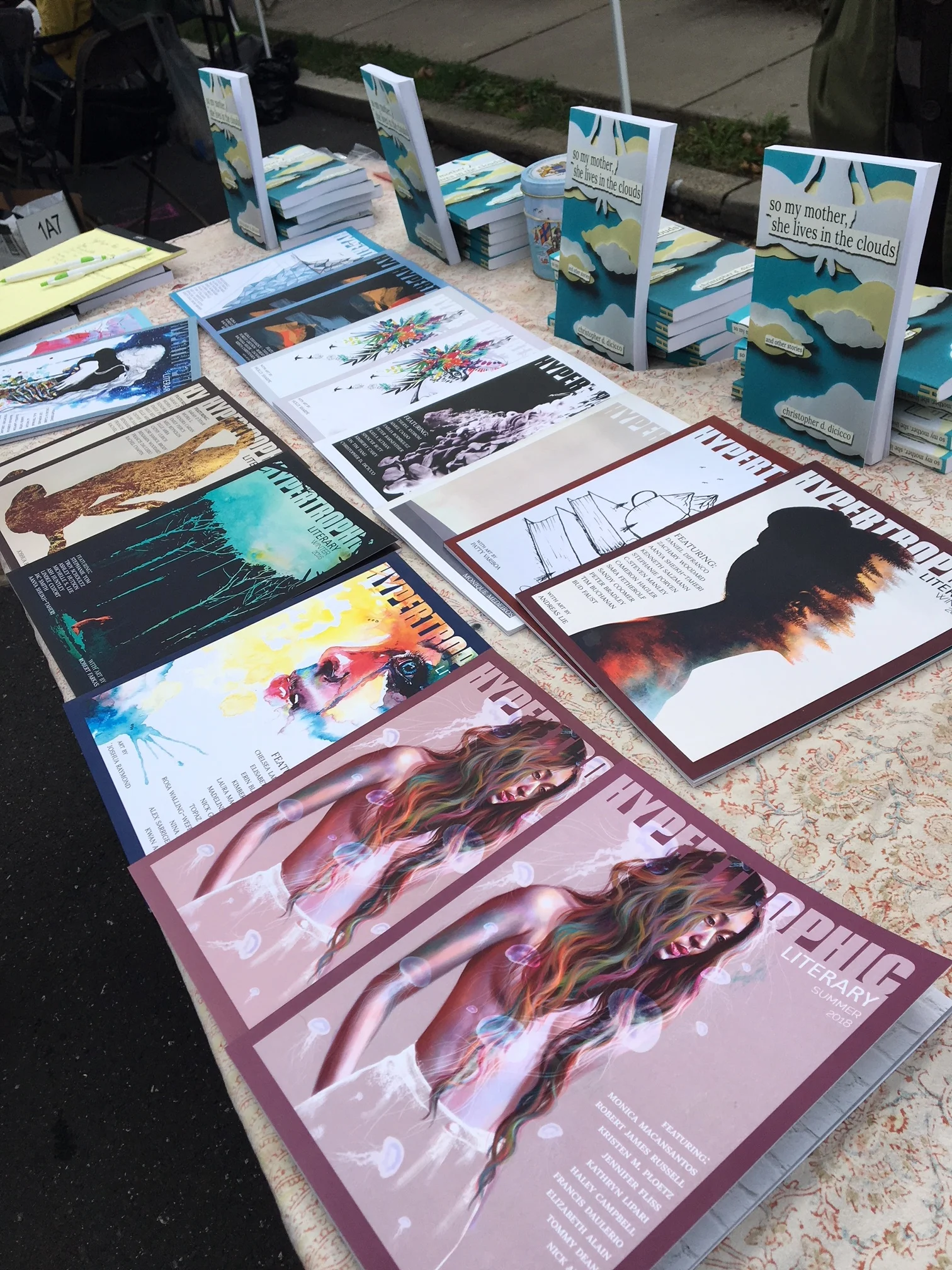
Many Hypertrophic journals and Christopher DiCicco’s latest, So my mother, she lives in the clouds
Directly adjacent too the novelists’ table was one of my favorite journals that I discovered this year: Hypertrophic Press is helmed by a trio of talented editors and writers in Huntsville, AL and Bucks County, PA. Maddie Anthes, being the acquisitions manager and masterful fiction writer, is also an Arcadia alum and displayed the quarterly journals with prominence. Assisting her was Christopher DiCicco, author of So my Mother, She Lives in the Clouds (Hypertrophic Press, 2015) and editor of a local high school’s journal. He fielded many of my questions in the journal and how each cover is “both uniform, yet idealistically original”. Jeremy Bronaugh and Lynsey Morandin, creative director and editor-in-chief respectively, solicit artists from all walks of life to fit their templates. Within the covers, are an eclectic mix of poetry, fiction, and nonfiction which dive into their typically unrestricted submission process. “Hypertrophic is Hypertrophic” DiCicco stated, further garnishing the literary merit that the press has acquired throughout the years and the defined aesthetic that they uphold. Unfortunately, Hypertrophic is on a hiatus for the time being but will close out the year with a December issue. In the background, a startled, yet complacent cooing could be heard; Anthes’s newborn needed some attention.
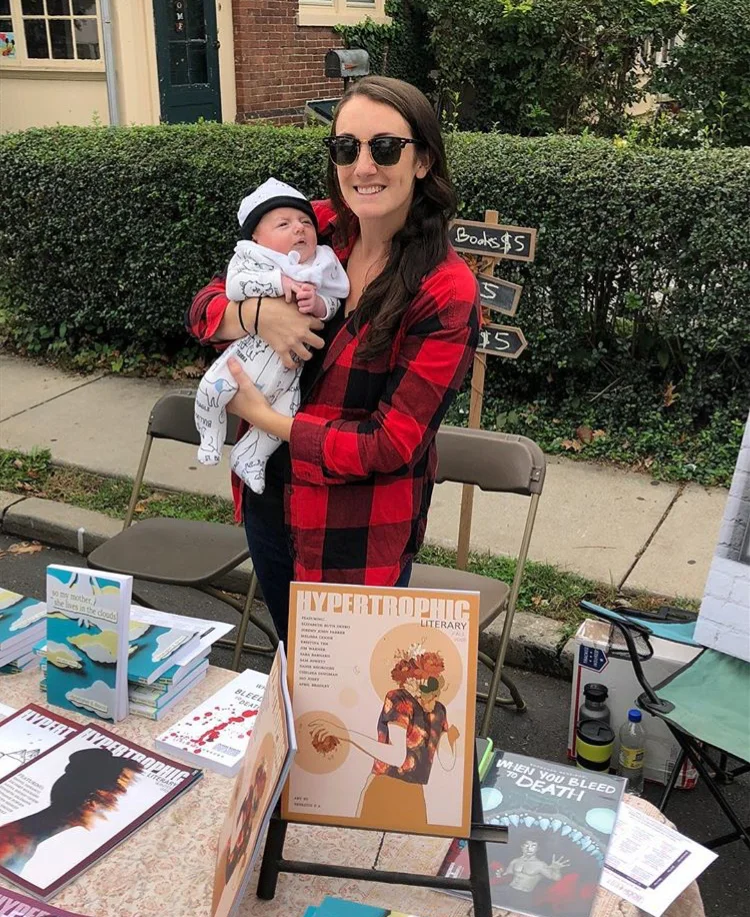
1/3rd of the Hypertrophic triumvirate, Maddie Anthes, with her assistant.
I strolled down the way in search of my third feature, who was shaded underneath the vast tent of the Bucks County Writing Workshop. H.A. Callum has been an ardent supporter of Thirty West for some time and to meet him in person was a delight. It also came in the form of a new book, Whispers in the Alders (Brown Posey Press, 2018). Being a native of Bucks County, there is a heavy influence of the scenic wonders that populate his novel, a coming-of-age tale of two writers as they grow not only in age but as authors in their own ability. “The narrative spans decades, which has attracted both YA and adult readers to the themes of sexuality and moral foundation as any teenager would expect,” said Callum describing the flexibility of the novel. He is also a member of the Bucks County Writers Workshop, a long-standing, and highly sought, group of revolving fiction authors. Founded by author, Don Swaim, the workshop has culminated many types of novels and short story collections ranging from fantasy, mystery, and romance, to literary and nonfiction. Callum, and scores more, are thankful for the bastion of literary hope in the region.

H.A. Callum with his latest novel, Whispers in the Alders
I bid my farewells to the tabling folk and settled into my final event of the day: a conversation with Tom McAllister and Mike Ingram. The pavilion was crowded with eager listeners as the moderator introduced the Temple University professors and Iowa Writers’ Workshop graduates and their lengthy acknowledgments.
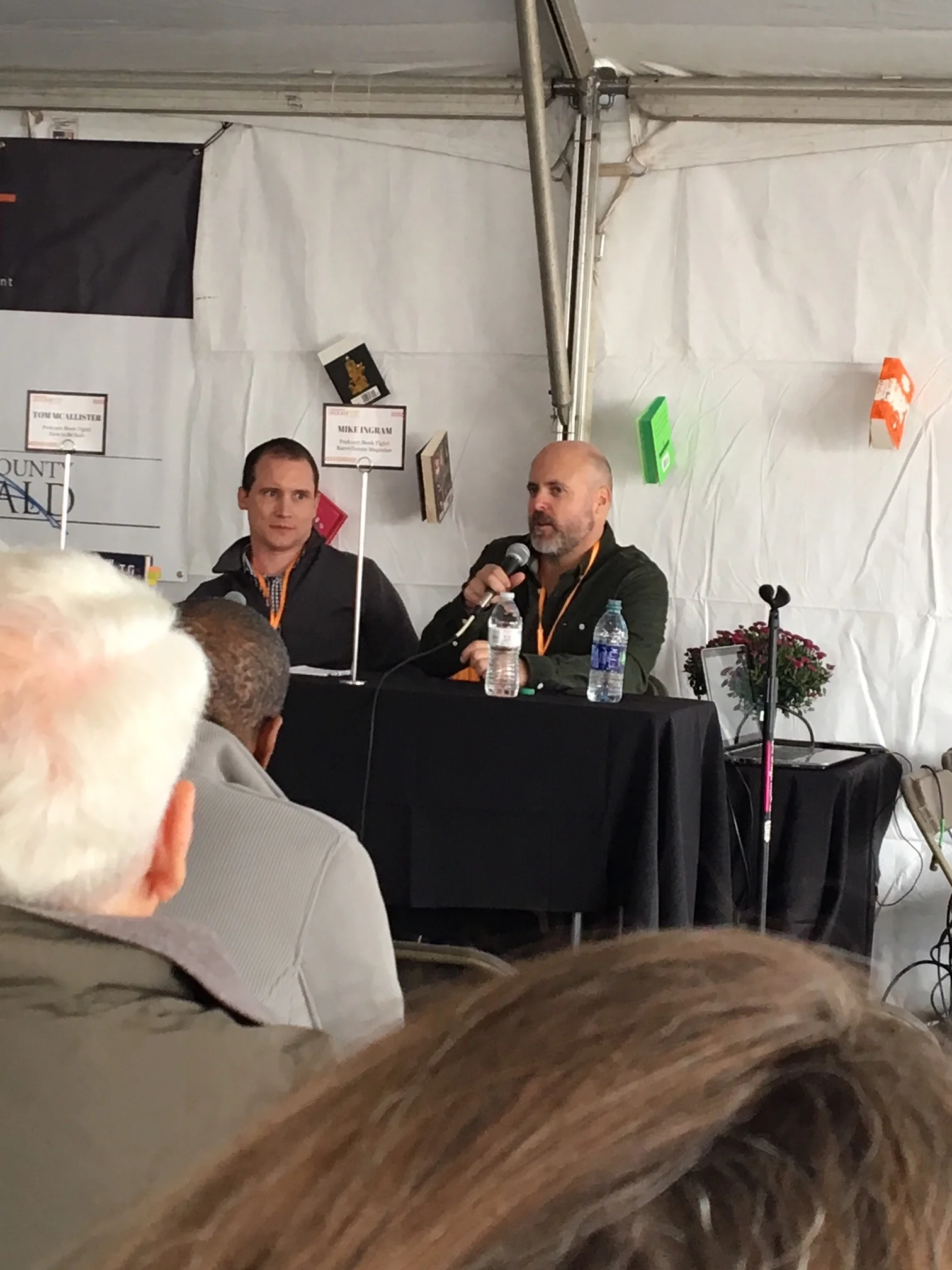
Billed as a podcast Q&A, McAllister and Ingram began with their experiences with Book Fight!, a podcast hosted by them that’s been publishing new episodes every Monday morning for many years (excluding holidays). Within, they would discuss classic and contemporary works from obscure to well-known figures, usually themed as “Fall of Failures” or “Summer of Scandals”. Ingram stated that his early editorial career with Barrelhouse, a non-profit magazine, and collective founded in 2004, allowed him to meet people in the writing industry and the “desire of a middle-ground between high-academia and common vernacular”. Thus, the podcast was formed, and it is a riot, spoken from a multi-year subscriber myself! Jokes were passed around about Tom’s recent literary success and if his English Composition students care enough to research their eccentric and passionate professor. Coming off a newly-released novel titled, How to Be Safe (Liveright Publishing, 2018), McAllister recounted, too, on how his three books taught him the skills to not only interview but to jokingly interview with fellow writers and readers in candid authenticity. The same principle goes into their podcast every episode. The conversation veered into academia and the perceived “bar” that people associate with it. Ingram continued that Barrelhouse gives back to the literary community with open calls for submissions and even merit grants for small presses and independent authors. The questions were then turned over to the audience for a time before McAllister read from his novel, which I am anticipated to get my hands on.

McAllister reads an excerpt from How to Be Safe while Ingram ingests the harrowing scene.
I concluded my festival with a sweep of the book tent and, you guessed it, the giant banner of book titles. I stood in line as fellow festival goers jotted their all-time favorite book. Among the anonymous repeats of The Sound and the Fury, Harry Potter, and The Alchemist, I wielded a red sharpie and squeezed in the first novella that really recaptured my life-long love with literature, Ghosts by Cesar Aira. I rose, patted my ringing cell phone in my jeans, and departed Bucks County Book Fest. The clouds grew dense and I power-walked back to my car in a brisk ten-minute stroll (I actually knew exactly how to return this time.)
And now, here I sit, recounting memories just like the writers and publishers before me. I can imagine as I recount this tale, someone is dog-earring a novel, jotting marginal notes on technique and “wow!” passages. I imagine the children, that after doing a lesson in grammar at school, come home and use the closest writing utensil to jot down something, anything, that will be cherished and framed on the refrigerator for months to come. Book festivals empower us, inform us. They give rise to entrepreneurship, literacy, and lifelong dreams of others reading one’s soul on paper. Here’s to many more years of this festival and hundreds more around the world. We love you more than you can imagine.
Josh Dale is a Temple University alum, bicyclist, beer enthusiast, and owner of the sweetest Bengal cat. His poetry and short stories have appeared in 48th Street Press, Huffington Post, Page & Spine, vox poetica, and others. Establishing Thirty West while in undergrad, he’s the current editor-in-chief and has published two chapbooks and a poetry collection, Duality Lies Beneath (Thirty West, 2016)
Edythe Rodriguez: 1 Poem
bombs over osage
a boarded window:
a soul’s eye so obscured we forget to call it a neighborhood.
silence drowned noise into the background.
a schoolteacher came home from work
a cute boy waved to me and Big Millie
while she spoke to Lil Millie through her screen door,
and all I see is trash. Tastykake and peanut
M&M wrappers, all I see is ruin and aftermath,
devastation where lives are.
“Are you trying to say it’s dirty?”
I’m not saying—
I’m trying—
dirty is a relative term and— yes.
I ain’t seen trash like this in a minute
I see a landfill so excuse
my dumping all this bourgeois baggage
ghostwhite bars call through pastel panels.
Who painted you? Who built houses on Ground Zero?
Who can walk here and not see a bomb,
a fire, not wear black, not hold this
wake, not trace an old scar on
this new body.
I’m not blind. I see the fence they
built you. The sleek windows
and straight-rowed shingles.
I see they got y’all looking
like a hood Ikea.
I see the eye rolls when I say John Africa,
I see you Big Millie,
I see a scar
on this place that I won’t forget
to call a neighborhood.
Edythe Rodriguez studies poetry and Africology at Temple University. She is a a Philly-based creative raised in Upper Darby, Pennsylvania poeticizing whiteness, racism, and the Black woman experience.
Leigh Fisher: 3 Poems
CONDUCT
Visited home today
to hear of all the latest deaths
Neighbors and old friends
flickering out like the light
swaying up and down
on a buoy out at sea
The connection giving life
fading out as the wires
Disconnect
DO NOT SPEAK
It’s a place of silence
all but the mechanical whir
Words don’t form
while the tracks wear down
Lights shine bright
like they would upon actors
performing on a stage
But no soliloquies
are uttered here
It’s an unspoken law
to only talk to the person
sitting right beside you,
mere inches away,
if you walked together
as you embarked onboard
But while you’re side by side
on two seats adjacent
close as lovers sleeping
in their shared bed at night
Neither of you say a word
since that’s the silent law
The opportunity lost
on a train with no seats open
GOOD FOR YOU
“It'll be good for you,”
they say it like a promise
She simply nods her head and agrees,
since that’s all that they expect of her
She has no reason to fight or say no
and she won’t have to deliver bread
ever again
“He’s gotten a good job, he can take care of you,”
As they say these things,
she’s sure it’s true
but it doesn’t change
that she still feels nothing
“All he wants are a few children in return.”
she knows she should be like her mother
think pragmatically
perhaps the callouses on her hands will soften
“At least I’ve met him before,”
she murmurs as she climbs the stairs
“I know he’s a kind man,”
she thinks, with five loaves on her shoulder
as she walks faster up the hill
“He’s quiet, he doesn’t speak much…”
she continues to think
she starts walking a little faster,
darting around the cracks in the old pavement
But thought makes her afraid
thinking of going to live with this man
what she must do for this man
when they’re alone
“I’ll manage somehow,” she whispers aloud
They’ll pass time in a quiet, little house
where all they share
is the language they speak
and the country they came from
“I’ll manage somehow,” she repeats,
as she reaches the top of the hill
it’s tiring to tackle the upward incline
but going down also has its challenges
maintaining balance
while plummeting downward
like a skydiver jumping into fate
“I may never care for him, but it’s like they say; it’ll be good for me.”
Leigh Fisher is from Neptune. No, not the eighth-farthest planet from the sun, but from the city in New Jersey. She is a historical fiction enthusiast, with an avid interest in Chinese history. She has been published in Five 2 One Magazine, The Missing Slate, Rising Phoenix Press, and others. She can be found as @SleeplessAuthoress on Instagram and @SleeplessAuthor on Twitter.
J. Bradley: Remembering the USS Flagg
The sailor’s shell-shocked. I tell Jim to triage him where we’ve got all the other survivors waiting for medical attention.
What’s triage, he asks. Jim picks his nose and then eats his discovery.
Something I heard on that hospital show mom likes to watch. Just get him over there.
Jim picks up the sailor like he’s god. I grab Jim’s wrist. Not like that. Jim lets go as I steady the sailor. I take a packet of ketchup I stole from the sauce drawer out of my pocket, tear away one of the corners with my teeth, and pour it on the sailor. I take my index finger and smear the ketchup on the sailor’s face, chest, the parts of his arms not covered by his uniform skin. I show Jim how the wounded should move for a step or two before letting him take over.
I watch the sailor stagger for a few steps under Jim’s supervision before getting up and heading over to my closet.
What are you doing, Jim asks.
Add some moans. Jim moans in the sailor’s voice: help, my god, mom, help, uhhhhh, why.
I grab the yellow stethoscope from the closet floor and talk into it to make sure it’s still working. I look for my bathrobe I use like a lab coat but it’s not there; it must still be soaked in blood from the last time I had to tend the wounded.
J. Bradley is the author of the flash fiction collection Neil & Other Stories (Whiskey Tit Books, 2018). He lives at jbradleywrites.com.
C.M. Crockford: 1 Poem
Mark The Place
I'll take you in the sharp and hollowed wood,
Moving like the world was stripped away.
Tearing into steaming teeth.
A rabid dog meets another.
Give me a drink of
What's-between,
Salting heavy tongue
In such bloody fires.
I'll take you to the baited breath,
Where the riders meet,
Whispering to their horses
Against a red desert sky.
Mark the place on scarlet brown skin.
That's where my lips belong.
C.M. Crockford is a writer on the autistic spectrum living in Philadelphia, PA. His work has been published in Ethos Literary Journal, Paradise In Limbo Magazine, and Oddball Magazine among others. He also a columnist in No Recess Magazine.
Rebecca Kokitus: 2 Poems
grief on her sleeve
I envy my mother and the way
she wears her grief on her sleeve
I have mine tattooed on my forearm
in an attempt to do the same
when I cry, I cry for all
the fatherless girls
those wishing wells gone dry
lovers flung like pennies
when it finally rains it
smells of blood and gunmetal
my body is a flooded graveyard,
my father’s corpse resurfacing
mourning after
the morning after he died
I prayed to my father for
forgiveness while I prepared
my menthol cigarette breakfast
apologized for wrapping
my mouth around his killer
like a lover, sucking out the venom
as if I could still save him
this was my way of
trying to conjure him
and he spoke to me then—
in breezesong, in the call of
a crow perched in a maple,
he told me smoke and ghosts
are genetically similar the way
they say humans and rats are—
he told me god was toying with me
at that very moment, like a cat
blowing out ghosts like smoke rings,
watching me watch them dissolve
Rebecca Kokitus is a poet residing in the Philadelphia area. She is a student at West Chester University of Pennsylvania, where she studies English with a concentration in Writing. You can find her on Twitter and Instagram and @rxbxcca_anna, and you can read more of her writing on her website: https://rebeccakokitus.wixsite.com/rebeccakokitus
Joe Lynch: 1 Poem
Blight and Hunger
(The Great Famine. “ an Gorta Mór” 1845-49 Ireland)
Hunger first resides in the eyes,
then wrestles it way to the belly,
churning the muscles on its journey,
pausing only to ache,
on its way through Ox Mountain
Failing crops from Dublin to Donegal,
dead fields, costumed in decaying rot,
seasoned by deaths odour,
like an obituary notice of the poorest,
where the mercy of god played truant,
Just like the absentee landlord.
The Mother, translucent skin,
whispering with heavy eyes,
breath slowing, almost fleeing,
memories flickering in an out,
like the country mouse,
joyfully curling in the plots of bountiful corn.
The Father struggles in blighted fields,
cap in hand, his face ploughed weary,
hands raw, raging for revenge,
seeing nothing but his shadow,
destitute by English rule.
The child stood by a turf fire,
a rare moment of comfort,
so, few and numbered,
ribs, like a ladder to the heaven,
almost transparent,
a ghost, just waiting.
Hunger was the blight of nature,
starvation, the might of Trevelyan,
delivered with brutality,
not a kernel of humanity,
Ireland under one sun, ripening the corn
and bleaching bones of a million dead.
Joe Lynch has lived and worked in Belfast, North Ireland his entire life and has recently spent time writing poetry and painting. His poetry delves into themes such as social equality, civility, and human rights.
Carroll Susco: Bean Spiller
What you are about to tell, no one can know. Since you will tell it anyway, you cannot order the sequence of the memories. You will write it quietly in the order it came.
Three and a half years old, left alone, again, I walk confident by the houses in bare feet down the hill to the park. More of a baseball field, but I did not know that then. I sit on a bleacher, get a splinter in my thigh. Staring at the field before me, I feel an angel of the Lord beside me.
And he says, “God created the earth.”
I look at the grass and up at the trees, the blue with white cloud puffs, the bend in the horizon. I don’t have words for what I feel. Amazement, maybe. The trees strike me the most, something about each green leaf.
Put that memory away! That did not happen! Just believe me that you are psychotic and you made it all up. You’re not touched. You’re not special.
Rain on one side of the street. Sun on the other. A perfect divide down the middle. It is a sign. It is perfection.
Do not say what happened in the other field, the one They told you never to go to. Be angry with God for what he has allowed.
My first memory is of my death. I am two and a half, and a boy squirts his black squirt gun up my nose. As I fall I think his face evil. So rabid was he. And then, I only see dark. Black. In it, a glowing old man with big hands that holds an orb that is me. As he puts my soul back in my body, he says, “The first sound you will hear is your own voice.” A gasping breath. My eyes open. Sky. And then it comes out, “What happened?” My grandmother is over me with smelling salts. She is crying and moving the smelling salts from one of my nostrils to the other.
Do not tell the next part. Never write about us, including your sister, Chris.
Sitting up from my death pose, I look over my shoulder to see my sister, Chris, five years my elder, walking out of the apartment across the grassy area that separated the buildings. She has a stuffed, green snake. A very long one. She is proud of her new acquisition, and somehow the coincidence is not lost on me.
See, this is the thing. You do think your sister is evil. You’ve never written about her. Don’t start or we will do something. Why are you tensing? Scared?
Yes.
Good.
There are slugs on the sidewalk on a summer night. I hear crickets, see fireflies, feel heavy, hot air as I sit with a couple of neighborhood kids and my sister in front of our house. She leans in and so do we as she tells the story of a young girl ghost who hitches rides in cars and gets dropped off where she had once lived before she died. She makes sure we understand that part. She makes sure we are afraid of the dead. She teaches us the song, “Never laugh when a hearse goes by or you might be the next to die.”
Remember the words.
I am in the potty. My sister, Chris, knocks and says she wants in. An angel tells me not to let her. But I do. I open the door and she and the thug neighborhood boy laugh and stare. She swore. I trusted her. Now the Satan men will be able to watch me pee the rest of my life.
Give us a break! No one will believe you. Joke’s on you, sistah.
The thug neighbor boy shows me his penis on the porch. I don’t want to see it. I find myself in the bushes with who I thought was a nice boy but who says, show me yours and I will show you mine. Him I simply tell no. Perhaps that’s the difference between naughty and nice.
Horny?
I was three.
Angry?
My sister, five years older than me, makes a haunted house in the shed and only later admits I was not feeling brains. It was spaghetti. Eventually, I fall asleep.
Blame it on your mother. Blame it on your father.
My father runs into the house he had to leave because he is “sick” and slaps my mother who is in the kitchen. On the couch, watching TV, I see him come in. I see him go where he knows she is. I hear him yell, “You let my baby get sick!” (A sign from God I am in trouble.) I hear her yell, “Dick, no!” I hear the slap. I smile. My sister crouches by me and cries. My father runs out. I am three. I was three. All this, too young.
Blame it on yourself.
I’m four or five. Christ swoops passed as I lie in my bed and says, “What do you want when I come?” I tell him chocolate milk and chocolate pop tarts. They don’t make chocolate pop tarts anymore. I blame Satan.
Stop. Now. You’re adding to this. We told you no.
Chris sends me a text and says I am evil. She says, “Own it.” She is very angry with me, and I don’t know why. I watch her sickness as it starts, intensifies, the way my fathers did, the way mine did…. I hide from her now, at 54, and bar the door.
You don’t even know why she hates you? You moronic imp. Run while you can, sweetie.
My sister sees demons in her smoke, in her photograph, and in lights. I would hold her tight, but she won’t let me. I would hold her, anyway. If I could hold on, maybe I could push her and my demons away. Maybe I could keep her from wriggling out of my arms. Maybe I could save her, my father, my mother, and me. If onlys. Whys and why nots are tiresome.
You can’t love her. Don’t even start with us. She’s evil! You’ll pay for this.
I know. I always do. But, I don’t know anymore what the enemy is: innocence, knowledge, neglect, presence, time, what we see or what we fail to notice, what we do or don’t, when we love and when, when we don’t.
All your spew is impressive. You are mocked despite your puny fists! And! We get the last word. We always do, mincemeat.
Carroll Ann Susco has an MFA from the University of Pittsburgh and numerous publications, including Cutbank and The Sun Magazine. This entry is part of a memoir chapbook currently in progress.
Angelina Fay: Art for Art's Sake
He opens the door wearing leather loafers, a half-buttoned shirt, and a slightly frazzled smile, but welcomes me in anyway. It's about exactly what I'd expect Art Garfunkel's apartment to be; stacks of books, demos, photographs both large and small. Things are housed underneath desks, in the space between chairs, slid into every corner. A large canvas alive with colored signature reads love from West Choir! and we heart Art.
Artie Garfunkel shuffles around the room, eventually situating himself amongst pillows on a pullout couch. He quips about recovering from a recent trip to Switzerland. He was also just in the greatest, deepest sleep when his doorman called him to let him know that I was there (early), just so I'm aware. At 74, the wisps of his signature curls are still visible on either side of his ears, poking through the lenses of thick glasses.
He checks his voicemail, pleased that his former roommate has just called. We chat about the recent march for gun control, about the weather, and about New York. He makes no secret that he wishes he wasn't here.
"I shouldn't have come back to New York." He looks out the window. "I don't want to see anyone." He brings up Zurich again, where his oldest son had just found him a house, and his face comes alive as he details the mountain peaks and the rolling hills. It is strange to picture him, a Queens native, anywhere but here. But when he talks about the new, "cold" New York, I can tell that he feels out of place.
In a conversation I had with a coworker, he said that he thought Garfunkel had "retreated from fame." I realized that this is a commonly-held perception of Art, no matter how many locations are listed on his website as upcoming tour performances. Little about Art is this simple; his story is not just one that he shares with Paul Simon. His story is intricately woven through different art forms, each equally in his limelight; the tale of Art Garfunkel is one of dark pockets of mental struggle, bright sunspots of celebration and life, and the crippling reality of what it means to be isolated. To reduce him to those two decades of Simon & Garfunkel is doing him a great disservice; while the duo's ship has long since sailed, Artie has cast his line out in many different seas, discovering new loves, passions, homes, and reasons to smile.
"We have a way of denying ourselves..." he trails off, and then begins again, choosing his words carefully. "Everyone is wildly in love with being alive - but on the inside."
He laments that we can converse without ever truly understanding each other, that nothing he says will translate correctly into print. I assure him that it will.
Once half of an Everly Brothers-emulating duo called Tom and Jerry, then Simon & Garfunkel, Art experienced the most charmed years a person could have, traveling the world doing what he loves most - singing. By the time he was a senior in high school, he had already been on Dick Clark's American Bandstand. He and Paul were inseparable as friends and eventually as performers. Though they took many hiatuses throughout their colorful careers, they seemed to always find each other again.
"We fall into things," Art says. I can certainly understand; I fell into his music quite randomly. My mother owned the Concert in the Park on CD, and we would often hear "Me and Julio Down by the Schoolyard" and "Sound of Silence" on the classic rock station Q104.3.
This is how we encounter most celebrities; they are what goes on in the background while life is happening, and before we realize it, they become a part of us. A song that I once knew some words to became something that felt like my mother's car, like a backyard in Long Island, like a younger me with fewer thoughts.
Art and Paul have always fallen back together. Every few years, they reunite for a performance or two, or, if we're on a lucky decade, for a tour. In 2004, they held a free concert at the Colosseum in Rome. Over 600,000 people attended a true testament to the everlasting and international significance of their music. They are a place of respite for many.
Artie calls it luck, and insanity, that students worldwide are still singing "Feelin' Groovy" and "Scarborough Fair" in their annual choir concerts.
"If you eat something that tastes delicious, that's great," he says. "If it stays delicious for 45 years, that's just an extra treat." A pause. Then: "That was good. I'd write that down if I were you."
I do.
A piece of paper taped to his lamp, emblazoned with the Hershey Lodge logo, reads, love is all there is - Art, Kim, Arthur Jr., Beau.
"I'm hooked on Snapple, Angelina," Art says as he offers me one of the two "best" flavors - lemon and peach - and lauds America for this one great achievement of bottled iced tea. After some reflection, he decides that caffeine is a good addiction to have after all, especially since ditching his Marlboros years ago, but not before the damage was done on his vocal cords. He lost his voice in 2010, canceled a tour with Paul, and spent the subsequent four years yelling into empty theaters, trying to force his range to resurface.
Over those four years, before he reported to the Rolling Stone that his voice was back in business, Art let his music take the backseat. He turned to his writing, something that never had the full soil in which to take root and blossom, always overshadowed by his first love. For thirty years, Art had traveled with a notebook in his back pocket, walking with no direction, writing for no audience. He compiled these writings into his book.
"That thing that I've been thinking about, where does it take me?" he says of his writing process. "Where does the rhythm take me? What does it demand?" He calls these micro poems "bits", and integrates them into his new shows. He sings ten songs ("April Come She May", of course) and speaks eight of his poetic bits. And he still writes by hand, even today; he succumbed to a smartphone a few years ago, but still refuses a laptop.
"It excited me," Art says of his new type of performance. While the travel is taxing, he admits his deep reverence for his own performances, claiming that it is all worth it at show time. He does three shows per weekend and spends the rest of the week at home with his family, "being a Papa."
He takes his role as a father very seriously and always has. His oldest son, Arthur, or just "Junior", is 29, and Beau is 12. On the couch is a sixth-grade summer math packet, a reminder of just how young Beau really is. Junior, who now resides in Hamburg, is releasing a new album soon, and the pride is evident in every line of Artie's face. "He's not overplayed with life," he says, and I wonder if that means that he considers himself to be the opposite. He then ponders what name his son will go by since his is already taken.
The doorbell interrupts us; it's the Silver Star deliveryman with Art's coffee (two extra shots of espresso).
"How is your day?" he asks the man.
"Good, how's yours?"
"I am Scorpio rising."
I ask him if he believes in astrology. He does not. )
On the set of Catch-22 in Mexico, 1968, Art began to read, starting with War and Peace. In his apartment, he pulls down a folder of laminated sheets, all with perfect penmanship - "My friend Artie, the human typewriter!" Paul would say - that list every book he has read since then, with red dots next to the ones he especially loves. One thousand, two hundred and seventy-one books. Saint Augustine's Confessions and Virginia Woolf's A Room of One's Own are dotted, and he raves about From Dawn to Decadence by Jacques Barzun. He has one hundred and seventy favorites. His most recent favorite: How to Grow Old by Marcus Tullius Cicero.
Opening up his own book, What is All But Luminous, Artie reads from the middle.
Jacques Barzun or anyone
who talks to me like him
wins my sympathy in this decadent age.
What has "learn to earn" meant
but a fight against civilized discernment?
Is it that "time thins out things"?
Does the quality of life lessen
with human increase?
If it all dilutes through the centuries,
then from Rembrandt's soulful portrayals
to Chartres Cathedral
to Aquinas
to Arete
people have seen their better day.
As he reads, he makes sure I'm paying attention, not taking notes or wandering off. He asks me many times if I'm following, if I understand. He says, "nothing is profound, Angelina."
I wonder if he truly believes this, or, as he did often during my time with him, was about to laugh at his own cynicism. His book alternates between a chronological tale of his time with Paul Simon and poems, some only one line. One of my favorites is, you can’t discover fuchsia twice, page eight.
We talk deeply about this Barzun allusion in his own writing, and he tells me that he feels we must go back in time. Civilization is not improving but decaying. We must go back in time to find what matters, and what counts, and what was great. Forward motion is destruction.
It wasn’t Monet, it was France;
It’s not what we say but the dance we’re in
Therein lies the mysterious glue
And the printed page I paint for you.
May 14, 1998.
“For Kim.”
Art reads this from page ninety.
When he’s done, he shows me an illustrated children’s book titled When Paul Met Artie, by Gregory Neri, which had been released a few days before we met. On the inside cover, Artie had written a message to his youngest son Beau, with all his love.
We avoid the topic of Paul, for the most part, which was very much my plan. We gripe about the drama of it all - the 2015 Telegraph article claiming Art "created a monster" out of Paul Simon, which is very much not what he said - and rolled our eyes considerably about the need for the mainstream media to find something "juicy" enough to publish.
When I bring up Paul Simon's recent announcement of his farewell tour, I mention that the social media stratosphere is electrified with the idea that a second Concert in the Park could happen. He says, "Again? This is the third time, right?" - alluding to the two previous times that Paul Simon has "quit."
I remember an interview that I read in which Art mentions something that George Harrison had said to him a party, forever ago. "My Paul to me is what your Paul is to you." I bite my tongue as I try to find the right words with which to bring this up, the tiniest of phrases that carry a world of weight. He smiles, makes a comment about how I had obviously done my research, and offers nothing else.
But they are still old friends, which he sings as he walks around the apartment, claiming that it is his favorite song. "Old friends...sat on their park bench like bookends," I ask him what else there is to do for a man who has done everything. What next for Artie Garfunkel?
"I haven't done everything, but what a great thought." He looks off, and I let him. "I don't know how to record now. I'm afraid I'll get lost. Do I make a YouTube? Where do I even begin?" He is wistful, and I am sad.
"When I made Bridge Over Troubled Water, I made it for people. But I made it for art's sake. Capital A." L'art pour l'art. How fitting.
To turn back time, back to 1981, back to the decadence of Simon & Garfunkel. This time without the criminal New York or Ed Koch. This time with a much older crowd, now parents, even grandparents, holding onto these drips of nostalgia that escape their eyes at the opening notes of "Sound of Silence." We cannot just let these memories dance —we want it back, something that was never ours, to begin with: a facade of harmony, deeply cracked in the fragments of a lifelong friendship.
We want it back. This is the way we escape reality through music; that if we can immortalize ourselves in a September rain in the middle of Central Park, things don't have to change. We don't have to change.
Maybe, moonlit in the park with a half million people, Paul and Artie will emerge anyway, just over a half million heads, luminous in memory. But even then, in 1981, that harmonious front was cracking as Art struggled to learn Paul's guitar bits, as he realized that his partner had rewritten the lyrics they had penned together, as he found himself desperately clinging to the 60s-style concerts that had fled his grasp before he could realize.
We claim ownership over those that have carried us through our own phases. In letting go of our rose-colored heroes, as fans and as people, acknowledge that time has passed and that we, too, are not the same as we were. This is not to say that the pedestals we carve for our icons are wholly dangerous to us. But to recognize that our heroes are also in flux, are also fluid, are not the people that we make them out to be, is a heavy thought. To humanize our heroes past what they meant to us means shedding our own selfishness, means knowing that they do not belong to us - that they never did.
Even then, in a perfect 1981, those angelic sounds were recorded onto tapes that would end up in landfills; the songs that would dissipate into the tabloid drama that, unbeknownst to us, is layered with discord and distrust. And would it even matter, would it even really, truly make a difference, for the two to perform in a feigned lust for their music? What would we gain?
On the one hundred and forty-first page of Art's book, of which he is so proud, he wrote:
To Paul, from Art: We're out under the stars now, the harbor we came from is gone from view.
Amidst the books, demos, tapes, papers, photographs of his children, other people's handwriting, and vases upon vases of freshly-cut tulips, I think of one of the first things he said. "That is all a woman or a man wants - to be whole, balanced, full." Out among the stars, a writer Art, a father Art, perceiving his past as the light of an ocean liner far on the horizon. Dim, but still there. Still alive and beating with the pulse of a thousand moments of love.
There are other selves that inherently live in our favorite heroes. Letting them live in harmony with our pedestalled love is an acknowledgment that time is passing, that we cannot stop it, that we never could, and we never will. I, then, discover Art twice. This is the least I can give him; the favorite voice that has always been in my ears, embodied: a writer on a page, a poem spoken into a crowd, a delicate frame in a soft chair reading to me like the sage I knew he would be.
I watch him move around the apartment. A man that, in his fragile frame, embodies generations of art, of transformation, and of love. But still just a man. He sings scat and whispers about old friends.
Angelina Fay is a writer at New York University in the final year of her journalism and creative writing undergrad. This private interview with musician, Art Garfunkel, was under the direction of author and professor, Ta-Nehisi Coates.
John Ashbery: An Interview
In honor of what would've been his 91st birthday, The Weekly Degree takes a moment to reflect on the humbleness of Mr. Ashbery, one of the most prestigious poets America, and the world, has ever seen.
Rania M.M. Watts: The Poetry Olympics

The inaugural, Instagram-exclusive Poetry Olympics begins on August 1st.
What do you do when you are supposed to be working on an article for Thirty West Publishing House?
A. Whine to your friends
B. Suck it up and take it or
C. Oh well just give up
Ding Ding Ding
The answer is B, which indeed means exploring every facet of a world that has not only moved me through words—to the point of extreme inspiration. Can you guess what world I’m talking about? All of them. The minute you read a book from an author, especially an independent author, the work contains pieces riddled with painful truths. These words are created by writers who genuinely bleed letters; these scribes who constantly express themselves so freely are the contestants who will be participating in the first annual Poetry Olympics.
The origin story is not as simple as the premise. I’ve been writing poetry for 31 years and through those years never in my life had I ever experienced writer's block. I had no idea how crippling and debilitating it could be to be surrounded by self-doubt. Emotions transmute themselves to a freshly opened box of Kleenex that houses a pile of used tissues absorbed with tears. A pain so immense it genuinely renders you incapable of even moving forward. One day, I spoke to my good friend Tony who in his own right is an accomplished musician. I told him those dreaded words: I could not write anymore. I felt so broken as though the words would never find a way to me ever again. Do you know how difficult it is to write a poem when you are creatively blocked? It has got to be one of the worst feelings ever. Eventually, I came across Danielle Krysa’s book, Creative Block. It’s riddled with so many suggestions by artists around the globe as to how to “unblock” yourself. My favourites from the book were from photographer Stephanie Vovas’, “Project No 35” and ceramic artist, Mel Robson, who also had a wonderfully eye-opening block to get you out of your comfort zones. All you need is a watch and a pair of dice. You roll the dice and the numbers will tell you how far you are supposed to go—whether it be by walking, train, bus or car drive—until you reached your “time”. There, you create on that spot in an unabashed manner. It empowered me to explore my surroundings further. Even though most of them ended up on my studio floor, there was indeed merit in performing this exercise as it allowed to me to write how I really feel even though the eloquence & sophistication was lacking. Do you know how hard it is, as a writer, to try something new and knowing you might fail? It has got to be one of the most debilitating things, but it does encourage one to be bolder through their body of work instead of just allowing it to remain stagnant.
In addition to that, Tony suggested a bunch of activities I could perform to get myself out of my funk. He knew how much I love poetry and suggested I create the Poetry Olympics. It could be an exercise not only to cure myself but to inspire others who are also in a drought. It’s as though there was a magic door that opened every single possibility. The poetic forms to be explored would include but are not limited to: abstract, erasure, cinquain, katauta, haiku, tanka, prose & of course, the ever-lasting Shakespearian sonnet. I also had to think about prizes. I mean, what kind of Olympics would it be without prizes? I was frightened, really. All I really wanted to do was ask those independent writers who would be participating for book donations to serve as prizes. But at this point, I really had nothing left to lose; the worst thing that could happen was for someone to say no.
At first, all I wanted for the event was eBooks but then, some writers approached me saying that they would rather donate printed books. With my committee at my back, we decided to give printed books to those who would receive the gold classification for that day and eBooks to the silver & bronze winners. I made a deal with all the writers who wanted to mail there books out that even though this is an international event no one will have to ship outside of their home countries, which in turn means that no one will end up paying a ton in shipping. There are so many contributors I could not possibly list them all. But, let me say this the caliber of independent writers is beyond my wildest dreams. It’s quite inspirational if you think about it.
It’s also important to discuss our esteemed judges. Alicia Cook, a human being who is an award-winning writer and advocate, has fought in the trenches against drug addiction and the losses that come from it. Her work speaks to me from a very honest and vulnerable place where she is not afraid to express herself. Check out her books now available on Amazon: Stuff I’ve Been Feeling Lately & I Hope My Voice Doesn’t Skip (both of which are prizes for these Olympics). My second judge is Josh Dale, founder of Thirty West Publishing House—Josh in his own write is an accomplished writer and editor. My favourite book by him is Duality Lies Beneath. I must admit I still refer to the letter to William Blake. I found it ingenious and a write that will surpass the parchment it is written on. The third judge is screenwriter & microbiologist, Liz Lugo. Liz’s work speaks of raw emotion she does not mince her words and displays them always with elegance and grace. Our final judge is singer, songwriter, musician and my mentor throughout this whole thing, Tony Moore. Tony has been in such bands which include Iron Maiden & Cutting Crew. Currently, he is a solo act with several brilliant songs under his belt which include: “Dear Me”, “Save the Day”, “Perfect & Beautiful” and two of my all-time favourites, “Tunnel Vision” and “Best Day of Your Life”.
Our globe is suffering and only with literacy and creativity will power us through these dark times. Despite the issues that I and scores of others have gone through, I do hope that this blip on the cultural radar will guide those lost in this sea of despair. We are still taking submissions for entrants and more information can be found at http://cementcoveredinkquills.blogspot.com/p/poetry-olympics.html or directly on Instagram @poetryolympics. Thank you all for aligning with this selfless curation and friendly competition of poetic prowess and will see you in August!
Rania M.M. Watts is a Palestinian-Canadian poet with an eventful past and humble future. Her latest publications are from KUBOA, 48th Street Press, and through her blog, Cement Covered Ink Quills, where she has interviewed and showcased creatives of all disciplines. She is a stay-at-home mother and knows how to top a pizza. Roach Print Anthology, curated by Watts, is available on Amazon with all proceeds donated to victims and survivors of mental disorders.
Greg Leonard: Art Gallery
To kick off the Kennel-born pre-sale, here is an art gallery by the immensely talented, Greg Leonard.


A self-taught artist, Greg Leonard creates weird if not slightly disturbing surreal images. He works mostly in the dry mediums of graphite and color pencils but also experiments with different mediums and substrates in his collage pieces including novel pages. Greg has been a contributing artist for both Thirty West Publications and Out of Step Books. His work has been featured on several online galleries, most notably Cross Connect Magazine. He is a lifelong resident of Pennsylvania born in Philadelphia. View more of his work on Instagram
Laura Ingram: A Response to the Return of King's Article "5 Reasons to Date a Girl with an Eating Disorder"
5. She is better in bed.
She sterilizes herself with Chanel No. 5. Her clavicles bud with bluebells at the brush of your fingers.
In the time of tuberculosis, when a man wanted to impress a woman, he would learn the language of flowers.
Most of the perennials were meant for apologies.
She insists you scrub the dirt from beneath your nail beds before she slides under the sheet. You didn't know love was something with prerequisites.
She doesn't have to know you only kiss her pelvic bones for practice. She won't remember the alias for alarm you whisper in her ear.
When surgical students are training with cadavers, the fat comes off before they open up.
She will love you and love you until she is empty, behind closed doors and beneath open palms again.
4. Probably has money of her own
She picks up the tab when you take her out for sushi, taps the tines of her fork against her teacup, cleaves her lettuce into crescents while your friends stare, and when she gets up to go to the bathroom, they ask you what is wrong with her and you pretend not to know.
She comes back to the table, eyes red and whirring as the evening news, leaves a generous tip.
When you lean down to kiss her goodnight, her mouth has been replaced with a hotline number.
3. She is fragile and vulnerable.
Her doctors worry she will fall and break her hip. She worries you will remember she is only ulna and aspartame, and leave her in search of something more solid.
She never leaves dishes in the sink, but her hair is falling out, and her sweater isn't clean.
2. She will probably cost less money
Her nightmares are the color of magazines. She trims diet plans out of Women's Day in hospital waiting rooms, laminates her frontal lobe, cancels her subscription to the cerebellum. You watch her rustle into a backless paper gown, wonder if, as a little girl, she ever sliced supermodels from the pages of her sister's seventeen, snipped off bits of their legs and creased them into chairs at Barbie's kitchen table.
You take her to a dietitian, a psychiatrist, a holistic healer. The bills grapple with her pill bottles for space on the countertop.
She apologizes when men with small eyes and large hands tell you she is dying; they do not.
1. Her Obsession with Her Body will Improve her Overall Appearance
She knows the reflection she flushes down the toilet is distorted, but she looks smaller here than in any of the mirrors.
She stares at herself in the flat side of the spoons when she rinses the silverware, organizes the knives dull-side down, but you still worry that she will hurt herself with a salad fork.
She never leaves the house without makeup, always rinses her mouth before cringing from your kiss.
Date a girl with an eating disorder. Watch her ghost from the body in your bed to a body in a box.
All that's left is a life of hospital corners and cereal getting soggy.
Both of you on your knees.
Laura Ingram is a tiny girl with big glasses and bigger ideas. A sophomore student, her poetry and prose have been published in fifty-four literary magazines, among them Juked Literary Journal, Jet Fuel Review, The Album, and Allegro Poetry. Laura's chapbook has recently been published with Desert Willow Press and she has an upcoming middle-grade novel with raven publishing that she penned as a cocksure fifth-grader. Laura loves Harry Potter and Harry Styles. This poem was previously published in Forest for the Trees