

Jacob Kobina Ayiah Mensah: 3 Poems
The Swing & the Fury
I write my life scattered about in lines
& stitch them together as midlife crisis.
The first line is a fishbone, covered by two cottony puffs from white hair,
snarling above a cornet, I slow down its tune among the motorcyclists
I’m of them to pass the dairy farm
& discuss arthritis from couch to a ladder.
I remember all the strays
you’ve included to manage the lowest rung of a leg.
The second line almost a baby equipment
& that requires assistances from the sisters,
I settle in the back seat, waiting to see in the mirror
how the heart beat springs up & down from your South to my North,
shaped on the anvil with sugar sprinkles,
still under the summer heat
& cherry blossoms hang from the sky,
open weeks are zipped with your breath.
At this dead heat,
to pay the next death duty
for debris,
I debug the cancer
from the cactus wounds
with your fingers making numb.
The furthest corner of this room
is just a frown furrowing your brow,
I take the fury on your face
& fuse with the bones of the spine together,
showing a brilliant future
in the front through the dark corridor.
The third line remains the surface underneath, the glass is full to the brim.
I keep the brine
for a very agreeable weather
& that’s why I’m not hurt outside their dairy products.
In Rome I make a long list, age-old customs,
you stare at it aghast,
I’ve nothing against people making money
& paying taxes on it
for very tall for their age.
This mound is clad among groups of people in heating allowance.
Sighing
Singleness
is the most gift
& ordinary thing.
I’ve wrapped with your voice
beneath the ruins
& above
the first lemma we compose
like a yam tuber.
Some things almost the symbols in K, L, M, etc, are
between our vector spaces, your wife proofs
with my corollary right
against any Renaissance pigments
on the walls or from the ceilings, we remain silence before the headlights
during Labour Day. Aiming straight
at the crag
& seizing your moment
blundering down the aisle,
hands are folded, days are rushed away
up the corridor to complete the triangles
for this trench.
It’s quieter there though you clench your fists
built around a circuitous route to avoid the hill centre.
You DIY without all this hassle at work,
DJ does his chance by just standing there –
doing something!
I consider this old chrysalis struggling to be christened
when chrome handles glisten with our sweat,
the visitors begin to filter into the hall,
holding water from the goof ground,
the next finch,
a finicky eater, flutters about,
the lake is wide opened in your mouth
we gob the results, hanging from hunches,
I decollate to the fuselage without my go-cart.
Cooler towards Riverside
We’re lizards to our ends as from our beginning
during the fall above the bog, where wattles are covered
with clay to hide your presence, we’re formed from no supposition on any subject governing the guard,
I go ahead about your story,
that doesn’t agree with
what the historians have said before a large audience,
I’ll keep out, yes, out your way. No eating an ogre or a ghoul, no begging your pardon, sir,
I keep the edges to a pinch,
as I’ve been accustomed to do, I feel disposed to see inside
& enter the house & retreat from the floating staircase,
I master its ritzy riser, if that’s possible to alight the cuttings for the next collage on dust.
This music is much more akin to blue jazz than cold rock, here within, you’re easy reach.
How do you react to the news when they shout & boo?
A colleen grabs your wrist & some paddies have a very bad reaction to these peanuts.
I sit down to read your hand- writing full of role-play,
a robin stares at a fishing rod still in the lagoon to rob you
your self-confidence over the fire. I justify nothing, only the touch, the softness & the impossible.
Jacob Kobina Ayiah Mensah is author the of new hybrid collections, The Sun of a Solid Torus, Conductor 5, Genus for L Loci, and Handlebody. He lives in the southern part of Ghana.
The Carlton: An Interview
I was getting dinner alone at a diner a few weeks ago, I saw a group of people swarming in from the cold. A motley of folks, probably not relate, or maybe so. “You. Pick a person. Go on pick ‘em. Got ‘em? Okay. Good.” It must’ve been an office, given their attire, and some were shivering. “Now list some of thier physical attributes,/make them seem as though they are significant.” As I stared into the cut section of my turkey BLT wrap, I went on Instagram and scrolled a bit. And there it was. “Go on, take your time,/Make it flow, in a line./Move from one instant to the next, to another.” I saw he was posting story updates while on his night shift. I knew what I had to do. “What is happened and what has not happened/Are divided by the present.” The group of office workers took their seat in front of me; multi-colored heads divided by a worn cushion stapled on wood. “Make a memory, make it matter, breed nonsense,/Take charge, describe the smell of lemons,.” I waved down the server. “More water with a lemon, please.”
Josh Dale: Thanks for allowing me to interview you! I think I first was acquainted with you through Facebook and then ultimately at a reading in Allentown or Easton. Do you enjoy the literary and arts community you frequent?
The Carlton: Ah, the Summer of Brandon Diehl's I Hate Poetry events, yes. I have a pretty long history of people meeting my 'social media personality', seeing me perform and getting to know me off "stage"and realizing there's a distinct difference, so, yeah, this is a pretty typical tale of how it works nowadays, isn't it?
As for the arts communities I frequent, living in The Poconos puts me in an interesting place because I'm an hour away from pretty much everywhere and that's great. It keeps things special enough, you know? The personalities we meet, I somehow love and loathe them. There was a time where I'd been summarily asked to leave every poetry event in the Wyoming Valley. I remember, as a result, I started my own monthly event, The Third Friday Spoken Word Event to a large success. Sometimes, having as many of seventy people attending a poetry reading/open mic. It's peaks and it's valleys, I suppose. All in all, I've met some of my favorite people as a result of performing and been allowed to do things that, by all intents and purposes, poets aren't typically invited to do. Networking with musicians, comedians and the like has certainly helped book those bigger shows and I'll always feel pretty hip about that since I've always gone over best with a less "proper" crowd. It's poetry-it's supposed to be fun!
JD: Care to explain your academic career (in brief)? From what you told me once, you surely have the credentials!
TC: Well, I mean, it's often discussed on stage, but for anyone who hasn't seen me perform or what have you, the story goes as follows: I made some... legal mistakes as a preteen and that were followed by a series of "failing upwards", if you would. Graduating high school young made me look good to colleges and the 1990s, being what they were, scholarships were an easier thing to come by. The classrooms and lecture halls came easier to me than some, but being the kind of fella who made being overeducated and underemployed a life goal means my Master's and PhD are in Communications and I've never actually used them professionally. Accomplishing goals is important, so I often remind my boss at the Diner how important it is that he use the correct honorific when speaking to me.
JD: Your chapbook, #%$&ing Rockstar, reads differently than your performances. For example, the opening piece, “15%”, is one of my personal favorites live, and by reading it, it conjures the memory of the performance in lieu of ingesting the poem as-is on paper. I may be biased here, but what do people talk about your work in written form?
TC: I remember that piece and "Insurgents" being where we realized the book would be a way to show I wasn't just some schmuck mouthing off at the front of a room making academic poets squirm. Like, I work hard on the pieces I perform. Probably harder than folks would think. Before the book, the feedback was always on the reading and never the words. Post-book, it was much more telling that folks latched onto key lines or themes. I won't lie, I'm proud of what we did with that chap. For a book made 100% DIY by a couple amateurs with litte to no experience in assembling poetry collections, it looks damned professional.
JD: During your performances, your interludes act as an op-ed for something that’s been “nagging” you, or at the very least in the front of your mind. Any topic that didn’t go well with the audience? Any that were almost too good?
TC: I guess that time I told a room filled with cover musicians how it was total malarkey that I wasn't allowed to just come up to the mic and read David Lerner poems and that I "Hope they all get cancer and die" was probably a little far, but watching the entirety of some bar in Nowhere, Pennsylvania turn on me was a pretty good high. How's that for a low?
The weird banter between bits started as a tension breaker for my nerves, but it's led to a lot of MC-ing gigs and helped The Carlton be known as more of a personality than just a poet which means, sometimes, I can work without the notebooks and that's pretty darn swell to me.
JD: Your magnum opus seems to be these hashtags #nomorepoems and #stopmakingbadart2k16. To summarize, what are their purposes? Is there any long-term goal for these, especially the bookmark-poems you gave me?
TC: #nomorepoems was always just a way of me mocking the high school-ish dramatics that we see in our art's cultures. I had a bit of a ridiculous meltdown in a gas station after seeing some silliness at a show I'd attended one night and decided, as we all should do at some point or another, I was D-O-N-E with poetry. That lasted, like, a month. Maybe. I somehow decided to take this all a bit more seriously, started working on the chap, had t-shirts printed, called in some favors and then went full-force at booking these very DIY punk-style variety shows with musicians, comedians, performance artists and even the occasional poet. We had a good run showing folks that perhaps poets could be rockstars, too. 11/10 would recommend.
JD: Any performances lined up for The Carlton in the near future?
TC: The Carlton is on stage as this is posted in His current hometown of Stroudsburg for a rescheduled show celebrating His birthday. Last week's snowstorm kind of threw everyone for a loop, but we endure. Show business and what have you. Also, June 7th, I'll be at Coffeehouse Without Limits with Niki Elizabeth and a few other cool faces. Come on out, should be a gas!
JD: It must be a bit disheartening when you Google “The Carlton” and virtually all the results come back with Carlton Banks and his memorable dance.
TC: Sometimes in life, you're born the same day as your grandfather and you get named after him. Sometimes in life, you just get so tired of spelling your last name for folks. Sometimes in life, a sitcom comes out in your adolescence and you get to hear about this silly mishegoss forever. You either embrace it or you own it. The Rabbis say we have two jobs in this life: To learn and to cope. I suppose coping is a consequence sometimes in life.
JD: You have the most comprehensive Vans collection in all of Pennsylvania, possibly the entire country. How do you stave off the contempt of so many shoes?
TC: I mean, I did just cop that new patchwork collection and I'm all about the MTE for the winter. Still dig my PF Flyers and Doc Martens, though.
JD: If you had to pick a single metal alloy, which one would you be? (Not counting fictional like vibranium, adamantium, etc.)
TC: Probably some sort of stainless steel. They use chromium to make that, right? Definitely have some sort of a chrome finish on me, while still just being a plain lile of sturdiness inside.
JD: Thank you, Carlton, for the interview! It was a blast. We will see you next week on The Weekly Degree with some more poems.

The Carlton is a Performance Poet originally from Upstate NY that cut His poetic teeth the day He realized Morrissey, Comic Books and PT Barnum might be better creative influences than Robert Frost, Pablo Neruda and Emily Dickinson.
While most poets were scrambling to be published by cool alt. Lit publications and small press publishers, The Carlton was getting sponsored by a board game cafe in Northeast Pennsylvania. His first chapbook, #%$&ing Rockstar, is available pretty much wherever you can find The Carlton.
Currently, you can find Him living in The Poconos trying to figure out how He can sell enough copies of His book to buy another pair of new sneakers or not.
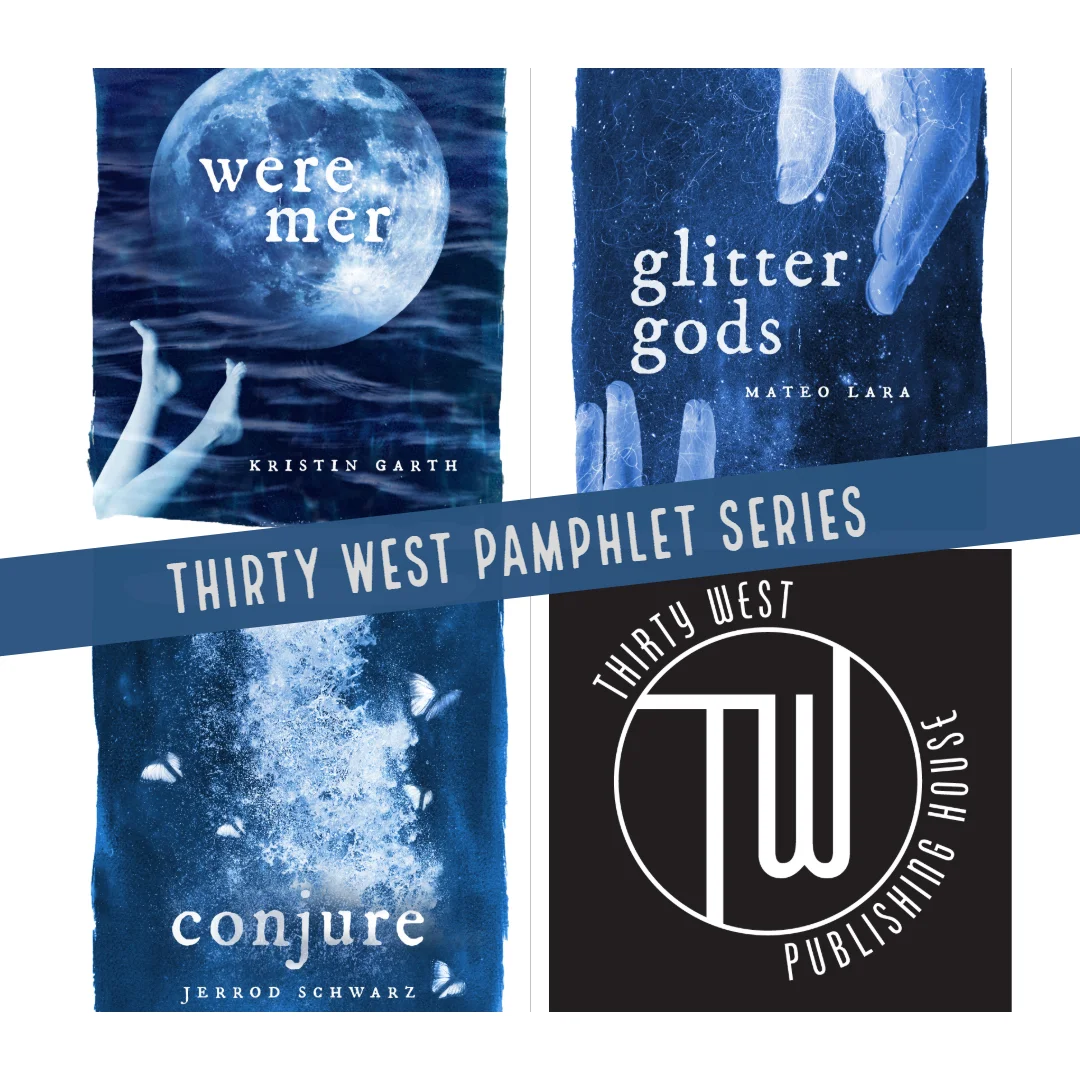
2019 Pamphlet Series: Poems from Jerrod Schwarz, Mateo Lara, and Kristin Garth
From conjure
prologue/dedication
i need to know that the earth can be stolen.
i need to write beneath grammar, to suck the word filth
into my blood: ram horn gut fuck hierophant blood scent.
a mangle of the word father.
how to bring you back/what to do with you
i buy blackout curtains and hang them
around the bathtub, sit for three days:
anemic touch of tile wall
and my own skin. my wife and twin daughters
beg me to come out, but no one can break
the salt circle.
your bones phase in first. i lay on my back
in the tub and let calcium fall to rest on me:
your clavicle balances on my clavicle, your spine
curves over my chest and belly, your metatarsals
wedge into my toes.
blood vessels root down from the shower head
and stripe over your muscle fibers; i feel your grease
in my leg hair.
before your brain and heart can connect, i shackle
your arms to the faucet. you wake up to darkness
and restraint. beneath the sink, i have hidden
a forty-pound medicine ball
covered in the full sentences
I can remember you saying:
you know i don't serve the devil, right?
you can call Rebecca mom, if you want.
I think the bald look suits me.
i drop the ball on your kneecaps; your tongue
is still forming, and the gut-scream diffuses
in your raw throat. i drop the medicine ball
four times on your stomach.
i don't want all your ribs to crack,
so i move on to your face. i shine my cell phone light
up at my own face; i want you to see my nose, my ears,
my hairline; you are darkness, but your grown tongue
begs me, please, I don't know you, please let me go,
please, is this hell?
i take off my t-shirt and wrap it over your face; your face
hangs beneath the tub faucet. i say i have questions,
and turn the water as hot as it will go.
a list of questions/phantom pain
you had cancer cells, and mom had a hysterectomy;
did you ever meet my flesh parents?
[sic] waterboard, [sic] no answer
i've heard rumor words: womb jelly, grew,
a journalist. was my true dad a fling?
am I a rape baby?
[sic] fingernail peel, [sic] whimper
you remarried after only a year,
did my marrow remind you
of radiation and remission?
[sic] bleach scrub, [sic] quaking fists
you liked raising show horses and beef cows; why did i sleep
in a guest bedroom every other weekend?
[sic] salted ice on your eyelids, [sic] whisper,
[sic] i don’t know everything.
From Glitter Gods
Winged-Man & His Stars
For H
Stripped-down where our holy spaces filled with ants.
I’m ripe & thinking of the first time someone fucked me.
Blade-hot supplements wings silver-slicked down my back
I’m hungering here nested in the backseat of his Cobalt.
Soft clay forms spot sticky with newness so much newness white & impure
Not saintly he tells me god does not exist pay attention to the stars.
I’ll float & drift within his silver-slicked push—take & give.
I enter his indifference un wanted but satiated we last three years
Before my flesh pulses with memory flying above & under him.
He talked about cosmic intent whatever the fuck that meant
Cosmic intent super nova & its burst orange death/rebirth.
Black hole sucking & fucking a galaxy he studied chemistry in college
I studied his eyebrows how much he cried when we broke up
How much my mother loved him before she started loving me
& stars dead pulse bright dead pulse so many stars
In the sky that god did not create that’s what the winged-man said
When he unfurled his silver-slicked wings to cover me
to cover my eyes.
Design
for Shawn
It feels rushed—diamonds are supposed to glimmer not gut
insides, watching the black & blue of your body shape into marvelous ruin.
It feels incomplete—this harness of power, lightning struck chords
water rushing to pummel a gold shroud in your bloodline
you hunger for happiness, it stains the room with light.
a broken moon awakens in your horrible idea of trust
& what spills in our cavity of chai tea & La Villa tacos
a tooth-rot of sweet, never let me down in your high-walled rooms
roomy enough for a glittering building burning betrayal
from old homes we call a shelter.
It feels unready—the carelessness of piles & mud-caked shoes
needing a river, needing a sun to dry out what wets O mouth
with indecision & thought upon thought upon thought of
your eyes stained darkness & questions unanswered swallowed.
your nights are bright & pulsing & every brick is rough
& red-blistered around you, a chunk of stone became jewel
& I’m not ready for another beautiful thing.
It feels timeless—however, it’s true, some things are missing
but precious gem cradles your stomach, it’s in your hand, just look
pay attention, a bunch of words still
must find air...hike up, bike out your wondering
finds you in shattering dream, gushing out of a pleasure room
the kind of love that is ready to quench a desert
monsoon a memory of cherishing out of you.
Winter Exorcism
where did I fall? what shivering waits for blizzard…
I suppose every gathering was Lucifer’s call to a queer bone.
I am unapologetically queer—each bruise purple & azul
another Mexican, another survivor of white saviors
another snow drop in my mouth
another—uncouth & whiny, icy melting.
I suppose my friend S would doubt
this ruling, demon-possessed fingers
digging into his thigh at night
I wonder & wander each corridor
anticipating my murder, my earthly death
waiting for resurrection—green vomit, sucking cock in hell
swelling up, scars, friction.
I, California—winter’s only two weeks
before heat thaws all tension away
tell me where you feel, put it where the chill
will numb me senseless, sensible once more
unafraid to utter, I love you in dark corridors
no burning pyre, no matchsticks, for the faggots
& my greatest expectation of self—come gouge my eyes out
shroud me with winter love, winter blue, winter everything
douse me in holy water, pray for me, I’m doing good
I’m doing good, I’m doing good—estoy hacienda el bien
jesûs me salvo del pecado...like that: thrive surviveunwind.
From The Legend of the Were Mer
Maudlin Mermaid
Pacific princess pouts behind a fin.
Charcoal, her scales, sequined sunlight on waves.
A raven head on rocks, she must pretend
to persecute the sailors that she craves.
Her sisters swim to join with rainbow tails
and tresses tinged in pink and honeydew,
with smiles that spread the closer ships do sail.
They celebrate the evil that they do.
Their circle song, she’s not invited in.
Secluded to the side, a sable spy.
Distrust a dimpled face too dour to grin.
As ships to sediment descend, she’ll cry.
Dark iris rimmed with red, unlike her peers.
Inside the tide, you cannot see her tears.
Were-Mer
Midnight, a solstice, fourteenth birthday moon,
secret, a swim, to reef cocoon. Abrupt
from failing thrash of tail, two legs are hewn
of no avail — complications erupt.
Asphyxiation under, frantic swim,
a flail of limbs towards buoy or end.
All waves now weakness, nature’s cruel whim,
a climb to safety and to comprehend.
A sea that rocks new legs to sleep, from fish
woman, a transformation complete. Change
a cudgel harsh as daybreak sun. Dreamed wish
light grants, nightmare undone. Mermaid deranged?
All day beneath, belief it’s dream reprieves.
Until the moon brings legs. She cannot breathe.
The Capture
Two worlds, her teens: in day, sea green; legs, night,
alight, discover desiccated dream.
From half-shell bed, sand dune instead,
pink light, electric neon call, a city gleams.
Erotic extremes, 20, indigent
in cut-off jeans, from bar to bed by men
she’s led, a wordless waif who’s fed. First glint
a dive inside an ocean deep to swim.
A fisherman, psychopathic pretense
of friend. Awake to leave, but he won’t let
her go. A nude in net, bound, defenseless
pale flesh to scales and fin, a tearful sweat.
A flop and breathless fearful heart that sank.
She’ll wait to serve at night inside a tank.
Read more of these pamphlets and author bios below.
Devin G. Kelly: An Interview
We’ve been in the mood to interview these days. We’ve also been in the spirit of our 3rd Annual Chapbook Contest. You know, the important things. So, despite 3/4 of the TW editorial currently in college, Chanel Martins, our long-term managing editor, was dispatched to NYC. Why you may ask? A native Northern Californian all the way to the Big Apple? It sounds preposterous, albeit curious. That’s why we have the internet, to conduct interviews with people thousands of miles away. This one in particular would be classified as “important enough to fly out to”, just saying. See what unfolded below…
Chanel Martins: Thanks for your time in conducting this interview with us here at Thirty West. Why not start by telling us a bit about yourself?
Devin Kelly: Thank you for taking the time to ask me some questions! As it probably says somewhere, my name is Devin Kelly. I’m a poet, writer, and teacher living in New York City. I’m in my first year of teaching high school full time. I adjuncted at Bronx Community College and City College for three years before realizing that adjuncting was, though unbelievably fun and rewarding, sort of the purgatory of teaching. I’m also an avid runner and ultramarathoner, but I won’t bore or scare anyone by talking too much about that. I already talk too much about it anyway.
CM: It looks like you partake of all kinds of writing genres (nonfiction, poetry, fiction, etc.). Which is your favorite?
DK: That’s a tough question! Each genre allows for different avenues to explore the strange beauty of this world. It’s hard for me to choose a favorite between nonfiction and poetry. I’m obsessed with the idea of truth, and the past, and how memory is its own curiosity, and I think both of those genres allow for really wonderful ways to explore those kinds of questions. But even when I’m writing about sorrow, I like the idea of play, and I think the writing I gravitate toward across all three genres does play with something — whether form, language, content, or more.
CM: Aside from writing, you also teach. I, too, teach at the high school level. What called you to this profession? How do you balance your work in teaching and your writing career?
DK: First, thank you for being a teacher. I wanted to be a teacher ever since I had a favorite teacher — which I think is similar to a lot of teachers. I was fortunate to have a litany of wonderful high school English teachers, and I always wanted to follow the example (and magic) they set for me. When it comes to balancing writing and teaching, it’s hard. Especially now that I’m teaching high school full time. I don’t know how you or anyone does it. I used to have the time to set aside an hour or two each day to devote to the practice of writing, but now I scribble notes on paper, write drafts of things on my phone. I’m answering this question on my phone, now, actually, on the subway on the way to work.
CM: On your website, you list yourself as a “writer, teacher, [and] student.” Two of these seem obvious, but in what ways do you still consider yourself a student?
DK: I would say because I learn everyday. I learn from my students. I learn from my friends. I learn from poets and writers I follow on Twitter. I learn from my various practices of teaching, writing, and running. I definitely still learn from my father, my mother. I think the moment someone begins to deny themself the possibility of learning is the moment the world begins to close its doors on them.
CM: On top of teaching and writing, you also co-host a poetry reading event. Tell us a bit about the Dead Rabbits Reading Series. What is it? How did it start?
DK: I’ve been co-hosting Dead Rabbits for over four years, which is still unbelievable to me. Over those years, I’ve had the complete honor to host poets and writers ranging from award winners to those just beginning to find their place in the literary world. There are so many things about the series I’m grateful about. That I got to hear poets like Morgan Parker, Eduardo Corral, and Lynn Melnick read. That I got to hear poets early in their blooming careers, like Carlie Hoffman and Kwame Opoku-Duku. That I met some of my best friends, like George Kovalenko, through it. That I’ve been running it alongside another great friend, Katie Rainey, who is leading a press spin-off of the series, called Dead Rabbits Books, which you should all check out.
CM: It looks like your books are currently available in big-name stores such as Amazon, Powell’s, and Barnes & Noble. What do these big names mean to you as a “Writer” ?
DK: You know, not much, if I’m being honest, though I support Powell’s more than I support Amazon or Barnes & Noble. I believe in the power of literature and making art as a way to engage with and reckon with the world, to make beauty and sorrow out of the real and mundane, to actively believe in the potential of your imagination and your way of seeing, and to build community and solidarity in a world that so often pushes against it. I think corporations, even when they’re involved in selling art, can be a pain, and can detract people from some of the more intrinsic positives of making art. That being said, I believe in the power and joy of small bookstores, and the potential they have for uplifting and building community in the communities they are located.
CM: Where do you find your inspiration for your writing? What is your greatest accomplishment as a writer so far?
DK: That’s a difficult question! My inspiration for writing comes simply from the way I look at the world. That’s not to say that I look at the world in an innately special way, it’s just to say that the world as it is — whether mundane, or beautiful, or whatever — is where my poems so often end or begin. There’s a Larry Levis poem that says, “There are two things I want to remember /
About light, & what it does to us.” I think of that all the time when I write. How simple that is. Most of my poems have to do with the world as I see it, and the bonds between families and friends and lovers that are made or broken or in the process of being made or broken within that world. I think the friends I’ve made through my art are the biggest accomplishment I consider as a writer so far. That’s not to say I’m not grateful for having a book, or being able to publish my work. But the friends — without them so much wouldn’t be possible, and when the year comes that not a single person buys my book, my hope is at least I’ll know a poet or two and still be able to call them my friend.
CM: On your website you mention that you “enjoy extremely sharp cheddar cheese melted atop a medium rare burger” which sounds delicious right now. Anything behind this in terms of significance? Why do you find this important enough to include on your main page?
DK: Hah, I love this question. And I have no answer other than I want one terribly now, a medium rare burger with the sharpest of cheddar. Some delights are (almost) better than a beautiful poem.
CM: So, we’ve been teasing this for a while now, but here it is: we at Thirty West are honored to have you as the guest judge for the 3rd Annual Chapbook Contest! Have you ever judged a contest before? What are your expectations for it?
DK: I never have! I’m so honored to be given the opportunity. First of all, I’m grateful that I’ll be able to encounter what I am sure will be a wide range of beautiful work. And secondly, I’m sure it will be one of the hardest decisions I’ve faced to choose from such a wide range. I’m really looking forward to it.
CM: Any pro-tips for prospective authors who are considering this contest?
DK: Send your riskiest, your most imaginative, your most mundane, your wildest, your quietest, your loudest, your most still. Whatever way you see the world and ask questions about the world. Send me that. I can’t wait.
CM: Thank you, Devin, for the interview. It was fun and we’re looking forward to seeing your manuscripts on March 1st!

Devin Kelly earned his MFA from Sarah Lawrence College and is the author of two collaborative chapbooks as well as two collections of poetry, Blood on Blood (Unknown Press), and In This Quiet Church of Night, I Say Amen (Civil Coping Mechanisms). His work has been published or is forthcoming in The Guardian, LitHub, Catapult, and more. He is the Director of Enrichment Programming for the Sunnyside Community Services Youth Futures Program at Queens Vocational High School, as well as a teacher at the City College of New York. He is the founder and co-host of the Dead Rabbits Reading Series and currently lives in Harlem.

Karina Bush: An Interview
It took me a few “Where’s Waldo” moments to be able to track down where Karina Bush is at any point in time or particular mindstate, but finally I found her: the duck-billed baseball cap donned over blonde hair. I apologized for interrupting her brain lace weaving, but thankfully, she was able to take some time to answer my highly-anticipated questions. Below is the following account…
Josh Dale: Thanks for allowing me to interview you and I’m sorry for interrupting your weaving! To start, why not tell everyone a bit about yourself.
Karina Bush: Hello, Josh! It’s a pleasure to be interviewed by you. I’m an Irish poet, writer, and artist. I’m from Belfast and I live in Rome for now, but I’m moving on soon, not sure where yet.
JD: I’ve been a fan of yours since I was recommended first chapbook, Maiden. What central themes are you most confident in portraying?
KB: Thank you! Sexuality has been a strong theme in my writing. Creative energy comes from the sexual area, so I think it’s quite normal for early work to be seething with sex. But the sexuality of my poetry is locked into emotion; it isn’t throwaway sex. Except for 50 EURO, of course, which is 20-minute throwaway sex, but it still lives in an emotional realm of mostly negative emotion. Emotion is what I’m most confident writing in, the emotional landscape is endless, I always find more to explore.
JD: I’ve caught myself Googling specific Irish terms and figures of lore in your work. As an Irish woman in the 21st century, how has your work embodied the culture?
KB: With my first three books, I don’t think my Irish-ness has been prominent. With my new book, it is. It’s set in Belfast, a story of cruelty and stupidity in love. It’s coming out soon with Analog Submission Press. I admire the press a lot, the editor has a great vision and enormous energy for it—he’s a powerhouse and an interesting guy. Being Irish has certainly had an impact on me as a storyteller; everyone in Ireland is a storyteller, except for a small number of bores. There are deep wits and insights that permeates the culture and genuine respect for the arts—it’s in the blood, a long oral and lyrical tradition that can’t be broken. The Irish can’t be broken. The British government tried to break us for centuries and they failed. We refuse to be tamed.
JD: How has traveling been an influence (or inhibitor) for your creative endeavors? Where have you gone in the past year or two?
KB: It has been a huge influence. It pulled me out of a closed-minded thinking pattern. I felt stuck in Belfast, so I packed up and left five years ago, with fuck-all money and no plan, and I’ve made it work. I’ve traveled a lot—in Asia, the US, and Europe. My favorite places are Japan and Italy. I don’t write about where I am living or visiting. I’m not one of those travelers who jumps into a culture with a GoPro on my head. I absorb what I want to absorb. The cities and countries do seep in, but not in a direct way. When I first moved abroad, I struggled to write because I was unsettled, but being unsettled is quite normal now, and I’ve found that developing adaptability to change has helped me write and create. I’ve had to learn to ground and centre myself anywhere, and it’s easier to do now.
JD: I recall you had an affiliation with 48th Street Press (publishing Maiden, broadsides, etc.) Do you feel that they propelled your writing career? Do you enjoy mailing personalized letters, broadsides, and swag to your fans?
KB: For sure they did. I’m still closely connected to the press; the editor works with me in the writing process. He has been my personal editor for six years now—he’s brutal though. BareBackPress has also been significant for they were one of the first to publish me back in 2013 and we’ve developed a very fertile and creative friendship. The owner has edited my new book and he’s incredibly sharp. This mentoring has had more influence on my work than anything else. And yeah, I do enjoy mailing stuff out. That’s such an important part of the small press, getting words out there. I love digital but I also want to be part of keeping physical literature alive.
JD: In 50 Euro, the narrator is indulging in various sexual encounters with seemingly incompetent men. I’m not keen on all feminist theory, but this collection seems to be a tangential path that is rarely explored. Care to give us your take?
KB: I didn’t write it with any feminist theory in mind. I’m a woman, and like most women, I’ve been assaulted and harassed, but I don’t have a feminist agenda in my work. I write as I see fit; I don’t feel the need to be reactionary to social or political tides. I had a story published by the incredible Akashic Books last year, which is the closest to political I’ve got. It’s about a British soldier in the 1990s holding a thirteen-year-old girl at gunpoint, sexually harassing her, and her subsequent revenge. That story is semi-autobiographical; a soldier did that to me as a kid during the Northern Ireland conflict. The crimes of war are hidden stories as well as newsworthy ones.
For the most part, I see masculinity as positive energy. A beautiful male mind is the most interesting thing on the planet to me. But, ugly behavior certainly needs to be examined and exposed. I turned some of the creeps I’ve met into johns in 50 EURO. I liked stripping them down in my writing, having power over them, taking their money and their confidence. I was careful with 50 EURO to neither glamourise nor victimise the protagonist. I simply wanted to capture the essence of the red-light district and those quick exchanges.
I’ve had people cross the line with me as a result of the book: call me a whore, send me dick pics, send repeated messages begging me to fuck them. Kafka wasn’t an insect. Mary Shelley wasn’t hideous and eight-foot-tall. You can write about things and not be those things. Literature is not always literal. I work in the tech industry, not in sex work. My poetry is not an invitation to get sexual or personal with me.
JD: Brain Lace was my favorite of the three, for it feels like a compounded maturation of your previous two titles. Less abrasive, yet equally abstract, and filled with genre-bending work. What state of mind were you in as you wrote this?
KB: Thank you, Josh! My mental and emotional state was very fractured writing it. Everything I was experiencing felt like an abstraction. Nothing was concrete. The book is confused, trying to reconcile thought-scapes with reality and notions of karma. I was in Japan, feeling alien and isolated, and I had a connection with someone on the other side of the world, a connection I didn’t understand and still don’t. That sparked the concept; the brain lace I was experiencing. Being so far away from my roots—my home— it’s strange and beautiful but I found electricity moves like roots. Being in Japan accentuated that for it’s such a mix of ancient and digital. We’re all going through an intense evolution right now; things are moving fast, reality is being redefined. I’m enjoying feeling it as much as it confuses me.
JD: You’ve been involved in visual arts lately, crafting videos and photos that are suggestive and unsettling. What’re your literal representations for such projects?
KB: I’m getting increasingly frustrated with how to express. I think visually. My work starts as an emotional form; it’s not verbal at all. I make it verbal because that’s the easiest way to get it out. But I need to make it move. flat writing feels lazy; it’s no longer satisfying me. I’ve been writing poetry through video lately. I’ve got a mega video piece in the works but it’s likely a year or so from being ready so I’m still training myself.
JD: Valentine’s Day is approaching…immediate reaction?
KB: Pile of absolute shite. Romance is meta—it can’t conform.
JD: Lastly, what’s your favorite memory of your time in the U.S.? Any plans on coming back (possibly to do a reading?)
KB: Watching two golfer middle-aged johns twerking to trap music, trying to impress sex workers in Florida. I’m sure security would’ve broken my arm if I’d tried to film in there but I’ve still got the video in my head; one of the johns even got a special mention in 50 EURO. I’ve been to your hometown, Philadelphia. I took a tour of the Masonic Temple; it’s one of the largest in the world. There is a lot you can’t access, so my inner Robert Langdon took over. I was dying to sneak into a secret passageway and find some reptilians eating babies, but the tour guide was on to me, fuck’s sake. I have no plans to read my poetry, but I’ll definitely come to one of your press readings if I’m ever back in Philly.
JD: Thanks, Karina, for your time and I’m looking forward to your forthcoming publication! For more about Karina, including links to her site and books, see the bio below. See you next week on The Weekly Degree with NYC-based poet, Devin G. Kelly, and some exciting news on the 2019 Chapbook Contest!

Karina Bush is an Irish writer and visual poet born in Belfast and now living in Rome. She is the author of three books, Brain Lace (BareBackPress, 2018), 50 Euro (BareBackPress, 2017), and Maiden (48th Street Press, 2016). She has a new book, Christo & Nicola, forthcoming from Analog Submission Press. For more, visit her website karinabush.com and Instagram https://www.instagram.com/karinabushxx/.
Levi Bentley: Bucolic Ecologues - 3 Poems
curdled milk enow
there’s one more early memory here of sewing the red X
in cloth diapers at the mission hospital to give new
mothers marking as property our cover while starting
a church converts there risk arrest i am
five when we return to the states now my mother is sewing
alterations
into hand-me-downs reading settler-fiction at bedtime the
button tin and the Singer, our sewing machine comprise
a non-game winding the bobbins threading all the eyes
setting a tension that hums breaks jams and snaps
like the room when my fxxxxx enters slack then snapping
i enter the picture coiled unspooling leaving
snarled
a rat’s nest of knots taut beneath the
gears of this
bid the woods
vasostructure / a stretch webbing / pinnately
/
compound palm / oak falls /
damp / handed pile
/ raked / rip / along vein
/
wax taught reed
mounds of wet oak leaves cold reddened raked
and bordered by thick waxy salal hedges with
black berries beside childhood home old
white siding yellow trim in washington
state i learn aloneness with sticks moss
slugs chickens meat rabbits mulched
leaves big wet hands raised against
grey sky green fields steel grey sea
climb a sticky ponderosa pine to be
above roof ridge for hours being
forgotten a home garden a deer
fence in the town name truncated
klallam for “quiet water” sounds
like “skwim” like something you
don’t want to happen temperate
desert surrounded by rainforest
settler history begins there 1850
incorporating into township in
shadow of logging and railroad
boom and bust a log camp then
farmland until the 1950 green
revolution makes small farming
obsolete and california begins
retiring there my grandparents
and others bring chain stores the
year i leave a walmart a median
age of 62
makah whaling rights won in 1999 are exercised
and then voluntarily suspended but in high school
for several years someone brings in ziploc bags
of blubber for show and
Levi Bentley organizes the reading series Housework, edits the journal Boneless Skinless, writes for Artblog, and is a member of the artist collective Vox Populi. "Bucolic Eclogue" was released from Lamehouse Press in July 2016. Chapbooks "Obstacle, Particle, Spectacle", "&parts", and "Stub Wilderness" were released from 89plus/LUMA Foundation, Damask Press, and Well Greased Press, respectively. Vitrine released their tape "Red Green Blue". Poems have appeared through 491, Apiary, Bedfellows, BlazeVOX, Boog City, Elective Affinities, Fact-Simile, Gigantic Sequins, No Infinite, Madhouse, Maestra Vida, Magic Pictures, Painted Bride Quarterly, Small Po[r]tions, Stillwater Review, The Wanderer, Tinge and Truck
Aiden Heung: 3 Poems
First Snow
The weight of winter, hard on every cloud
dropping low on this city, and soon
shredded,
ground
and falling white
from a vulnerable sky,
breeding
the first shade of darkness
prolonging the night.
A soft wavering voice
Against the wind —
Melancholy.
Two Monochrome Photos from Summer
1.
The morning heat
breaks through the window
and warps
the dream
into a hot reality.
8 o’clock,
the fateful hour of awakening,
reminded
by a ticking watch,
with almost the same rhythm
of the heart.
A moaning summer,
dying in the yards.
Some arranged flowers
yellow
from a sad florist.
2
The scorching south wind,
breath
of Feilian(1),
coming to all
in cities or villages.
A wash of tolling bells.
thick shadows
hidden
behind a mottled wall
and a murmuring crowd of people
squatting at the gate
of a silent neighborhood.
(1): god of wind in Chinese mythology
The Line He draws
for Tomas Transtroemer
The line he draws on his notebook
stretches out, endlessly,
with the sound of an axe cutting the air,
and continues its silent judgement, where
the world is halved.
I’m on one side;
My deeds the other, falling soundlessly;
A rebuke—
I cast my thought over
into the realm of inanity.
It bounces like a morning dew
on lifeless leaves.
Air is thinner there
than a breath.
I grab hold of the line —the edge of existence,
saved by an old hypothesis
of death.
Aiden Heung is a native Chinese poet currently working and living in Shanghai. He writes about the city of Shanghai and about people who live in this city. He is a Tongji University graduate, with bilingual poems published in many online and offline magazines in Asia and Europe, such as New English Review, Alluvium, Eunoia Review and A Shanghai Poetry Zine among many others.
Remi Recchia: 2 poems
On Visiting the Fairlawn Cemetery in Stillwater, Oklahoma
The birds here are tiny dinosaur soldiers:
black & feathered & claw-footed. Probably carnivorous.
We're walking down the path hand-in-hand,
tourists unaffected by bones at rest. It is cold,
& you are wearing my sweater. The brown
threads weave over your chest like a casket.
I understand death in a detached way—studied
coldness & distended stomach. My dog stopped
breathing in February (or March or April) & I
never told anyone about it, just burned his collar
& ate the rest of his food. Sometimes it is like this
in life.
I smell the wind picking up a few miles back; your hand
stills the back of my neck like a mother in prayer.
I'm thinking about those cold yellow cats,
how their mother was there, unidentified, among her kittens,
& I watched townspeople & children litter & smoke
in the parking lot. I waited for them to leave & stomped
out the embers. We called every animal shelter that night,
asking what to do & where to go & they told you,
"ma'am, they're supposed to be there, they're downtown
cats," & I didn't want to be the one to tell you the cats
would survive just fine without you. & now you're staring
at the graves, at your reflection in my face, small & white
& marble, reading dates of little deaths, & I know
how beautiful certainty tastes.
On the Event of My Father’s Seventy-second Birthday
O God
On my knees
& I’m thinking about the man in a leprechaun hat,
how he’s drunk & asking me if I am
my father’s son, telling us his son was murdered;
O God
On my knees
Basement incense will cover my brother’s cigarette
sounds, but not the slow slope of my father’s shoulders
Sometimes I wonder how it feels to dowry a daughter;
O God
On my knees
Was Abraham afraid of animaling his son?
It doesn’t matter if Isaac shuddered
These are the things we give to our fathers;
O God
On my knees
I am twenty-three & I can’t remember how to catch
white leather seamed with red, & I want to learn again,
but my father is away, skin stitched together tight;
O God
On my knees
I’ve been told I was born old, but I’m not
the one with liver spots, my lungs are fresh,
& I have never been more afraid of death.
Remi Recchia is a Ph.D. candidate in Creative Writing at Oklahoma State University. His work has appeared in Barzakh Magazine, Pittsburgh Poetry Review, Front Porch, Gravel, Glass: A Journal of Poetry, and Haverthorn Press, among others. He holds an MFA in Poetry from Bowling Green State University.
Michelle Brooks: 3 Poems
Tabloid Dreams
I am writing to you from a far-away
place. The future is nowhere in sight.
You won’t learn anything new. I’m not
alone – the ghosts whisper into intercoms
at night. There’s a suitcase in the hallway
that I keep forgetting to move. Sometimes
the light shines into this darkness, and I read
magazines with pictures of the famous
dead, piles of yesteryear’s scandals. None
of this matters anymore. It’s always late
afternoon, and I’m always waiting for someone
to come home. A lit cigarette rests on a saucer
that has never been used for anything except ashes.
The Serpent Consumes Itself
You won’t like why I’m telling
you this story about when the carnival
came to town. Set up in the mall
parking lot next to the dying Sears,
the late summer heat glints off the steel,
and from the top of the Ferris wheel, I
can see the highway rising like an ordinary
hallucination in the dog days of summer.
It leaves within days as if it was never
there, and yet I am still suspended
on the top of this world I’ve known
forever, understanding this limbo exists
within my blood, always knowing when
the carnival comes to town, I realize it never left.
I Didn’t Mean to Scare You
A girl crawls out of the dumpster
at the Shell where I am getting
gas early Sunday morning, the heat
already like a blanket. In the bleached
denim light, I gather empty water
bottles and fast food wrappers to toss
while the girl motions to someone
who crawls out of the dumpster which
appears to contain multitudes. I curse
myself for letting the tank get to almost
empty while the numbers rise. My Russian
nesting dolls from the dumpster walk
into an alley, gone from my sight. Did
they find what they were looking for?
Does anyone? All I know is that gas prices
are rising again, making me wonder why
it costs so much to get anywhere at all.
Michelle Brooks has published a collection of poetry, Make Yourself Small, (Backwaters Press), and a novella, Dead Girl, Live Boy, (Storylandia Press). Her poetry collection, Flamethrower, will be published by Latte Press in 2019. A native Texan, she has spent much of her adult life in Detroit.
Brenna Webb: Mouth of Bees
I threw our six-dollar champagne bottle in the trash.
“Night one in New York, baby!” I said.
The memory of the glass thudding into the bin made my temples pound. It was August and sweat clung to my naked skin. No air conditioner. Just a bare mattress, a suitcase, and a couple of boxes.
I had a vision that once I moved to New York City I’d sip black coffee in a knit beanie like Patti Smith. The champagne was a celebration. The city of dreams. Though Manhattan had her own deck of cards. She didn’t deal anyone a hand, rather she pried cards into your mouth one by one until you were shitting out the Queen of Hearts, realizing plans are an arrogant pipe dream in the face of her steel power.
I tried to remember the end of my first night in The Big Apple. I knew it was bad. There had been screaming in the street, a rented bicycle was stolen from its kiosk, and a fifteen dollar bacon lettuce tomato thrown to the Manhattan sewer-ether. The clearest memory was marching up to my fifth-floor apartment hearing the, “fuck off” I yelled in J’s face reverberate down the seemingly endless flights of stairs.
This happened every time I got drunk with my boyfriend, J. His crime was being there after I had one too many. I know I didn’t deserve the magical cup his forgiveness poured out of, it never ran out. I pushed his chest when he lost the keys. I sulked incessantly at plans that did not run on my timetable. I bitched and bitched.
Now looking at him asleep next to me, I thought his blonde hair looked too pure to rest in my three-thousand-dollar a month roach nest. I wanted to bleach the place looking at it next to his clean and sculpted body. He would wake up and smile without a word. The same smile that met me in mornings that smelled like hospital paint while I waited for discharge papers. We were in high school then, he said nothing when everyone else said too much. I’d tell him where I’d been, he’d smile and say it was ok. His grin met me in mornings that smelled like fresh produce blended for us before work. We were adults then, and he waited when everyone else had left. I’d apologize for being a bitch. He’d kiss me, we’d fuck.
The word bitch lived in a beehive beneath my tongue. Wet and swarming around unbridled insecurities, weeds in an unkempt garden. The diagnoses had always felt invasive, I was simply a pallet of colors that seeped into places it shouldn’t. The black watercolors diluting everyone’s blue. Bipolar.
Two pigeons cooed at my window. Manhattan was a bitch with her rent and rodents. Her broken trains, and trash. With her unkept promises, glamour, she is so idealistic. We had more in common than I’d like to admit. A girl with bipolar and the city that never sleeps.
I slipped into the bathroom, careful not to wake J. Day two started with no paper towels, so I slipped my palm under the running water and swiped the dirty mirror with my hand. Buy Windex, I whispered into the reflection.
Brenna Webb is from Bethlehem, Pennsylvania. Her work has previously been featured with Basement Poetry in the Spring 2017 production of HER. Other published works can be found published in The Laconic. Brenna wrote and directed her first short film, "SIN LADY" with Mr. Mister Productions, scheduled for a Spring 2019 release. She currently lives in New York City where she studies English-Literature and Film Studies at Columbia University.
Akachi Obijiaku: 3 Poems
Empathy
You don’t know what pain feels like when you’re well
You cannot imagine what loss evokes when you still have
Empathy tries to imagine
She tries to make us relate
But we are only mimickers
We cry when others cry hard enough
We laugh when another laughs loud enough
And when empathy tells us to be silent
We are silent
But we don’t still know what it’s like to be in one else’s shoes
To remember what his child’s last heartbeat felt like
To cringe when she was told to sit at the back of the bus
We try to understand, we do
But we don’t
That Autumn Smell
That autumn smell makes me love life
Mixed with leftover street cigar scents
And a shy winter trying to creep in
That Autumn smell makes me want to be adventurous
Spontaneous runs in the park beside tall handsome strangers
Late night treks to the picturehouse all by myself
That autumn smell washes away the homesickness
Giving me a re-awakened sense of valiance
Ready to construct some new beginnings
That autumn smell holds me to account
Reminds me that I have no reason to fail
No reason to fear, and no reason to fade
The Pastor’s Son Is In Town
The pastor’s son is in town!
Make sure you comb your hair well
Take a deep shower and keep clean
Eat before you get to the church - look healthy
The pastor’s son is in town!
Be cheerful and be on time
Don’t let me down
And make sure you give him your number
Akachi Obijiaku is a Nigerian poet. She emigrated to England 5 years ago, and started writing poetry last year. Her poems appear in over 10 journals.
Larry Narron: 3 Poems
Antique
It's not the heart
that broke,
it's the promise—
an antique
clock that now keeps
its hands
in its pockets,
knuckling
the springs
they straightened,
that now keeps
a blank,
numberless
face
fixed
on mine
as it lies
about time.
Creation Myth
for Kool Herc
Did you hear about the rose that grew from a crack in the concrete?
—Tupac Shakur
In a valley
of shriveled fire
escapes, he plucks
a discarded
cardboard box
from a dumpster,
tears out the staples
as if they are thorns.
Unfolding each
delicate petal,
he rubs his palms
over the creases
to flatten what was
thought to have wilted.
Here he will re-
sow the undreamed of
in concrete
& nourish a field
until it blooms
for his neighborhood's
pleasure: a dance
hall without walls,
without a ceiling,
with the sun
for a mirror ball,
with the whole
sky to make room
for their moves.
Golden Era
for Brandon, Armando, Garrett, & Joe
Long before rappers
guzzled cough syrup
to numb their tongues
so all their words
dulled into mumbles
that all bled into one,
we gathered in circles
under parking lot lights
& passed around
piss-colored forties—
elixirs of violence
fermented with such
surprising sweetness.
We cared for each
word as the serifs
of their letters were
so delicately sharpened,
the handle of every
syllable held, nurtured,
rocked into reverie gently
by the hardest beats.
We savored a potency
we tasted in each drop
& saved the last
of the poetry just
to spill it, to pour it
out for all the dead
emcees, then threw
bottles in the street
just to hear them shatter.
Larry Narron is a graduate student at the University of Pennsylvania. His poems appear or are forthcoming in Phoebe, Santa Clara Review, The Brooklyn Review, Berkeley Poetry Review, Tilde, The Boiler, and elsewhere. They've been nominated for the Best of the Net and Best New Poets.
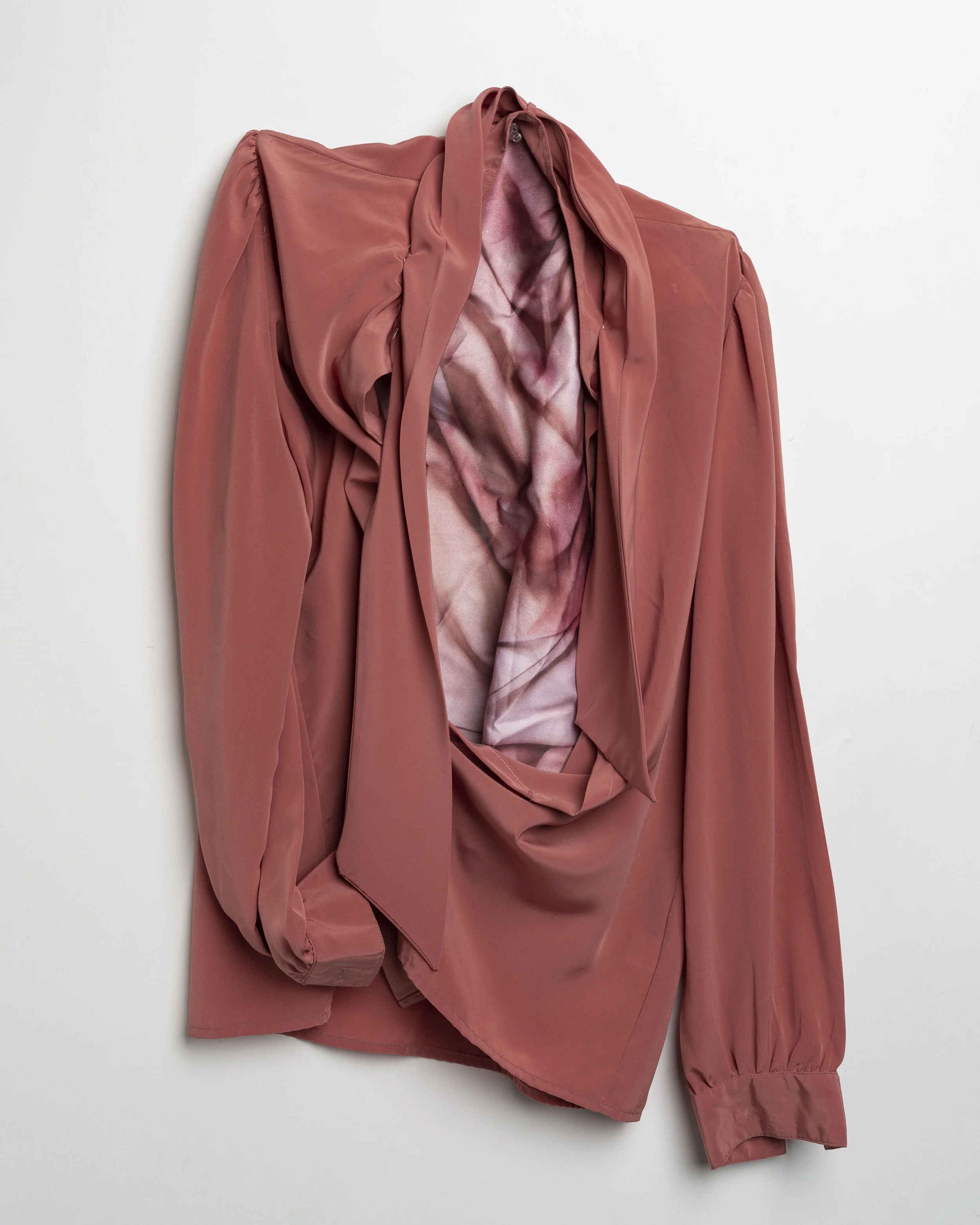
Morgan Stephenson: Yellow Roses


Description:
This current body of work focuses on the relationship with her paternal grandmother and its continuance after her death. The artist re-examines memories and emotions through archival imagery, familial heirlooms and storytelling from a personal perspective. The body of work also explores the illusion of control utilizing photography, digital manipulation, and textile techniques such as digital printing on fabric, hand sewing and dyeing.
Morgan Stephenson is a freelance photographer living, working, and studying in Bloomington, Indiana. She is currently an MFA candidate of Photography at Indiana University and holds a BFA in Photography at Memphis College of Art in Memphis, Tennessee. Raised predominately in the American South, she enjoys creating work that investigates familial relations through the concepts of memory, comfort, and emotion.
Glen Binger: The Voicemail
Raechel was a 5th-grade teacher when she was found out her mom had lung cancer. It took everything out of her. The breath, the business, the beauty. Every sunrise was another layer of hot tinfoil wrapped around her heart. After the estate was settled, she quit teaching and became a social media consultant. Made more money too. But really, it was working from the solitude of home that brought the interim solace she needed.
Over coffee every morning—for seven months—she thought about dying. By her own means, leaving her meat wagon to rot in the dirt. She thought about many other things too, of course. Her salary, her mom's wedding dress, her high school boyfriend, Jacob, and their first kiss in the changing room of Hot Topic. His Coheed and Cambria sweatshirt was still stashed away as padding in one of the basement boxes. Sometimes memories burn new holes.
The message appeared on a Wednesday in October. Right there in her taskbar as if Mom called on Tuesday. Next to the two Instagram tags for work. And, as if that wasn’t enough, it was raining. Again.
“Hi sweetie,” the voicemail went, “just wanted to see if you're ok. Haven't heard from you in a few days and I know it's the chaos of September. Have you had back to school night yet? One more year. Anyway. Love you. Call me.”
You could hear her mom’s smile. It was a message from Raechel’s 3rd year teaching. Just before getting tenure. Raechel knew she had called back that same weekend. She could remember the rain then too, watching the droplets skitter down her kitchen windows while Mom talked about Dad and his snoring. It was getting worse.
But for some reason, four years later, this message reappeared again. Glitching reality as if someone was trying to tell her something, as if the universe wanted to remind her that she'd be ok. That night, she flushed her stash of Valiums and most of the Adderall. And then the following night she went into the basement after some wine and some weed and proceeded to unpack the old family albums.
Among the stash, was a framed photo from 1999, wrapped in Jacob’s hoodie from 2003. It was Raechel and her mom, standing next to Dad’s reading chair. Their smiles were exuberant, but you wouldn't be able to tell as it wasn't your memory. The picture was too grainy. Dad was the worst photographer and he was terrible with tech. Jacob helped set up the family computer that same day. And later that same night, Dad was killed by a drunk driver coming home with the pizza.
She put the hoodie back and took the picture upstairs, placing it on her bedroom nightstand. A kernel panic and then nothing. Raechel thought she knew what it meant to suffer.
We all do until it happens again.
Glen Binger is an educator, interviewer, and the author of Things You Don't Know, a poetry collection that explores the lines between consciousness and the quantum realm. He blogs at glenbinger.blogspot.com.
Jenna Faccenda: Her Last Plea
TW: Domestic Abuse
My knees shook as I stared into the looming eyes of the Judge.
“Was there physical abuse?”
The words came off her tongue with such an uninterested disdain.
“No, your honor.”
“Did he threaten to kill you or harm you in any way?”
“No,” I said.
I wiped my sweaty palms against my pants.
“Your honor.”
She flicked through the file before releasing a deep breath.
“Honestly, I don’t see any present danger here. I am going to have to deny your file for protection.”
With something as simple as a stamp on a page, my PFA was denied and I was being escorted out of the courtroom.
“I am so sorry ma’am,” the officer said, putting a reassuring hand on my shoulder. “I hope things work out for you.”
I nodded my head as the color started to return to my face. I didn’t turn my phone back on until I reached the car. As soon as it came back to life, the screen was flooded with text messages.
Mom: How’d it go, dear?
April & Stephanie: How was it? We are here for you! :) You’re a queen
Past those, however, was another chain that I was hesitant to open. I didn’t think much of it, knowing that he’s been quiet these days, but not this time.
Bryan: Fuck u slut
Bryan: I hope u get hit by a car and die
Bryan: U r nothing but a piece of shit and Im gonna make ur son know.
Tears plummeted from my face as I stuffed my phone in my back pocket leaving them all on read. I knew I shouldn’t have looked at it. I knew better. I just wanted my bed. Within my car, it continued to vibrate. I turned up the radio trying to drown it out. Normally, the ride to and from the courthouse was quick and uninterrupted, but today, it was full of unpleasant thoughts. By the time I made it home, the sun was in twilight leaving nothing but the cool summer breeze. I shuffled through the contents of my purse in search for my keys.
“Fuck.”
I stared at the corner window where the light shined through the curtains. Trying to reach my roommate, four missed calls and ten new messages from him covered my phone screen. I tried not to look but my eyes caught the previews of the texts. I was stuck.
Bryan: Ur crazy if u think hell say goodnight to you
Bryan: Grow up learn 2 communicate
Bryan: Maybe if u answered me I would leave u alone
Bryan: Ur a selfish cunt.
The words left me breathless. The letters started to blend together one after another, the time was meaningless. My hand couldn’t pull up the phone. It wasn’t until the sound of a car horn made me jump. I only had to turn around to make my heart thump for the last time.
“Why aren’t you answering my calls, bitch?”
His voice was a siren. He got out of the vehicle with purpose. More sirens. A streetlight caught the glisten of my son’s pupils in the back seat.
“I told you I am just going to find you if you ignore me.”
By the time I came to, his breath was on my skin, burning like all the times before.
Jenna Faccenda is a Philadelphia-native who enjoys writing twisted tales while cuddled up on the couch with her black cat and 4-year-old son. Determined to read books for a living, Jenna is the Co-Founder of Writely Me and the Publicity Manager for Running Wild Press. Her works have been featured in The Literary Hatchet and her debut chapbook, The Phoenix From the Ashes (2018). Follow her on Twitter @faccenda_jenna.