

Amy Soricelli: 2 Poems
If I Went Back to School it Would be For Everything
My lost books can be blamed on the scratches
on the desk with the names like deep holes in the earth.
Pens and knives carving out letters from your eyes.
No one in the back is listening.
If you wear red they will find you after class it was
green yesterday.
If you don't listen to the whispers you won't know;
your hair gets wrapped in a fist and there is no tomorrow.
Is that the ice-cream truck. I think I hear the ice-cream truck.
Those desolate mornings on line with all the others
eyes drilling holes into the broken concrete.
Caught bees on a frozen roof.
Hair tied up in a knot not screaming look at me
down the length of your back.
If it is long with spinning ribbons or plastic balls
it will get caught in angry windy fingers;
scissors like magic from behind their backs
your ponytail on your desk before the bell rings.
She won't explain it again. She is afraid, watches the clock.
Blurry chalk against the green board the coded symbols
won't settle into my head before dinner.
Hope there is no test on this.
Her voice is black tape across her mouth.
No one in the front is listening.
I bet she cries to her mother every night.
How the velocity she teaches after lunch cannot
carry the space in her soul.
There are chapters ripped from my book.
A whole war is missing.
There is gum holding together my brain.
Dead air caught in the spine.
Classroom walls designed in deep green peeled paint;
fairy dust on my shoes.
Don't go to the bathroom.
Heard it is a tunnel with bats; they cut your hair in there.
And no, I never read that one either.
She Doesn't Sleep That Well, Really
I sleep on top of bridges when I think there will be a dark
spot on the sun or if I think I am getting a headache,
I will put together last thoughts and scream them
down a tunnel.
No money in my pocket you see my head
filled with cardboard boxes sleeping curled-up
hands around my face.
My old boss walks by not surprised.
My loss of a word escaping in a stumbling sentence,
I am caught in red tape and MRI's,
convinced I will walk around distorted
by new voices in my head.
Few sneezes and I imagine permanent bubbles
of protective wrap, and notes slipped lovingly
through slots or zippers.
People say - they ask - why go there so fast so speedy
down the bleak road of desperation.
Safe, I say, to be waiting there with boxing gloves
and purple hat.
If you're early you get to sit in front.
Amy Soricelli has been in the field of career education and staffing for over 30 years. A lifelong Bronx resident, she has been published in Grub Street, Camelsaloon, Versewrights, The Starving Artist, Picayune Press, Deadsnakes, Corvus review, Deadbeats, Cantos, Poetrybay, The Blue Hour Magazine, Empty Mirror, Turbulence magazine, Bloodsugar Poetry, Little Rose magazine, The Caper Journal, CrossBronx, Long Island Quarterly, Blind Vigil Review, Isacoustic, Poetry Pacific, Underfoot, Picaroon Poetry, Vita Brevis, Voice of Eve, Uppagus, The Long Islander, The Pangolin Review, Plum Tree Tavern, Red Queen Literary Magazine, Terse Journal. Ethel5, as well as several anthologies. *Chapbook, Dancing Girl Press, Summer 2019. Nominated by Billy Collins for Emerging Writer's Fellowship/2019, Nominated for Sundress Publications "the best of the net" award 6/13, and recipient of Grace A. Croff Memorial Award for Poetry, Herbert H. Lehman College, 1975
Rebecca Pyle: 4 Photographs and a Drawing


Synopsis
It sounds mundane, the word contrast; but contrast is, I think, what enlivens these images: the abandoned tattered old red leather sofa, abandoned in front of the very alive and green late-spring rock garden, together almost a summer Christmas gaiety of reds and greens; the quiet tree stump, now pedestal for the modern inventions of television and telephone, a chalk cityscape behind them suggesting the tree is now in the new electric forest of tall buildings. A Pan-like bronze boy atop a zoo gate in Central Park, in that pose forever, with real and moving trees behind him. A bouquet of tulips in water, on glass blocks which look very much like swirling water, but are forever still: what looks like trapped water within squares is glass.
And last, the crayon-on-cork drawing of two figures in a thriftstore, "The Beekeeper and Me in the Thrift Store, Looking for Dior," reminding the viewer that even in a thrift store, perhaps most of all in a thrift store, we have elegant wishes/dreams.
Rebecca Pyle lives in Salt Lake City, Utah. She is a writer and an artist. Other places her visual art can be found are The Menteur (Paris & U.K.), JuxtaProse, Belle Ombre (U.K.), and New England Review, or on the covers of issues of Raven Chronicles Journal, Oxford Magazine, and her own poetry chapbook, The Underwater American Songbook (Underwater New York, 2018). (See rebeccapyleartist.com.)
Cody Roggio: 1 Poem
End
I get fired from my job for stealing money from the register. I am weeks away from a promotion I’ve worked two years for. On my last day you pick me up and I tell you what happened; you are disappointed but not surprised. I ask if we can go to bed early tonight so we can wake up early tomorrow and you say that’s fine. You fall asleep at ten and I stay up until six am smoking your cigarettes. Something inspires me to write. Something inspires me to masturbate. I do it quiet next to you hoping you won’t wake up. After I finish, I pull out my old computer from my closet and take it apart. The motherboard looks like a tiny city. In the dim of my cell phone flashlight I take the parts of my old computer and create a version of myself. I program it to love you using beginners C++ and basic HTML. The computer version of me makes money by mining bitcoin, and every two weeks it’ll automatically order you a tarot card deck and a pair of black boots. You’ll be happy. I lay the robot version of myself in bed next to you. You turn your body and put your head on it’s chest; you seemingly can’t tell the difference. The computer version of me is programmed to kiss you awake at ten in the morning. I open my window and step out into the cold. There’s a car parked nearby in the alley and I try opening the door. It’s unlocked so I get inside and start trying to hotwire it. Halfway through watching the Youtube tutorial I pulled up on hotwiring vehicles, the police pull up. They charge me with a misdemeanor but I need a felony so I start swinging at the cop, hoping he’ll shoot me, but I’m too white and he just tazes me instead. I get two years for assaulting a police officer and attempting to steal a car. I read a lot in jail. I write a lot. I eat a lot of food. I don’t worry about my belongings. When I get out, I’m clean off of drugs and staying at my cousin’s. He hides his guns because he’s afraid I’d kill myself if I found them. One day while looking for them while my cousin is at work, I open a door in his apartment I’d never seen before. Blue light bursts through the doorway and brings me to my knees, the force pushing me down and away as I grip the wood paneling of my cousin’s bedroom floor and try pulling myself towards the light. The noise coming from beyond the blue light is deafening, like a hundred trains all going by at once, and I wonder if the other folks living in the apartment complex can hear it. I wonder if my cousin knew about this door when he moved in, and if it brought the price of the apartment down. I am flattened on the floor and I reach one arm out toward the open blue flaming deafening door, then I reach my other arm out and pull myself closer with all of my might. It takes me five minutes to get to the door and I push my hand into the light and I feel a million particles come at me, my skin gets so warm, I’m so close, I bend my knees and dig my shoes into the ground and push forwards, my entire arm is engulfed in the light now, it feels completely asleep, I hear my cousin open the front door downstairs, drop his bags, and start running up the stairs. He turns the corner to his room and screams CODY NO! but I can only half hear him over the noise from the blue light door, and now my body is engulfed down to my knees and I give one final push and I’m gone.
My life flashes before my eyes and I see a couple places I could have made better decisions, but all I can muster up is a “meh.”
I think about you and your robot boyfriend. I hear you two are getting married and I’m happy for you.
Sometimes people live long lives and you think that eventually, something important will happen, just because it has to, right? but then the important part never comes and then boom.
Cody Roggio lives somewhat outside of Philly and has been published on Philosophical Idiot, Clash, Heavy Athletics, and in Witchcraft Mag. He runs Secret Lovers, but that’s on hiatus right now. His Instagram is @somethrills. He’s working on an experimental harsh noise project, hit him up if you can scream well.
William Blackburn: 2 Poems
Parabolas
All those folk tales told of long ago- fountainheads
Heads will roll if new ideas get too extreme
Extreme sports played in extreme weather, whether or not
Not likely, given the forecast. Foreman casting lines
Lines in the sand box, rock gardens guarded by ceramic gnomes
Gnomes and Faeries flit about: alight upon chicanery
Chicanery chickens clucking in the side yard pecking
Pecking one finger typing achingly slowly to the finish
Finish peeling and flaking without dandruff shampoo
Shampoo and soap-on-a-rope will wash away most problems
Problems solved with applied mathematics
Mathematics done: graphing answers in wide parabolas
Parabolas, parables, riddles and kells, fables all
Spelunkers
Before our trip abroad to those grand vistas offered
A repast in cafeteria-styled dining proffered
Provender under heat lamps
With trays laden before cash register coffered
Being low on funds, pocket more lint than lucre
A salad side and toasted whole wheat couture
Perfection in cream cheese
But some miscreant did purloin my bagel future
As eggs in cartons, lined up to take the tour in dungarees and old shoes
Flashlight at right, father left, we slipped down into that open sore
Clamorously climbing jumbled tumbled rock stumbling like a ball pit
Bully pulpit for echoes and that slow, steady drip abounding
Surrounding and caressing as the hand of mother at crib side
Gentle progress deeper gone, sliding and scraping knees and knuckles
Gloves for kid-handling might be advised in all things human
This adventure, familial indenture to slavish attitudes
Father and son separately return to that virginal orifice of Mother Earth
Limestone and postnasal drip, this gullet wide and seeping
We went in creeping, hand on map amid bleak blackness and wonderment
Impediments, obstacles along the road- barring fruition, inconsistent climb
Stacks of books and board games in nooks toddler gates drawn up
These early warnings sprung up in the way on the way to next steps
Must learn to walk and then to run, each a segue to ventures beyond
The exit at the end of the tunnel, this funnel we each must pass through
Breaching, reaching the terminus of childhood and freefalling to parenthood
The lengthy cycle circles back once more each time and tries again
Crawled we caving headlamps beaming
Through fissures of earth, deep spasm of scheming
As worm amid the apple of my eye
Barreling through sheltered chasm of dreaming
Some skeletal, secret closet unstepped from
Spiraled down, embarrassed as flushed to this slum
Amish-made for barn raising
This framework of exploration, my solitude and freedom
Explorers, implorers, exploding potentials in the dark
Radiating waves effervescing, coalescing prickles on my skin
Raised hackles, raising alarms, sounding off by ones and twos
These cavernous thought bubbles, streaming mistranslations
Cosmic, comic-book speech balloons overhead like Signs
As a heavenly beacon to lost ships and wanderers found
Giving away my inner monologue, inside voice shining
Unrepentant, unmitigated, unwilling to assuage
Then falling silent as this waterfall trickle over stone
These walls open out upon a vista turkey-carved of rock
Spiny gate guardians of the way, masticating, gnashing of teeth
All those premonitions of monstrous dentition: eyes wide glaring
Borne of childhood fantasy, a misunderstanding of the words
Each hovel a new tunnel, a cave of fancy for prowling fingers
Those walls adorned with scrawlings and scratchings
First inklings of communication beyond childhood slurs
Decorating the refrigerator doors of our insulated world
While real monsters do exist: they wear sheep's clothing
In these languid days of preschool squalor
Little mensches playing games in the parlor
Obeisance to our daily gods
Those schoolmarms dressed in parental pallor
As cave art in France, those colorful sensations
Decorous, festive hangings in museums of our relations
Such primal playthings in crayon
Monsters as naturally occurring, uneducated explanations
There in that deeping darkness star chart cast upon roof and walls
From flashlight seeming, Greek stories beaming skyward gleaming
In the vastness of our sepulcher, wandering in the mind's eye
Along ancient transit ways, those rivers of the sun suffering its end of days
That heavenly visage, bringer of life and sunburn, once more with feeling
Drawn now to other suns, other worlds basking and baking
Other children somewhere dreaming and thinking fondly of us
In dankest dark cosmos of the night, some fickle chance of fate
Each day should spark and coalesce into these magnificent happenings
Stargrazing as cattle "ooh" and "ahh", seeking sense amid the silly
That central question at the heart of it all: WHY?
We are handcrafted so much stuff of stardust and dreams wondering
Just add water then brew and blossom minor godlings everyone
Asking now as ever, "How can we be the only ones?" Now gaze:
Omnipresent in this moment casting stones across the abyss of knowledge
Catching twinklings and inklings writ among those stars
The next, great American novel, published serially with movie rights
All stories have been told before, laid out at picnics of thought
Currently based in OH (USA), WBlackburn still struggles to find his car keys. His work appears in SCRAWL, Emerald Press, Route 7 Review, and Edify Fiction. He is a contributor to Adirondack Center for Writing's PoemVillage 2019.
Dmitry Blizniuk: 1 Poem
Baby Dragons
translated from the Russian by Sergey Gerasimov
The autumn was like a column of brown fire.
We roamed the wine-colored afternoons—
the gauze of trolleybus wires, fruit flies of birds—
working up blind happiness, for later,
squirreling away velvet lyrical fat.
Unsteady phantoms of future snowmen
were so funny growing out of the clouds,
snowy bubbles ready to burst.
The smell of the cold weather and smoked leaves teased us.
October had dropped mittens of fox fur
into freshly scraped fish scales.
The dull, tailless days were caught in the glue traps
of thin liquid-crystal puddles.
The puddles reflected scraps of faces, overcoats, phrases.
October was cutting living photos with a pair of charred scissors,
making silhouettes, shortening parasols.
And the black with maple spots monkeys of the lawn
wanted to be picked up.
Poplars stood still like giants
but birch trunks—piano keys with awful incisions on them—
jerked silently:
someone was cutting ropes
deep underground.
Life routine hadn’t touched us yet, letting us fool about.
A velvety family of tiger cubs swirled in the park like a stain-glass miracle,
Bright red, leafy, lazy, and rough.
They bit our boots, chased the crows.
I believed we would get through the meshes
in the ripped net of destiny.
Yellow, webbed trees
looked like baby dragons
suffering from hepatitis.
You took my last name;
You did it so competently
like only women can do.
You took it like the crown from a sleepy king’s head.
Dmitry Blizniuk is an author from Kharkov, Ukraine. His most recent poems have appeared in The Pinch Journal, River Poets , Dream Catcher, Magma, Press53, Sheila Na Gig, Palm Beach Poetry Festival and many others. A Pushcart Prize nominee, he is also the author of The Red Fоrest (Fowlpox Press, Canada 2018).
Aris Brown: 3 Poems
Key
The bow, the collar, the pin, the post.
Precisely cut ridges, a city skyline,
nickel silver glistening under the streetlight.
You fumble them one-by-one, each clink paired
to a gym locker, a mailbox, the apartment door
with steel round bars on the glass.
How awkwardly they fit between your knuckles
at midnight, walking from the theater district
downtown. How subtly you silence their jingle.
The faceplate, the latch bolt, the strike, the spring,
the fist clamping the knob to the door that cannot
open fast enough. The space between the exit
and your car. The pointed edge, just sharp
enough to break through skin, the contours,
the crevices, the Taekwondo class you never took.
The hull, the plug, the driver pin. The master key,
a cocksure screw to unfasten the most stubborn
locks, a slight jimmy, a little coercion, an otherwise
perfect fit. How quickly you’ve learned the brightest
route to your house, which streets you can cross,
makeshift claws at the ready.
Indigo Hour
She knows she glows this time of night;
when the moon carves diamonds
from her skin. She is a lunar-lit
coal mine, her ashen tongue coated
in cinder and scalded prayer—
Below the streetlight,
she drops to her knees and begs
her feet to become wings.
She knows the space between her luck
and her front door,
she missed the window—
Forehead pressed to the street,
she claws at concrete until she draws blood,
knowing the flesh beneath her fingernails
is only earth. She uproots the asphalt,
but digging feels clean—
She scrapes the sidewalk for the fragments
that slipped through her temples
and presses them into stones.
But she knows her fossils are fuel,
and do not look the same under fire,
melted down, poked, prodded—
Violet Night
I catch his silhouette, wind through his hair, curls taking flight.
He meets me at the fountain draped in rotting leaves and moonlight.
I wave a peaceful greeting when he steps into my sight.
He flashes me a midnight smile, teeth sparkling like moonlight.
A car backfires and he’s on edge, eyes peeled for flashing lights.
I want him in my arms to hold under the moonlight.
He curls his fingers to a fist, his knuckles full of fight.
I reach my hand to touch his skin, an indigo in moonlight.
The instant when the black on black caress, I pray it might
stir up a peace inside him, asleep for many moons. Light
peeks through onyx trees, an orange and blue, a pink and white,
but leave us here below the whistling moon. When light
draws near, he asks in haste, “Aris, what is a violet night?”
When black-skinned boys are safe to roam between the moon and light.
Aris Brown has a BA from the University of Houston and is an inaugural member of CoogSlam, the 4th in the nation collegiate slam team. She is an associate poetry editor for the literary magazines Glass Mountain and Shards and is a reader for Gulf Coast. She has work published in Underground Journal
Suzie Nagy: 2 Poems
Too little, too big
for me, and for you
We hide, wedged in & tucked under
big staircase. There, in safe dark,
clutching flashlights to heaving chests, waiting
for the others to find us.
There, little me, pressing against tiled wall, knees tucked;
there, big you, pressing against me, knees folded.
Long hair clinging to sticky face,
small hands reaching with chewed fingernails,
smooth skin tanned by summer sun;
cracked lips stained a little blue.
Quick, you say, running upstairs.
Quick, you climb through closet door.
Scooting close,
little me with tight chest, big you with no answers
wrapping arms around shoulder blades,
breathing hot breath, keeping ourselves
in one perfect, shiny piece
& I never say I’m too afraid to go home.
sundown
Her frankness surprised me; slender fingers
tap, tap, tapping—an idea slowly becoming a bellow.
Rapid fire she shot, shot, shot me down.
I watched her surrender;
I asked her not, not, not
to—the sky was too dark, her hands too small,
and I knew she would never come home.
Suzie spends her free time tending to her house plants, caring for her dog, hiking, and meeting friends at local breweries. Her work has previously appeared in Apogee and Turnpike Magazine.
Kat Giordano: Some Thoughts on Authenticity
It’s a Sunday night, and I’m sitting at my desk with a poorly timed cup of coffee, typing. Writing something Stream-of-Consciousness, or at least that’s what I’m trying to do. But is it really Stream-of-Consciousness if I’m doing all of it with the intention of eventually posting it somewhere, giving other people a glimpse into my organic, unfiltered thoughts? How natural could my thoughts really be in the glare of the giant marquee scrolling behind my eyes that reads WELCOME TO MY DARK, TWISTED MIND?
But whatever, right?
I continue until I’ve typed a whole paragraph. At the end of the paragraph, I decide I’m not wording anything correctly and abandon the thought entirely. I break the line to signal a shift in focus and confess, “I don’t know if I’m saying exactly what I mean.” Then I wonder if that sentence sounds like I’m trying too hard, if people will read it and think I’m just performing Stream-of-Consciousness rather than recording my honest thoughts as they hit me. Which I really am doing. Right?
Back when I was first getting to know my boyfriend, I became interested in a blurb Bud Smith wrote for his book, Zeller’s Alley: “B. Diehl isn’t just writing phenomenal poetry. He’s using a sledgehammer to break apart a wall so you can look in his room.” Really, I shouldn’t say I felt “interested” in this blurb. I felt jealous of it. I wanted people to read my poetry that way, wanted people to feel like they knew me after they were finished reading it, wanted, perhaps, to come across like “The Real Deal”, somebody who was sitting next to you on the curb commiserating with you about your life and not trapped in some kind of aesthetic or rhetorical cloaking device of their own making.
My fascination with this project of authenticity ultimately led me to read and admire an entirely new crowd of writers. In stark contrast to the writing I’d been encouraged to emulate all through college, these writers were often mundane in their subject matter and direct in their delivery—qualities that suggested, as I might have previously assumed, a lack of attention to craft but instead a refreshing lack of reverence for the old gods of Timelessness and Universality. Suddenly, I was reading books that said what they needed to say in the only way that it made sense to say it. Unlike me, these writers weren’t getting distracted, tripping over themselves to needlessly salute long-dead men and poetry professors, and their work was better for it. More than ever before, I was reading books that made me go, “Wait, am I allowed to do that?” and then resolve to do it.
The pitfalls of this have become obvious to me over time. I read a book and the book expands my perception of what a book is able—or even allowed—to do or say. I want to do the same thing these books do, and I attempt to do so through imitation. If I write in this style, with this delivery, about these things, I will have achieved something just as groundbreaking. But I’ve forgotten something essential here. What makes the writing I admire so great is that it’s doing what’s vital to its own project, and in order to achieve the same kind of gut-punch I so envy, I must do the same. If I’m being overly vague or abstract here, it’s because the question of what’s individually vital to your work – is complex and deeply personal, and answering it requires bravery as much as it does a willingness, to be honest.
I say “bravery” because time and time again, I’ve encountered this belief that to pursue honesty and the reflection of your own inner life above all else is vapid or selfish. I reject this idea completely on the grounds that,
a) it’s reductive of what honest and vulnerable writing can evoke in a reader and
b) is often trotted out along the lines of gender, race, class, etc.—who can be authentic and honest?
Whose honesty is viewed as brave and powerful, and conversely, whose honesty is viewed as insular or divisive or whiny? But in the interest of brevity and maintaining some semblance of focus here, I’ll just alienate any naysayers and go extra-tasteless by discussing a very telling interaction I had when I was in high school.
As a teenager, I was very good friends with this guy who also fancied himself a writer/poet. During one conversation, to illustrate the perceived superiority of his own artistic pursuits, he said, “I write to make art. You just write to communicate.”
Allow me to say to that guy what I didn’t feel able to say then: Hell yes, I am out here trying to communicate. But more than that—I want to drill a hole in my skull and siphon out the brain juice and bottle it and pour it down the throats of everyone I see. Sometimes I wonder if I would even still write at all if it were eventually possible to just directly capture my consciousness and Project it somehow for other people to consume.
My favorite thing I’ve ever published isn’t a poem. It’s also not a piece of nonfiction—or at least not really. It’s a selection of my Google searches from a brief period in late 2017, when I was living alone for the first time in a small apartment in the heart of Pittsburgh. My time in Pittsburgh was ultimately a failed experiment that culminated in a dumpster-fire breakup, the complete dissolution of my social circle, and a throat infection/mono double-whammy that probably could have killed me, all before I left in a hurry to live with my new boyfriend in New Jersey and (unsuccessfully) escape from myself. When I read this incriminating list of Google queries, which includes,
“nervous breakdown,” “i hate living alone,” “get butter stains out of comforter,” and basically every permutation of the words “chicken bone stuck in throat.”
I see the initial rumblings of the disaster that had yet to take place. But that’s not why this publication is so important to me. It’s an accurate reflection of what it felt like to be me in a very specific period of my life that was otherwise marked by very intense denial. The nights spent dehydrated and crying, either utterly convinced I was about to die or wishing for it. The mornings spent straightening my hair and painstakingly curating some kind of “Hot Professional Girl” outfit and then flouncing to my cubicle like I wasn’t going to run down the hall in a few hours to hyperventilate in the bathroom. I’m positive that I wasn’t writing poems.
In short: if you gave 2017 me an enema, my husk would have fit in a cigar box.
This fact was inaccessible to me back then, though, because what we really feel, what we really want, is often hidden from us. If we want to say what we mean—to even attempt the paradoxical project of capturing a moment of real honesty—we must continuously circumvent ourselves. We must choke down our fear of being navel-gazing or vapid and search the places where we won’t see ourselves coming. We must dig down below what we say and even what mean, as far as it takes to stop seeing our footprints.
If we’re quick enough, we can bottle something pure in the second before we turn to look over our shoulders.
Kat Giordano is a poet and massive millennial crybaby who lives in New Jersey. She co-edits Philosophical Idiot and has had work published in Maudlin House, CLASH Media, Soft Cartel and the Cincinnati Review. Her debut full-length poetry collection, The Poet Confronts Bukowski's Ghost, is available now. She is also the author of many highly embarrassing social media meltdowns.
Alexander Breth: The Audience of Tourists: Spoken Poetry and Accessibility of the Past
Writing, to the artistic community, has consistently occupied a powerful role in relationship to trauma, embodiment, and overall notions of the self. By consuming someone’s writings – whether through reading or listening to a speaker – we are glimpsed with insights into the embodied knowledges of the author. Yet, while the audience here can access this ‘truth’ (as some may argue it should be called), this acknowledgement begs the question of the degree to which audiences can fully and authentically access the past through writing. In more clear terms, the question becomes how the embodied experience of another’s past for an audience member is fundamentally limited when compared to understanding the full, vibrant history that exists.
Albeit a bit pretentious-sounding, there is much to be gained from examining the role of an audience member as performing a role akin to that of a tourist at a historical site. It offers an intriguing understanding of the implications which the phenomenon of physically experiencing another person’s history comes with. Although in the moment we, as audience members, become “sticky”, a term defined by Sara Ahmed as “a form of relationality, or ‘withness,’ in which the elements that are ‘with’ get bound together” with the affects around us (Cultural 91)[1], we are not inexorably bound to them. This bond is tangible to us for as long as we remain under the guide of the author – their gestures leading us through the exhibit before us. We remain aware of our own corporeal distance, despite feeling moved to become one with the emotions of the author.
While seemingly novel, the notion of limited historical access through embodied experience has been discussed before in performance studies and memory work in ways that complement the point I’m trying to convey. Notably, in her essay “Slavery, Tourism, and Rememory”, Lisa Woolfork discusses how the touring of slave-castles in Africa and affects surrounding them pertain directly to the types of bodies experiencing the physical site.
The kind of slave-tourism presented by Woolfork uncannily parallels what Marianne Hirsch describes as Post-memory regarding the second generation of holocaust survivors[2]. Here, in Hirsch’s understanding, the trauma and emotional burdens of the first generation, those who experienced it directly, is transmitted so fully to the next generation as to imbue them with the same sort of existential trauma. Yet, this kind of embodied experience of memory seems to be predicated on the fact that there is a familial or successional connection between the two parties; whereas, with tourism, there may or may not be some direct correlation between history and the body attempting to reexperience it. It is for this reason that I believe that performance and memory work is only partially successful in its ability to access the past; instead of making the full experience of history available, tourism-as-performance of history is only able to create affects that make the modern performer sympathetic to the past.
To provide an example of this, it seems relevant to offer an analysis of contemporary holocaust tourism. Here, similarly to the tours of slave castles described in the Woolfork essay, the physical performance of experiencing history walks the performer through similar yet asynchronous paths to that of those who experienced trauma. This juxtaposition, the contemporary subject to the punctum of seeing sites of trauma, is in a sense a space of liminality; within it, the subject grapples with a myriad of signifiers and meanings that were previously inaccessible to them through immersion in the affect. Once returning to modernity, via recognition that they are ‘touring’ a site, they have a greater understanding of the sorts of experiences that history has to offer without adopting that trauma as their own.
What proves this point is the propagation of selfies and self-unaware images that arise from these traumatic sites by the very tourists within them. There are numerous selfies of smiling couples or people within Auschwitz shared with emojis and others of cooling shower fixtures with tourists dousing themselves in mist; both ignoring quite infuriatingly the pain and suffering that occurred there.
Here, performance (such as reenactment or other bodily forms of engagement with history) and memory work are only successful in making certain aspects of history available and consumable to modern tourists. There will always be, unless an intense, personal bond like the premise Hirsch lays out, parts of history and trauma that remain grossly inaccessible to modern subjects. For even through immersion in the affect of history and its various juxtapositions with one’s emotions and understandings, it can never translate poignantly the precise kinds of history that occurred, instead only offering a fleeting affect into what may have been.
This conclusion, too, can be said of audiences of spoken or otherwise performed writings. As intellectual tourists, we do not seek a full understanding or accessibility to the embodied epistemologies laid before us; instead, we delight in having these fleeting moments of sincere connection with a complete stranger. We, frankly, don’t care about the ‘truth’ of writing – we will never access it – rather we care only for writing’s ability to stickily bind itself to us for a brief time. This is not to overtly disparage those that claim their writing has an existential truth to it, for it indeed may, but through its presentation to us as tourists we may never fully understand that ‘truth’ simply because of our ability to spatially and affectively access it.
By adopting this way of thinking, it is possible to recognize our own positionality as audience members in a way that drastically changes our relationship to spoken art; through recognition of its incompleteness, we may actually better appreciate what it is rather than what we believe it should be.
Footnotes[1] This is the understanding of Ahmed’s stickiness that is reiterated through Rodríguez, Juana María. Sexual futures, queer gestures, and other Latina longings. NYU Press, 2014
[2] Woolfork, Lisa. "Slave Tourism and Rememory." Embodying American Slavery in Contemporary Culture: 98-131.
Hirsch, Marianne. "The generation of postmemory." Poetics today 29.1 (2008): 103-128.
Alexander Breth is a MA candidate in Communication and Rhetorical Studies at Syracuse University and the Thirty West operations manager. His current work focuses on the intersections of visual culture, affect, performance, and digital media. He can be reached at brethalexander@gmail.com
Morgan Boyer: 3 poems
Silenced by the PTA
The first time I read All Quiet on the Western Front, Paul & Kat’s
relationship graced the pages to be met by cheeks with gushing chuckles
coming from the mocking lips of lacrosse bros who rapped about the novel
in between first period and homeroom. Mrs. Griffith tried brushing aside
questions like “Are Paul & Kat gay?”, as if they were leftover cake mix
that had leaked from the womb of its package & split onto the countertop.
Eight years later, I bought a copy of the book; it was like visiting an old friend
at a cafe neither of you have been to but heard had 4.8-star gluten-free options.
Since then, I had read openly LGBT writers like Aaron Smith, Stacey Waite,
Richard Blanco, & Lorraine Hansberry. Discovered my own bisexuality & spent
three years pining over a woman. I had taken countless gender studies classes.
I looked my old friend in the eye. I felt as though I could now ask with more understanding,
“Tell me, are Paul & Kat really gay?”
The answer is yes. It’s rather blatant how clear their feelings are; but in retrospect
how blind we were to the compacting walls Mrs. Griffith was in.
Since my ninth-grade days I had the chance to experience the other side, standing up
& talking instead of sitting down. I was told that you weren’t allowed to discuss sexuality;
Sure, you have to teach Whitman, Bishop, Tennyson, & Milton. Quiz them on their sonnets!
But don’t you dare speak of how they loved in ways that the PTA would call sinful.
Brainwash them into thinking that their hearts were not beating for another,
but were just a multiple choice question on a stapled packet of printer paper.
Another gateway to accepting oneself silenced by the PTA.
pretend to care
give me a garland of used sharp-toothed pop-tabs
and call me a poet despite my lackluster verses
shower me with lead spray-painted gold
and claim the gods are gifting me divinity
throw littered Bud Lites at my face as I walk to the gas station
and sing to me that you’re laying down palm branches at my feet
pretend to care
I’m used to your lies
The Caged Bee
twig-length legs bent,
its onyx eyes and belly facing
the partially-clouded ceiling
peering upward, wiggling
its limbs as the chains of fallen leaves
that once clothed trees
confine it to the dew-coated grass
wings that cannot flap are not wings:
they are cages
Morgan Boyer is a Carlow University alum and author of "The Serotonin Cradle". Boyer has been featured in Rue Scribe, Voices from the Attic Vol. 24, the Pittsburgh City Paper and Rune.
Becca Mathias: An Interview
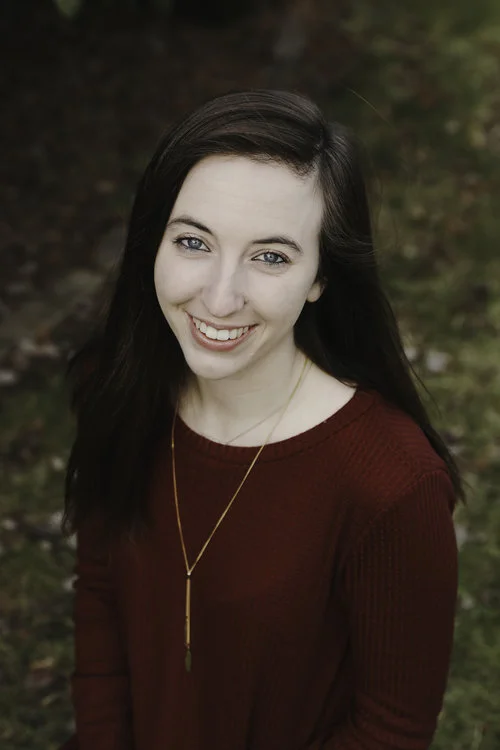
Flowers. There’s a lot of them by now. And you may be thinking: hey, I’m cramped up in this cubicle without a window anywhere. I need some Mother Nature. Right now. So, you go. Drive, walk—or sprint even—to your nearest arboretum and indulge in the flora and scents of the season. But then, you hear it, the subtle, yet mechanic, click of a Canon DSLR somewhere in your general vicinity. You scour far and wide and see another human equally as eager to see the flowers, but knows how to get all the right angles.
Josh Dale: Hello, Becca. Thanks for allowing me to interview you! Don’t let me get in the way of your next photo spread, though. Why not tell everyone a bit about yourself?
Becca Mathias: Hey, Josh! I’m so excited, thank you! Well, hello there internet, I’m Becca Mathias and I’m a photographer based in Northern Delaware. I primarily specialize in portrait and wedding photography, but I’m passionate about food, live music, and nature photography as well. I’m a volunteer photographer for Longwood Gardens and I joke that I practically live there… so if you ever see me around, say hi! Wow… talking about yourself is hard (laughs).
JD: Luckily, there isn’t a studio mic or anything. Like wuth those little screens and such. So, you’re the lady behind the lens. How long have you been partaking in photography? Do you have any formal training? Self-taught?
BM: Growing up I always had a disposable camera. I’d take photos of anything and everything. I always joke that my first portrait session was of my American Girl doll placed around my backyard. I took a photography class in high school and thought my “macro” photos of my eyeball and black & white photos of my computer keyboard were the most impressive. Yikes! I went to Wilmington University for photography and graphic design. That’s when I actually learned how use a camera correctly. It wasn’t until after I graduated college in 2015 that I really found my own “eye” for photography. You can learn how to use a camera, but you can’t teach someone how to see. It’s really cool to see how much my work has improved over the last seven years.
JD: Alright, fair point. I don’t see myself as anything better than an iPhone photographer, but I do know lighting is paramount. What are some techniques, in layman’s terms, that you utilize?
BM: You’re absolutely correct, lighting is important! I personally love natural light. I enjoy the bright & airy style of photography. You’ll notice that a majority of my work is bright, clean, and colorful. I also enjoy shooting through/around objects. If you take a look at any of my Longwood Gardens work, you’ll see that I like to frame flowers with other flowers to give a soft feel around the corners of the photo.
Also, there’s nothing wrong with iPhone photography! It’s a great tool to develop your eye for photography, without having to understand ISO, shutter speed, and aperture which can get overwhelming when you’re just starting out.
JD: Whew! And I thought engineering jargon was too much. You make food look so good (laughs) especially at that Moroccan Tea Party. What do you consider your favorite subject to photograph? Also, were the confections super delicious?
BM: Oh boy, food photography is quickly become my favorite subject. Taking photos and eating good food? Those are my two favorite things combined! Natural window light is the key to good food photos. Recently I’ve been networking to get more opportunities in the food photography industry. I’m hoping it’s something I pursue more seriously.
I’m also extremely passionate about music photography, which stems from my love for listening to music and discovering new artists. Combining the two is a dream of mine. I’m always attending shows and the opportunities where I’m able to photograph a show are the best. I photographed Firefly Music Festival last summer and I’m still convinced that was a crazy dream. I love capturing artists emotions while on stage and then turning around to see how the crowd is reacting. It’s a beautiful moment to witness closely.
JD: When photographing people, do you feel the synergy of the moment? As in, do you feel the clients act or look differently when behind the camera?
BM: Photographing people is challenging. You have to earn their trust and make them feel extremely comfortable. Being in front of a camera is nerve wracking (laughs) which is why I stay behind the camera. I believe in capturing real, authentic moments. Feeling silly? Express it! I want the capture the real you. At weddings I try to be a fly on the wall, except for the formal photos which are more staged. I’ve been told numerous times from wedding clients that they didn’t even realize I was there most of the wedding… which is my goal!
JD: Don’t flies see in like sets of 8 or something? I think we’re better off with just two! That sounds impressive though. I was at a wedding in Virginia last summer and the photographer was all over the place! I’m sure You mentioned before that you frequent Kennett Square, PA. As an artist in your own right, how do you see the community there? Is it budding? Acceptive of different creatives?
BM: It’s funny, I drove through Kennett Square to get to Longwood Gardens for years before one day I finally decided to park and walk around the area. I can’t believe it took me so long to check it out! There’s great coffee at Philter, good local beer at Kennett Brewing Company, and tons of awesome small businesses such as WorKS. I’ve met a lot of friendly creatives in that area that I keep in touch with regularly, ranging from chocolate experts to writers to artists and photographers. I love surrounding myself with other creatives.
JD: That’s great to hear. I’ll have to make it out there sometime soon. Ever hear of East Coast Creative Collective (ECCC)? They are based out of Philly/South Jersey.
BM: I have not! But I do love finding local photography groups. Meeting and connecting with people is so important in the photography industry.
JD: I highly recommend checking them out. Could be right up your alley. Ok, so, total throwaway question: is a picture really worth 1000 words? Like, is it 1000 in one collective viewing or 1000 lifetime words? Do you change the frame every 1000 miles or?
BM: The cool thing about photography is that you can capture a moment and in that moment it could mean one thing, but later down the road it can have a totally different meaning. Everyone sees a photo differently and can apply their own meaning to it. That’s what’s so interesting about art.
JD: I see you have adopted two lovely kitties…I must know their names and horoscopes.
BM: Yes! Those cute, little, plant-eating torties. They’re named Sage + Basil and I adopted them last September from a kitty cafe/rescue in Kennett Square. They were born June 13th, four days before my birthday, so we’re all Geminis. I already hear a collective sigh from the audience… us Geminis have a bad rep.
JD: I guess I’m a novice at all this. I know I’m a Cancer and that I’m probably too sappy for my own good…But anyways, thanks again for the interview. It was a lot of fun. If I could close out with one last question, and this is for my own personal satisfaction: is fisheye lens even a thing anymore? I kinda want to make a mid-90’s style band photo (if I ever end up in a band again that is).
BM: Thank you so much for thinking I’m even remotely interesting enough to deserve an interview (laughs). It’s been fun answering these questions. If any of your readers have any photography questions, they’re more than welcome to contact me through my website or Instagram! (below)
I personally never owned a fisheye lens, but they’re fun. There’s really no rules in photography. Do your own thing and go for it!

Photo courtesy of Tanner Mathias
Becca Mathias is a Media Design and Photography graduate from Wilmington University, portrait and wedding photographer based in Northern Delaware. She enjoys photographing food, live music, and nature, with much of her nature photography taking place at Longwood Gardens, where she is a volunteer photographer. Checking out new breweries and restaurants is one of her favorite hobbies, along with spending time with her new kitties, Sage and Basil. View her portfolio at http://www.beccamathiasphoto.com/ and follow her on Instagram, @beccamathiasphoto
Brenna Webb: 1 Poem
I wish this was more VULGAR: an entry
because it’s fall
Because I am writing this from the fire escape cleverly named PORCH
A (shit) rolled cigarette hanging from my never closed mouth breather lips
And I feel like sticking a needle with ink under my lip, let the ink bleed CUNT,
it’s fall and I just ashed on my keyboard and I think I have had water in my left ear for a month I can’t hear and I fucked a guy this weekend who mentioned after he is in an OPEN RELATIONSHIP and I am his thing in New York City but I smiled and ate a bagel with him the next morning, daydreaming about the ways I’d murder him then write a letter to his Free Spirit Blonde that says don’t be boring, don’t be a manic pixie dream girl, don’t tell anyone your secrets, just dance and sweat and wait for the cold to keep your little frame inside…
It’s fall stop googling boob jobs like tits are the answer to your mommy issues
I have had to edit this to insert the endings to my sentences because my mind runs too fast for my fingers when the leaves fall, so does my composure
I have ash on my velvet shorts that I want to duck tape to my hips because I keep letting them fall for people who don’t ask to read my writing but maybe that’s because I never shut the fuck up…
but I don’t want to wonder what would happen if I ever did, because I won’t and maybe don’t need to
And if you’ve finished this I am sorry the autumn is my season for please leave a message after the beep if I call you back
Maybe this is the start of a journal a blog a romantic novel with myself: a chronology of a new vibrator, anything to keep momentum when I am so
fucking
bored
as empty as the mascara I dip under the faucet to avoid walking to Walgreens for replenishing bored bored won’t leave bed because I hate it all
It’s fall in New York City I am almost twenty five
untethered and officially can’t keep up with the pieces of me flapping around different windowsills but why does October seduce me this way
if I call you back I’ll probably say sorry
Brenna Webb is from Bethlehem, Pennsylvania. Her work has previously been featured with Basement Poetry in the Spring 2017 production of HER. Other published works can be found published in The Laconic. Brenna wrote and directed her first short film, "SIN LADY" with Mr. Mister Productions, scheduled for a Spring 2019 release. She currently lives in New York City where she studies English-Literature and Film Studies at Columbia University.
Tianna G. Hansen: 3 poems
brittle
last night my bones became brittle,
obsequious to your every desire...
I felt them tremble within, a
vibrating skeleton of pearls.
watch me glimmer for you,
contort into
whoever
you want
me to be,
whatever
skeletal shape
I am perceived
in your eyes
nothing but
bones
scorched black
from rising heat of the fire
that darkened soot lingering
fingers of flame devoured my flesh
all that remains are these delicate
bones, becoming power with a single
touch – dust to dance away
with the wind.
to the leering
feasting on me, my body
is mine; belongs to no one else
no matter how you mar it,
stinging teeth & foaming maw,
I will burn you from existence
and dance through your ashes.
I will destroy all you claim
to create from my bitter bones,
drown you in holy waters
shimmering always like oil
slicks across the surface.
clutching keys between fingers
like claws, ready to strike
ready to draw blood,
taste of iron in my throat.
take those eyes off me.
offer me your disgrace
wrapped in tender plastic.
I will capture in gloved hands
your suffocating breath
as you shudder beneath,
my heels lodged deep
in your jugular vein.
let the whims of men
bleed out and the glory
of women, of what we can
create, what we hold true
in our tight wombs, stand as
goddesses. each and every
one of us, we are regal.
lay prostrate and worship us,
beg forgiveness for eons of sin.
your lifeblood on our hands
lends strength and power –
a grip on this Hell that you
have created; Persephone’s
liberating haven presents
pomegranate seeds of hope
only to destroy the buds
in deathly poison grip.
becoming Calypso
Adrift, I am unanchored from
the shores of my discovery, a buoy
floating through uncharted waters
fathoms of sea sprawling beneath.
Become one with the ocean,
worshipped over candlelit myth;
a goddess rising on waves to
overtake sailors’ ships
towering above
with scaled, perfect flesh
I am a dragon abreast,
breathing smoke and brine.
Come find me in the night
blindfolded by darkness
I am the nymph queen, capturing you
in spells. Never to be tamed
or caged.
I'll turn your black heart to coral stone
steal it from the cavern above your lungs
lock it in a chest—beating, beating
Embrace me,
stretch this skin until
it hugs my bones
a gown of seaweed
tentacles entwined
No mistress or maiden
I am goddess.
Tianna G. Hansen has been writing her whole life and focuses much of her work on personal experience. She founded and works as Editor-in-Chief of Rhythm & Bones Press which specializes in the idea of turning trauma into art. A poetess, novelist, memoirist, creative nonfiction and flash fiction writer, her work has been published widely – find it at CreativeTianna.com, follow her on Twitter @tiannag92 / Instagram @tgghansen24. Check out her press at RhythmNBone.com / Twitter @RhythmBonesLit / IG @RhythmBonesPress. Her first collection is coming this year from APEP Publications.
C.C. Hannett: 1 Poem
Epix
Our friendly sycamore
Zests The curbside
Imprints leaf-loss
Doomsday
Like the Challenger
Briefly stained the air with its breakages
Sparklers are cool Ampersand burn
Next to hopscotch
games
&
Vulnerable travelers; snails—
Who are we kidding?
There is no shield, no barrier thick
Enough to withstand
Our oblivious and merciless boot
If we’re not careful, all poems become tree poems
Lumbered epix If we’re not careful,
All poems
Become bird poems
Without an ornithologist to preserve
The integrity of the feeling
Or apply medallions to the correct
Elements to make
Our melancholy sing epix
You should never give away yr meaning
Of drawn metaphor
Though, you may suggest
Reference material
Rhythm
For punching
Out
Kris Hall / C. C. Hannett / kmwgh is a writer who feels queasy when he identifies himself as a writer. Or anything, really. Author of I Gave This Dream to a Color, Triune, and SAGA ctrl (Spuyten Duyvil) + a number of chapbooks. He is the event organizer for Quake: An Everett Lit Crawl and Poetry: Uncharted. Currently, he is the Managing Editor for Really Serious Literature (@rlysrslit) and their Disappearing Chapbook Series. Work has been placed with Softblow, DREGINALD, Gramma, Juked, etc. He currently lives with his wife and three animals somewhere in the PNW and/or behind you.
Jacob Kobina Ayiah Mensah: 3 Poems
The Swing & the Fury
I write my life scattered about in lines
& stitch them together as midlife crisis.
The first line is a fishbone, covered by two cottony puffs from white hair,
snarling above a cornet, I slow down its tune among the motorcyclists
I’m of them to pass the dairy farm
& discuss arthritis from couch to a ladder.
I remember all the strays
you’ve included to manage the lowest rung of a leg.
The second line almost a baby equipment
& that requires assistances from the sisters,
I settle in the back seat, waiting to see in the mirror
how the heart beat springs up & down from your South to my North,
shaped on the anvil with sugar sprinkles,
still under the summer heat
& cherry blossoms hang from the sky,
open weeks are zipped with your breath.
At this dead heat,
to pay the next death duty
for debris,
I debug the cancer
from the cactus wounds
with your fingers making numb.
The furthest corner of this room
is just a frown furrowing your brow,
I take the fury on your face
& fuse with the bones of the spine together,
showing a brilliant future
in the front through the dark corridor.
The third line remains the surface underneath, the glass is full to the brim.
I keep the brine
for a very agreeable weather
& that’s why I’m not hurt outside their dairy products.
In Rome I make a long list, age-old customs,
you stare at it aghast,
I’ve nothing against people making money
& paying taxes on it
for very tall for their age.
This mound is clad among groups of people in heating allowance.
Sighing
Singleness
is the most gift
& ordinary thing.
I’ve wrapped with your voice
beneath the ruins
& above
the first lemma we compose
like a yam tuber.
Some things almost the symbols in K, L, M, etc, are
between our vector spaces, your wife proofs
with my corollary right
against any Renaissance pigments
on the walls or from the ceilings, we remain silence before the headlights
during Labour Day. Aiming straight
at the crag
& seizing your moment
blundering down the aisle,
hands are folded, days are rushed away
up the corridor to complete the triangles
for this trench.
It’s quieter there though you clench your fists
built around a circuitous route to avoid the hill centre.
You DIY without all this hassle at work,
DJ does his chance by just standing there –
doing something!
I consider this old chrysalis struggling to be christened
when chrome handles glisten with our sweat,
the visitors begin to filter into the hall,
holding water from the goof ground,
the next finch,
a finicky eater, flutters about,
the lake is wide opened in your mouth
we gob the results, hanging from hunches,
I decollate to the fuselage without my go-cart.
Cooler towards Riverside
We’re lizards to our ends as from our beginning
during the fall above the bog, where wattles are covered
with clay to hide your presence, we’re formed from no supposition on any subject governing the guard,
I go ahead about your story,
that doesn’t agree with
what the historians have said before a large audience,
I’ll keep out, yes, out your way. No eating an ogre or a ghoul, no begging your pardon, sir,
I keep the edges to a pinch,
as I’ve been accustomed to do, I feel disposed to see inside
& enter the house & retreat from the floating staircase,
I master its ritzy riser, if that’s possible to alight the cuttings for the next collage on dust.
This music is much more akin to blue jazz than cold rock, here within, you’re easy reach.
How do you react to the news when they shout & boo?
A colleen grabs your wrist & some paddies have a very bad reaction to these peanuts.
I sit down to read your hand- writing full of role-play,
a robin stares at a fishing rod still in the lagoon to rob you
your self-confidence over the fire. I justify nothing, only the touch, the softness & the impossible.
Jacob Kobina Ayiah Mensah is author the of new hybrid collections, The Sun of a Solid Torus, Conductor 5, Genus for L Loci, and Handlebody. He lives in the southern part of Ghana.