

Florence Walker: 2 Poems
Exit Polls
My skin tears in three places.
One: a curve round the ball of my left foot,
where the shower door cut deep.
A curve I’d then follow in the rain
to knock on closed doors in unfamiliar streets.
Two: the back of my left ankle, in the place
where boot leather is most uncompromising.
I picked the skin in idle moments, until it tore
and new blood rose to meet my hands.
Where the skin breaks, there is red.
Three: the tip of my right-hand middle finger.
I don’t know when this one formed
but it gives dull shrieks with every touch.
A passage cut quick to the nerve.
My head, too, feels an exposed nerve
when I enter the cold air of the world
to walk amongst my enemies.
Further Notes on A Separation
I don't know how far you're going.
So much is hidden.
I'm praying for a second sudden relief;
I'm fucking agnostic.
It’s bitterer having been delayed.
That’s just a fact.
As true as my shot-through faith
in the power of place and time.
Tacking on a smile for your benefit,
is the fucking
cherry on top, really. But isn't that
the point? If I cared less-
Enough of this half-baked nonsense.
We're gonna make it.
Of fucking course we are.
And you’re never reading this poem.
Florence Walker is a recent graduate of Oxford University. Her work has been published in the 2017 Mays Anthology and featured on Acumen's 'Young Poets' page. While not writing, she can be found indulging in LARP (live action role-playing games), musical theatre, and video games.
To Jackson: A photo gallery by Fabrice Poussin


From the artist: These images seek to bring forth the simplicity which exists in all things, most of all in the creative process. An object need not be complicated to explore and propose answers to great questions, specifically those of esthetic values. Most photos here use found objects, accidental combinations and imply that the perception of a deeper understanding of our world is really not so far off after all.
Fabrice Poussin teaches French and English at Shorter University. Author of novels and poetry, his work has appeared in Kestrel, Symposium, The Chimes, and many other magazines. His photography has been published in The Front Porch Review, the San Pedro River Review as well as other publications.
Daisy Bassen: 1 poem
An accounting
Guilt fits in a circle, filling
The space to the edge,
The line that goes round
And round like the ring
On my finger, engraved
With the date, one day
When we made a promise
Out of all the days we did.
Staring into the sun—
You know not to do it,
The pale disc a match
To your retina, the weeds
Of ruddy vessels at the back
Of your eye. You know, I know
You know not to do it,
Transgression; you know rules,
Right, wrong, thudding
Like the struck mouth, diameter
Of a tongue-less bell. Guilt
Fits in corners, creeps
Into the avenues, crevices
When you see how much
Has been broken, hurt, virtues
Befouled, shat upon. It’s useful
To take its measure, cup-full,
Overflowing, a sewer rank
With offal, awfulness, thick
With thievery. Crows, wisely,
Fly away and babies sleep through,
Neurons too busy to make memories
Stick. We’re stuck, the rest of us,
Guilt is democratic: it touches us all.
The answer is: enfranchisement,
Black wings confident against gravity,
The sweet breath of a newborn,
Hungry soon, again, for milk, willing
To wail, to scream the house down.
Daisy Bassen is a poet and practicing physician who graduated magna cum laude from Princeton University’s Creative Writing Program and completed her medical training at The University of Rochester and Brown. Her work has been published in Oberon, The Delmarva Review, The Sow’s Ear, and Tuck Magazine as well as multiple other journals. She was a semi-finalist in the 2016 Vassar Miller Prize in Poetry, a finalist in the 2018 Adelaide Literary Prize, and the winner of the So to Speak 2019 Poetry Contest and 2019 ILDS White Mice Contest. She was doubly nominated for the 2019 Best of the Net Anthology and for a 2019 Pushcart Prize. She lives in Rhode Island with her family.
Jules Archer: Cheap Tanya
He wrote my name in the stars. Connected the dots of the constellations until his index finger spelled out Tanya. It was romantic. A starlight billboard, backlit by black, splashed with my moniker. “Tanya,” he said, and I watched the way his mouth moistened, how he worked the word over with a fat, red tongue. James was honest like that. He said fancy things. Touched me in fancy places. I loved it.
The rain fell warm as bathwater, but the cement was even warmer. I rolled up onto the balls of my feet — not to get away from the heat; to embrace it. I got close to James’ mouth. His breath was like a sunset: juicy from orange Fanta and lazy with his south Texas drawl. He liked to pretend he was a cowboy. He had a motorcycle and a polished belt buckle with guns on it. Sometimes when we laid together, I liked to pretend we were one. I’d press my body to his, imprinting the cool steel from the buckle into a soft spot on my abdomen. I’d roll my bony hip over it, bursting blood vessels. James’ skin was like iron. I wanted it to brand me.
“If we go, we’ll have to live in cheap motels.”
“Good,” I said. “I can do cheap. I can do motels. Long as I have you.”
He stared at me. Ran a thumb across my sharp jaw. I felt the imprint of his nail — massive moon marks — as he pressed hard like he couldn’t believe I was real. Like I was Bonnie and he was Clyde. My heart beat like a pulpy drum inside my chest. I wanted him so badly to agree to take me with him.
I bit down on his bottom lip, fat like whale blubber. I felt the skin split. Blood and salt ran rivers into my mouth. James kissed me hard, then spat the muck we shared on the ground. It mixed with the mud and the rain until it looked like cold, mushy leftovers.
“I have to go.” His finger brushed feather-light against my cheek. “Mom wants me home for dinner.”
I watched him hop on his bike. Red taillights disappeared around a corner like jolly Christmas lights. I sank down into a squat. The soles of my feet were like two lonesome organs looking for an invitation to roam. Come and get me, I thought. I’ll be here. Ready and waiting to go.
*Cheap Tanya was previously published in Lunate
Jules Archer is the author of the chapbook, All the Ghosts We’ve Always Had (Thirty West Publishing, 2018) and the short story collection, Little Feasts (Thirty West Publishing, 2020). Her writing has appeared in various journals, including SmokeLong Quarterly, PANK, Maudlin House, and elsewhere. She lives in Arizona and looks for monsters in strange places.
Read this piece and more stories in Little Feasts, available 2-28-20
Michael Chang: 3 Poems


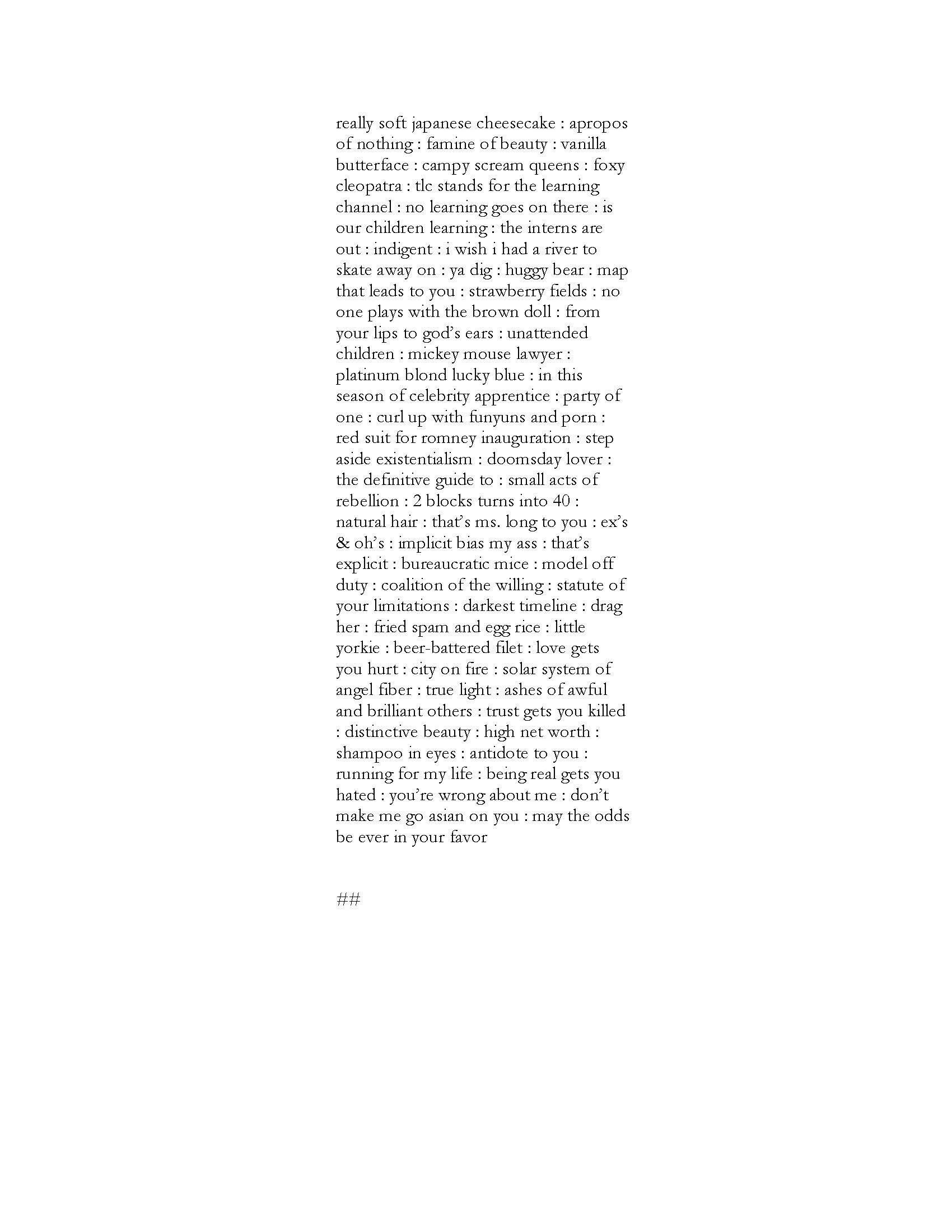
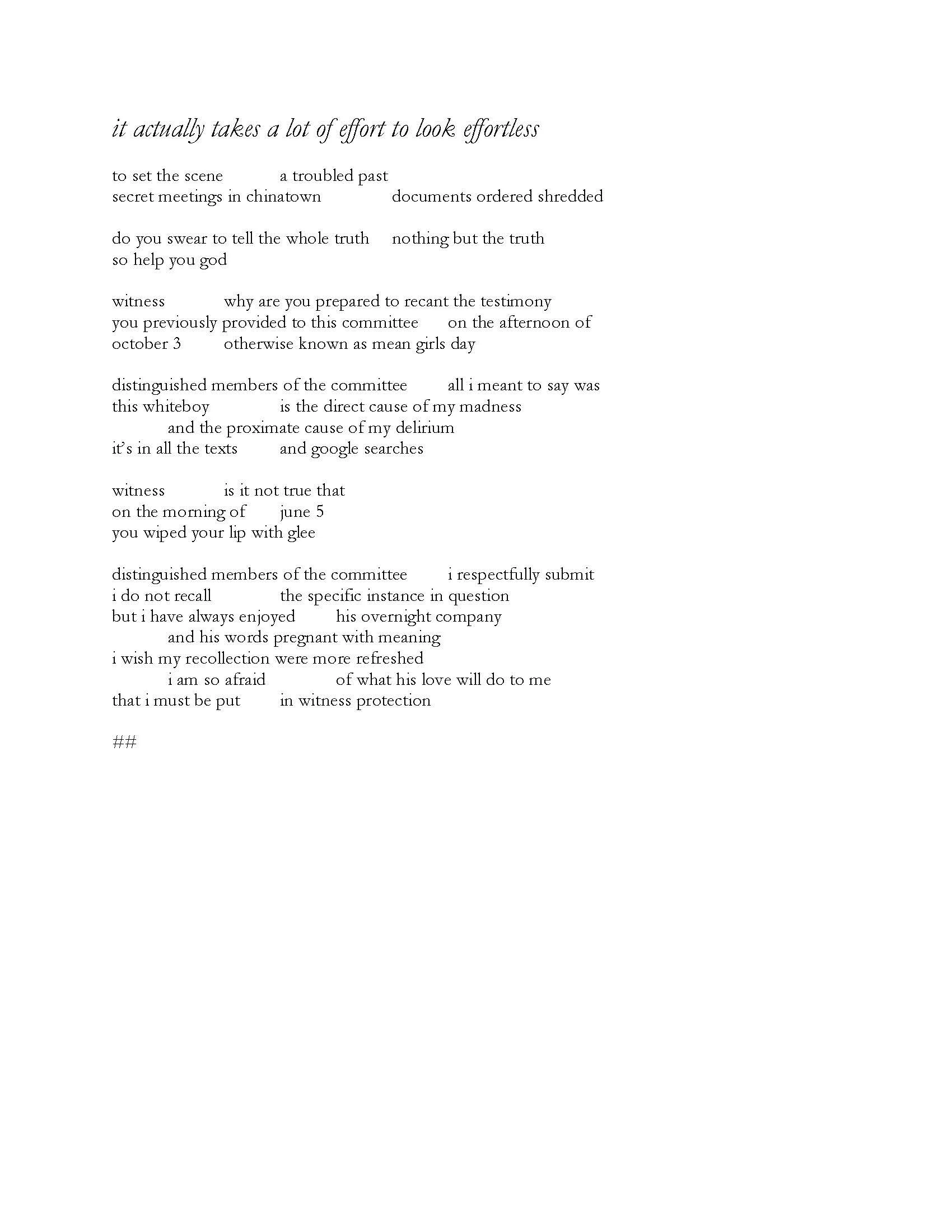
Michael Chang (they/them) is the proud recipient of a Brooklyn Poets fellowship. They were invited to attend the Kenyon Review Writers Workshop at Kenyon College as well as the Omnidawn Poetry Writing Conference at Saint Mary's College of California. Their writing has been published or is forthcoming in Yellow Medicine Review, The Summerset Review, The Broadkill Review, Heavy Feather Review, UCityReview, Chiron Review, Map Literary, Armstrong Literary, Fine Print, Kweli Journal, Love's Executive Order, Funny Looking Dog Quarterly, Glass Mountain, Straylight, Juked, Rigorous, Thin Air, ellipsis... literature & art, and many others.
Tova Feldmanstern: 3 poems
tenured
in the loneliest place i’ve ever been
i met the loneliest man i’ve ever met
he sat alone at the communal table
an animate venus fly trap
i kept a wide berth
we only spoke once or twice
i couldn’t bear the reverberations
his seventy odd years an affront
to my artless and empty youth
like backwards magnets
i still wonder: what is required
to become a human being?
mario kart ™
i always press
much too hard on
the controller trying to make my
little car go not
remembering it’s
just a game the
gold coins elude
me with their
sudden
appearances and
disappearances
i’m never ready i
wish i were better
at planning ahead
it seems i haven’t
gotten the hang of
caring an
appropriate
amount
the questions
my friends are having babies and i
would like to follow suit but it
appears we’re nearing the end and
i’m not sure i could handle a kid’s
questions about meaning or purpose
or what’s for breakfast when cold
cereal is our nation’s feeble
contribution to the potluck for
which we wrote invitations but
refuse to play host, so that
everyone at this party is either
crying or laughing maniacally or
desperately tearing at the plastic bag
inside the cardboard box labeled
cheer or luck or tricks or life
craving sugar and its quick results
just to avoid fainting from exhaustion
which reminds me that i recently
quit my social work job because
there is only so long we can survive
off of others’ pain before it starts to
eat us alive and this is another reason
i probably shouldn’t start having
children, i’m not sure exactly how
they‘ll be nourished
Tova Feldmanstern lives in the San Francisco Bay Area. She is a licensed clinical social worker and is currently pursuing a degree in music. Her writing has appeared in Panoplyzine, Gravitas and Aurora.
Leah Baker: 3 Poems
Conception
On the edge of a stone
ledge, I stood with my friend’s
small, brown hand in mine.
We closed our eyes in
the dusky sunset,
and two bats, somehow,
burst between our adjacent legs,
their quick and leathery wings
shocking us to laugher.
Nearby stood the two men about
to leave us. The night
before, I dreamed of conception,
the terrible timing,
and the relief that it wasn't his
because that would frighten him,
make him disappear sooner.
I worship each lover
even in the impossible task
of aligning my body's purpose
with my heart's.
You know, Parvati
made herself a son
when her husband went for years
into the mountains.
She mixed sandalwood
with the dew of her skin
and there was a child.
There is something beautiful
in the idea that a woman
could fulfill her longing alone.
I listen for the tingling residue
of bat wings against my
thigh, think of the thin
likelihood
that they should fly so brightly between her
legs and mine.
Bracing Hope
The lamps went out.
I slept inside the courage
of one little finger,
one nook in the crevice of a shoulder and
my thumbs lodged into the
curl of my fists. I moaned into
the first hour of morning, asked for your hand
to cover the space of growing ache inside of me.
Even when your hand was unwilling, it was warm.
I tried to be still, a comfort to myself
but couldn’t stop
from hoping you’d soothe me instead.
I am waiting for the long obstacle of mediocrity,
of wanting,
to fall into the deep knowing of self-gratification.
Somehow, our two hungry mouths
never really touch
when we kiss, like two fishes
both gasping hungrily for water to soothe their lungs,
lips opening and closing,
inhaling nothing but air.
There is a half burned hole that forms on my tongue
each time I think of
the other women you touch.
My teeth sink into the stem of Hope
they had been grimly bracing toward
and abruptly snap it off.
A song is a woman's voice
breaking out like a fist pushing through fabric,
a wash of scarlet across a pale face
sweetly sung, clear ringing.
I learned Courage at the academy of night
against the backdrop of my little self.
I stand embodied,
I, perpetually the larva
of my future.
How It Always Is
The heart grieves as deeply as it loved.
One night, the realization of its loss
will open as a sudden chasm,
writhing its abysmal anguish
into the milk-white soap of a bath.
What courage it takes to feel,
for pain to enter the canals
of one's throat
as water!
I will howl under the weight of loss.
It will roll through me,
the excruciating gleam of a winter's knife,
salt into the hotflash pulp of a new hurt.
Anger will erupt as fire.
I will dream of guns, crones, hot steam.
I will feign strength, prickly hardiness,
desert flower vibrancy.
I will seethe at the women
whose blossoming bodies you lay your itchy fingers on.
I will pity them.
She is the tender mirror of me, in which
you will make the same hurtful mistakes.
I love her already.
I hold her weeping heart already.
I will sink into the belly of despair.
I will dissipate.
(the image of my being is shifting /
the image of my consolidated being /
departing from me)
I will forget who I am.
I will remember.
I will vow
to marry myself.
And my heart will blow open
at the first touch of a mouth that
offers a kiss.
Leah Baker is an English teacher at a public high school, and works regularly with her students to develop, refine, and submit their own writing for publishing. She’s been published in Pointed Circle, Voice Catcher, and For Women Who Roar. She is a feminist, gardener, yogi, sound healer, and world traveler. You can find more of her work at www.OpalMoonAttunement.com.
Andrew Hutto: 3 Poems
Mint
What I saw when your mouth opened up is the mint leaves
between your teeth.
I smelled them over my own cologne.
I went to clink glasses with you but my grip slipped with
the sweat. The crystal shattered on my shoes and
sliced my ankle.
Can you see the horse’s ribs? When they gallop?
I hardly noticed the sound above the loudspeakers,
how the fasting horses whinny for hay whether they
finish in last place or in show or wear the ribbon.
My sympathies cannot explain it away.
While I realize I am not the most sufficient
ambassador for their caked hooves
and flapping reins, I am certain
I saw a blue
jay perched upon a black-gum branch, nesting
in a robin’s nest. Her little ones starting to fledge.
I need a recollection of the past four seasons.
What year did they switch from live fire to blanks?
To Thy Work
I desire beyond the desire of you - into the Other, (a)
a post-hoc- interlocuteur.
Move through semblance into the necessity hesitation.
Frozen water in a dog bowl.
People we see ringing bells,
spirit as symbolic-object.
(— φ)
i(a)
Sacred as you are, a sneeze and a sniffle.
You are still a filter from which the imagined draws itself into being.
Be born again, on his swift wings.
The foxgloves are sprouting and the glance has caused an early death.
Weep for the mind-dependent narrowing.
You will not finish in the same position in which you started.
Hesitate in conversation, be gentle with it,
prune the garden and feed the squirrels.
The goat will be tied to the altar in time-future, but in this known-world let’s
see how deep the river is and how far we can skip a stone.
Harvest-Time
On these claims,
On these colors
we will hang wreaths — together.
We will fall asleep in our twin bed
under the flannel sheets.
I will show you how to pinch a blade of grass
between your thumbs,
and scream.
I’ll get a Ph.D. and we will grow tomato plants in the Cumberland Plateau.
There will be wheat bundles under steel buckets,
there will be paws in a saucer of milk.
Your jaw is going to be sore
from all those caramel
apples.
It will all exist closer, to those cobwebs
closer, to those cattails.
In a world where crickets sing on corn stalks.
Andrew Hutto is originally from north Georgia but currently lives in Kentucky. He holds a B.A. in English from the University of Louisville. His poetry appears in The Thrush Poetry Journal and is forthcoming in Barnhouse Journal, Plum Tree Tavern, Eunoia Review, After the Pause, Amethyst Review, and Math Magazine.
Sheena Carroll: 3 Poems
A NOVELTY, ON HER RETIREMENT
Electric skin, Cotard delusion, whatever.
I’m ready to move on.
This has been traumatic enough
without having to play actor,
without having to build myself up like
a real Christmas tree: dated spectacle,
unsustainable spectacle.
Only survived because I am pagan
and I worship the dirt that I should
be buried in right now—
What, with my hands as cold as they are.
Neurotic nodding and thanks and
how many thanks have I said to the same people?
Are they counting? Are they relieved when I stop?
I know I am.
I also worship the Moon and the tides she controls.
As such, I cannot be washed away,
only whisked. Find an island only accessible
via another island,
Cemetaria traumatica.
Still, I become a Jenny Haniver:
dehydrated, dried, displayed.
UPON HEARING ABOUT THE GHOST SHIP FIRE
I remember telling a friend at an open mic
that a similar tragedy is bound to happen
in Pittsburgh within the next five to ten years.
At the time of this writing, it hasn’t.
But I can no longer afford my rent,
and that friend and that open mic
are no longer around.
THERE IS A PERPETUAL LOADING SCREEN OUTSIDE MY BEDROOM WINDOW
Unsure if simulation will display tops of snow-capped
skyscrapers or a line of rush hour traffic, or maybe bare trees.
Used to hate living in the middle of nowhere,
driving everywhere to get somewhere.
But now I crave nothing more
then the view of a premature night sky
cropped by blinding hills and evergreens,
to hear nothing but my own thoughts,
battering ram wind, and the discordant lo-fi
playing on the laptop downstairs, a reminder that
nothing remains, everything changes.
System overloads occasional drop out from society,
take time to recharge, energy source unknown,
system timed out, must reset, must rest.
Sheena Carroll is a Pittsburgh-based writer who enjoys watching mecha and taking naps. Her first chapbook, MISS MACROSS VS. BATMAN, was published by Dark Particle/CWP Collective Press in 2018. You can find her on Twitter @missmacross.
Jerome Berglund: Driving in the Rain: Photos


About the Dark Fantastic Project: Berglund explores a variety of themes figuratively, following a principle of fatalistic discovery within the chaos of natural elements spiraling through his daily experience and environment. Here he seeks out and constructs—via a scavenger hunt of sorts—a series of allegorical tableaus centered upon subjects of addiction, recovery, alcoholism, mental illness, depression, anxiety, alienation, loss, heartbreak, gentrification, corruption, hope, and acceptance.
Jerome Berglund graduated summa cum laude from the cinema-television production program at the University of Southern California, and has spent much of his career working in television and photography. He has had photographs (not the ones submitted here) published and awarded in local papers and recently staged an exhibition in the Twin Cities area which included a residency of several months at a local community center.
Maddie Baxter: 3 Poems
Mold Remediation
There is no such thing as mold removal.
I am obsessed with painting my nails
in a way that feels like 2014.
Mold can only be remediated
not exterminated.
We are not experts we are just
professionals we cannot return
your home to normal we
just return it to your
prelims state.
Frank O’hara died from
a dune buggy accident
on the beach.
Is there any other way?
Anyway to get rid of
mold?
American Bird
Milk glass on the movie screen
the dolls I play with have
names
I didn’t give them.
Saorise.
Greta.
Cameras comb their hair without the tender
love of my
overalled hand.
Usually I squint but
I have trouble making
out their strings.
Like a blood eagle I fly
naked on my back
looking up.
Dying is being a doll without the player.
Autumn Poem
The retina cannot focus +
neither can the pen.
The yes sets timer in motion
the confluence pauses the
metronome. There is no
yes and no at the
same time. The orchard
does not bloom and die
at once. But one season, there
is a yes. Pick fruit moments
before decay. Sopping juice is
symmetry. The symmetry is not
purposeful. There is no autumn night
that comes without reason.
There is no snake that sheds
without guilt.
Madeline Baxter is a 23-year-old poet and copywriter living in Charlotte, NC. She graduated from Wake Forest University in 2019 with a degree in English and Creative Writing. She does not know how to ride a bike and never will.
Dom Fonce: 2 Poems
Song for George
Our deepest fears are like dragons, guarding our deepest treasure.
—Rainer Maria Rilke
The roads were gravel, pill bottles
chimed in the wind, and I was
an 8-year-old given the latchkey, free
to make mud castles in the yard and catch
frogs under my shirt. Cousin George—high
and brain-fried—played too, moved
his old Cavalier out back and shot at it
with a rifle all day long as if tomorrow
made a promise never to come. He cursed
his hands whenever it jammed, his voice
as coarse as a stone swirling in a coffee tin.
I watched his muscles spasm with each sprung
casing, the dangling Newports ashing themselves
off his lips. I gathered his beer cans like fallen
coins and stacked them in the woods, thinking
the meager droplets left behind were elixir
on my tongue, then stole the BB gun
from the neighbor’s shed—in this fantasy, I was sure
I was drunk and dangerous like him, I was a ball
of fire like him. From a distance, the bangs echoed
in my ears, as I flung the cans into the air, picking
them off while they hovered within the clouds. Between
each massive bang, my small ting mimicked in turn—big,
small—until a stray dropped a cardinal, soft
as a pillow, from a tree. It flapped, squirmed,
and squawked as blood rushed into its lungs. With leaking
palms, I pumped five times and popped it from its suffering, staring
down at its lifelessness, blinking three times, not knowing
what else to do, not understanding why the air
around me fell as silent as a rest-starved eyelid.
Beetle Song
“Yes, of course,” I say to the boy
as summer fevers the cement—burning
each child’s foot while they scramble to snag
ants from the dirt—as a mother dances
with her daughter in the pool.
I see you, a sable
thumbprint, clamping onto the small
of the girl’s back. I hear you slice your buzz
through the swarms of laughter.
A boy with grass-stains
on his knees calls out, “Do you think this is
real gold?” Another boy cries to God, asking why
he’s never the one to find treasure.
In a memory, a beetle medallion is dangling in
the gypsy market when I am ten, when the Ohio
sun sieves through the tapestry-thin tent—I’m sure,
when the swaying woman draws near, kissing my
willowy cheek, its flaxen-green
flickers in her pupil. “It’s pure gold,” she tells me,
as my father sacrifices his wallet for my smile.
It is a birthmark that pecks
at my collar, a brand-burn on my neck—
until the chain inevitably breaks, and the yard
swallows it like a seed.
So, now, the mother brushes
you from her child like a spill
from a table, and you land
on my shoulder, humming secrets
into my ear.
The boy with filthy hands
pulls on the pocket of my
jeans—“Is this real gold?”
I remember asking my father
that same question years ago—a fleeting
“Yes, of course” bumbling off his tongue, and I feel
my father’s voice jump through my teeth.
Dom Fonce is a poet from Youngstown, Ohio. He is the author of Here, We Bury the Hearts (Finishing Line Press, 2019). He is the Editor-in-Chief of Volney Road Review. His poetry has been published in the Tishman Review, Obra/Artifact, Burning House Press, Black Rabbit Quarterly, Italian Americana, 3Elements Review, Junto Magazine, America’s Best Emerging Poets 2018: Midwest Region, and elsewhere.
Gale Acuff: 3 Poems
Blessing
I don't want to go to Hell when I die
for my manifold sins, manifold means
one Hell of a lot and for only ten
years old I'm a damn good sinner, a bad
one I should probably say and confess
with my mouth like it says in the Bible
somewhere though that confession's not the same
but anyway I'm flunking fourth grade so
what do I know about mysteries like
God and death and love and the Afterlife,
for that matter who does, although at church
and Sunday School they think they know every
-thing but then they tell me that I will, too,
once I'm dead and in Heaven or Hell
And to tell the plain truth, Gale, we're not sure
just where your immortal soul will wind up
so I said Anyway at least I'll be
immortal, even in Hell how can that be
bad but then they told me Well, you just wait
until you wake up dead there, young man, then
you'll know and I said Well, then at least I
can spread the word, among live folks I mean,
and they asked me Well, just how do you plan
to do that because only Jesus came
back to life and a handful of others
and those folks whose graves opened and they walked
around and I said Lemme go in peace
and then I split Sunday School angry, no
-body listens to me or, worse, they do
but they don't hear, or is it that they hear
but don't listen, and they see yet they don't,
and I think that Jesus said all that first,
I didn't mean to swipe from Him but it's
no wonder that when I die I'll go to
Hell so I'd better get the Hell saved and
no more screwing around, God will not be
mocked and all that so after class today
Miss Hooker and Preacher and my classmates
and I got down on our knees and prayed that
I get saved so that if I died walking
home from Sunday School then I wouldn't dwell
in fire and brimstone and with devils and
bad folks forever and when we cried
Amen with one voice I did feel better
but I've got weak knees and it was a real
blessing to stand up again and even
better to feel others raise you to that
position, I should get saved every damn
day but that would be a sin—I'm too good.
Goobers
I hope that wherever He is Jesus
is satisfied - He promised to come back,
that was over 2,000 years ago,
so where the Hell is He? That's what I asked
my Sunday School teacher after class this
morning and she winced, wince is a word which
you find in books, and the other word, Hell,
it's a big word, too, I think, then she sat
down and not simply sat down but sat her
-self down on her big orange plastic chair like
she was sitting on Trump's head but any
-way she pretty soon composed herself, that's
one that means not writing words or music
but in this case calmed herself down as if
I hadn't said a damn thing and then smiled
as if at the beginning of revenge
like those actors do on TV and then
frowned like crazy one long, long frown, then said
Gale, I'll pray for you that you forgive your
-self for those words and that God will, too,
and Jesus and the Holy Ghost and while
I'm at it me as well, run on home now,
I'll see you next week, so I said Yes ma'am
but didn't run, I walked, So there I thought,
but when I got home there was Miss Hooker
sitting on the back porch wearing only
a bikini - not the back porch, I mean
she was wearing a bikini, the back
porch wasn't, all it had on was that coat
of crummy paint it's always worn and it
was fading, too much sun, which may happen
to Miss Hooker except that my eyes played
tricks on me and it wasn't Miss Hooker
sitting there but Great Grandmother shelling
beans, goobers she calls 'em, and she's been dead
ten years. Which just goes to show you something,
maybe it was Jesus with a new joke.
Ticked
My dog's got a tick. I mean a big one,
inside his left ear, under the flap part.
Almost as big as a June bug. Well, half
that size, or maybe two-thirds. It's got to
go before it sucks up all his blood or
brains, what he has of them. And I'm afraid
to operate--out here in the sticks we
don't go for animal doctors. Vets,
they call 'em, in the city. That's ten miles
away and I'm too young to drive and it's
too far to walk because we'd have to walk
both ways. I've got no money. I'm too young
to work. There are laws against child-labor.
I told Father, I said, Father, I do
believe that Caesar has a tick. Father
said, behind his newspaper, If thy tick
offend thee, pluck that son of a bitch out.
I'm not sure what that means but I know bitch:
It's a female dog, which Caesar isn't,
and a bad word, but I hear them around,
sometimes here at home when Father's had a
snoot-full. Hell and Damn. Shit and You bastard.
I know the f-word, too, but that's Mother's:
Oh, fuck, I burnt the biscuits. I burnt the
chicken. I burnt the beans. I burnt the soup.
How the hell can you burn soup, Father says.
Son of a bitch. I'm afraid I'll wake up
one morning and there will be a giant
green bloodsucker of a tick lying there
on the floor where Caesar usually
does and he'll growl at me and scare me good.
At dinner I say to my folks, Father,
Mother, can we talk about Caesar? He's
got a tick. Not at the dinner table,
Mother says. I start to cry. Please, this is
important. So's passing the potatoes,
Father says. I do, with a sob. They're burnt,
Father says. Hell. Damn it, Mother says. Fuck.
Look, boy, he adds. After supper bring me
a kitchen knife and Mother's lighter and
we'll go to work on him. My assistant,
that's what you'll be. You'll assist the surgeon,
he adds. You'll be my nurse--haw haw haw!
No dessert tonight so we get cracking.
Scalpel, Father says. He means the sharp knife.
Fire, he commands. I flick the lighter.
He sterilizes the blade while I hold
Caesar down. I don't like this--he's never
bitten me but this would be a fine time
in a bad sort of way, I mean. Goddamn,
that's a big-ass tick, Father notes. Shit-fire.
Caesar squirms and whines. The blade's sharp and hot
but it gouges out the tick and he falls
on the sidewalk and I stomp him brainless,
blood squirting all around and it's Caesar's.
Father cleans the wound with a little beer,
not the good stuff, and Caesar ups and runs.
Father drinks the beer--one-two-three-four gulps,
then squashes the can against his forehead.
He'll hurt for a while, Father says, but he'll
heal. I need another brew. Holy shit.
He goes in and Caesar's run off and I,
I'm standing on the sidewalk, scratching my
head while I look down at Caesar's blood and
a flat green stomped tick. I sure feel sorry
for God, Who made things that eat each other
and drink blood and use foul language. Up there
in Heaven He looks down and sees the world
and it's all He can do, I'll bet, not to
step on it Himself and start all over,
not that He didn't flood it once before.
Caesar comes back and I inspect his ear,
gently, so he won't bite me thinking me
his pain. It's stopped bleeding but it smells like
sin. He'll have to sleep outside tonight, so
I will, too. I'm scared of being alone
and he's good company. For a dog. Christ.
Gale Acuff’s (PhD) poetry has been published in Ascent, Chiron Review, McNeese Review, Adirondack Review, Weber, Florida Review, South Carolina Review, Carolina Quarterly, Arkansas Review, Poem, South Dakota Review, and many other journals. He has authored three books of poetry: Buffalo Nickel (BrickHouse Press, 2004), The Weight of the World (BrickHouse, 2006), and The Story of My Lives (BrickHouse, 2008). He’s taught university English in the US, China, and the Palestinian West Bank.
J.I. Kleinberg: 3 Poems
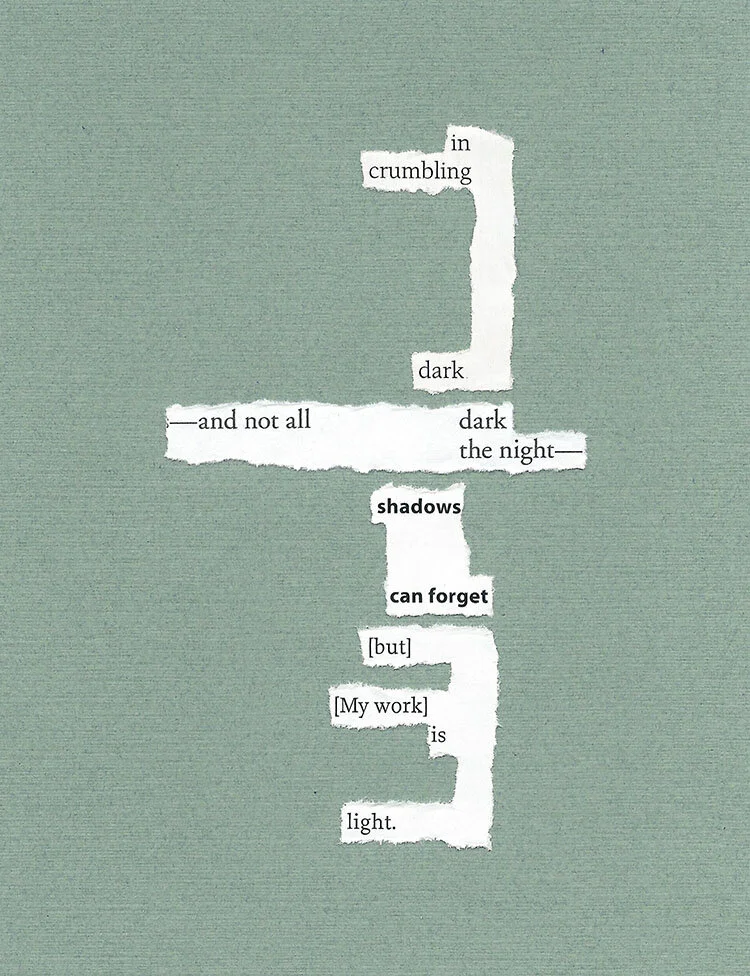
In Crumbling Dark

The Street
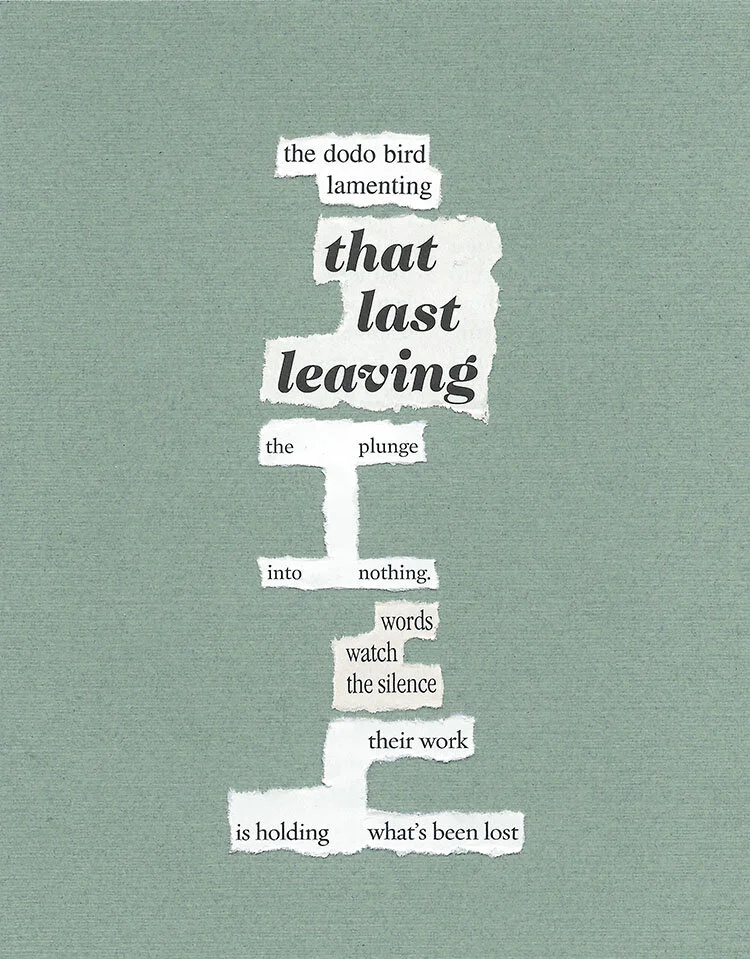
The Dodo Bird
Artist, poet, and freelance writer, J.I. Kleinberg is a Best of the Net and Pushcart nominee. Her found poems have appeared in Diagram, Dusie, Entropy, Otoliths, What Rough Beast, The Tishman Review, and elsewhere. She lives in Bellingham, Washington, and posts frequently at thepoetrydepartment.wordpress.com.
Sophie Peters: An Interview
It all began with a sketch. On Instagram, seriously. Then, a book cover commission. Here’s what followed.
Josh Dale: Thanks for allowing me to interview you. Why not tell everyone a bit about yourself?
Sophie Peters: I’m a young white artist. The likes of which has never been seen before! (laughs) Nah, I am queer and overly empathetic, paranoid and obsessive visual artist. I love making things and learning about people through art, through connecting with people. I think that’s what it boils down to, a desire to understand people and document the moments that are poignant to me in a visual form. I write a lot and play about with guitar and violin, but drawing is what seems to resonate best.
JD: I’m like that with drums. However, we’re on a break…Anyway, how does having dual citizenship affect your outlook on art? Life?
SP: I never felt very at home growing up, moving early to the UK from Minnesota was probably a template for how I would live the rest of my life. My mother’s parents never stayed still either, so it was not unusual that I didn’t want to stay in the town I grew up in in England. As early as possible I started travelling, first to Stroud, which was a three-hour train ride and where I found a lot of musicians and artists for the first time and spent my first important years, then moved to Birmingham and the USA as part of my degree. Dual citizenship only affected me when I got the opportunity to work in New Orleans. That’s when I realized how lucky I was to be able to come to this amazing city as more than a tourist. I have that outsider perspective, but I am lucky enough to be able to make myself a home here in the USA.
JD: That’s quite an experience! What’s your personal philosophy to illustrating (if any)? I know it’s kind of a broad question but its something to think about when one is not focused on a specific project.
“I think that’s what it boils down to, a desire to understand people and document the moments that are poignant to me in a visual form.”
SP: Philosophy to illustrating? No I hadn’t thought of it, I think working with text and writers is the best thing in the world, I look up to the artform a lot and to be able to add to a writers work in any way is a joy for me, because reading stories makes me better, makes the world better. It helps me understand the lives of people I have never met, that is invaluable.
JD: Binding art and text is something I could only dream to achieve. Ok, so. when transferring a tangible, physical painting/drawing into the digital, do you feel it takes away the nuance of the tools that created it?
SP: A little, yes. I am not as proficient with editing software as with a paintbrush so I’m sure some of the power of the work is lost. That being said, it is fab, because you can use and manipulate imagery far faster on a computer, with less mess, and can create a ‘gallery’ online in a sense, which is more practical in a way. I just like the tactility of craft artwork.
JD: You lost me at ‘editing software’ (laughs). I saw you won the Ashurst Emerging Artist Prize? How has this prize affected your current work? Your general well-being?
SP: It was great to win something. I needed the confidence boost to know that I wasn’t just good in my own eyes, y’know? I needed to know that other people could see value in what I was doing. The way it was organised and handled as a prize was actually very stressful. I didn’t like the lack of control they gave me, the restrictions on the subject matter (no nudity for example), their lack of adherence to deadlines... just general organisation was a bit ‘meh’ to be honest. One guy, from America, won a photography prize and didn’t get his prize money till weeks after the ceremony, which I think is a little disrespectful (I had to nag them for my prize money a bit too, which was embarrassing to have to do and made me feel cheap). But I learned a whole lot about the world through it and I enjoyed the experience overall and I am extremely grateful.

Peters accepting her Ashurst Emerging Artist Prize.
JD: Oh, yeah that is pretty dodgy, but hopefully you get what you deserve. On a lighter note, does your horoscope play a part in any of this? (laughs)
SP: (laughs) NO. I studied science! I don’t believe in any of that at all, I like facts and logic…it’s fun to play along with horoscopes though and some people tell me that my distrust of it is a VERY Scorpio trait.
JD: Well ok then, water sign buddy. What about the city of New Orleans, LA.? How does a city famous for jazz and Creole influenced your work?
SP: YAY fun question. I love New Orleans, but of course, I am a newbie to the town and still have a lot to learn. It’s a struggling city for sure, but the people here are just so amazing. It seems like everyone plays music, everyone makes art as a normal part of life. Where I grew up, I felt very alone. Despite music being a huge part of my life and my parent’s world, I never quite felt right. In New Orleans I feel at home, I feel safe to be myself, to be weird, to dance like no one is watching. Jazz and creole are around me all the time, and whilst I am not a jazz player, the love people have for music here makes it my kind of place. The sheer visual beauty of the city also influences me a lot, as do the strong character…no one in NOLA is bland. There is no shortage of inspiration. NOLA makes me bolder, reassures me that people care about art and can make a living from it. Hopefully, more time here will help me make some stronger work.
JD: I do have New Orleans on my map at some point, so thanks for painting that picture (pun intended). Total throwaway question: do you use all of the paint in a tube or does a little amount get tossed?
SP: All of it (laughs). A girl in my secondary school (middle school) used to joke with me and use more paint than necessary just to irk me. I use all my paint up every time. No waste ever. Same with food. I hate waste in any sense.
“It seems like everyone plays music, everyone makes art as a normal part of life.”
JD: An eco-friendly artist is always the best…Hey, thanks again for the interview. It was a lot of fun. If I could close out with one last question…what’s the worst American slang you’ve heard?
SP: Ah, no thank you! (laughs) I can’t think of anything bad…I love the slang here! I like ‘y’all’ especially...one of my friends says yander and yonder a lot which also makes me laugh I’m not sure if that is slang or what...
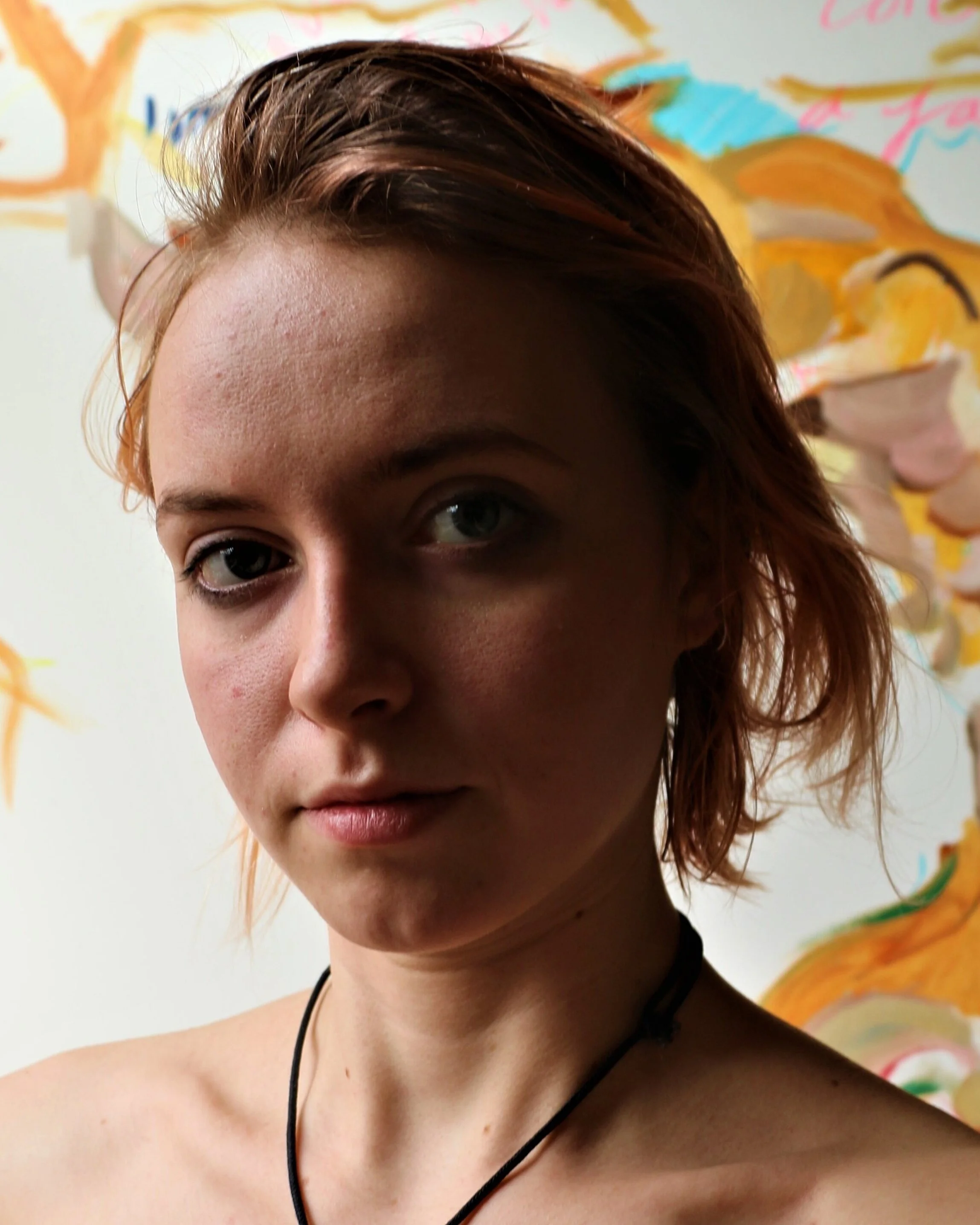
Sophie Peters was the winner of The Ashurst Emerging Artist Competition (2019) the CHBH (Centre for Human Brain Health) artwork competition (2018), Part of the (PARSE) Fifth Annual Southeast Louisiana Juried Student Exhibition (2018) and Highly Commended for the under 18 Artprize Award (2015). Her work has been published in Entropy Magazine, a book of street art by Kady Perry (2019), The Centrifuge Brain Project by Thirty West Publishing (2019) and The Boston Accent and Cotton Xenomorph poetry journals (2018).
Peters investigates identity, environmentalism and gender binaries primarily through paint, text, video and mixed media. They were born in MN USA, 1996 and grew up in England.